
Synthesia is the closest DeepBrain AI replacement for polished, news-style presenters, and HeyGen leads on custom video avatars and 175+ languages. Colossyan fits training teams, D-ID is the cheapest way into custom avatars, and Tavus is for real-time conversational avatars. If your presenter is a real person you've already filmed, Vidwip AI Video Dubbing re-voices that footage in up to 94 languages in their own voice, from $2.40 per minute.
DeepBrain AI built its name on virtual news anchors, so every list of DeepBrain AI alternatives starts with presenter quality. Its AI Studios product turns a script into a presenter video, with 100+ stock avatars, 2,000+ AI-generated ones and 150+ voice languages on the Personal plan.
It’s a solid tool. But teams start shopping for DeepBrain AI alternatives when they hit the plan limits: a 30-minute cap on Personal, 4K and 60-minute videos only on Team at $69 per seat a month, and a dubbing list of 73 languages next to the 150+ the avatar voices speak.
These seven tools are the best routes out. Every price was checked on the vendor’s own pricing page in October 2026.
TL;DR: the best DeepBrain AI alternatives
- Vidwip AI Video Dubbing: best when your presenter is a real person. It re-voices existing footage in up to 94 languages in their own voice, from $2.40 per minute.
- Synthesia: best like-for-like swap for news-style and corporate presenters. 140+ languages, from $29/month.
- HeyGen: best custom avatar of yourself. 700+ stock avatars, 175+ languages on paid plans, from $29/month.
- Colossyan: best for training teams. 300+ avatars, 120+ languages, $59/month billed yearly.
- D-ID: cheapest way into custom avatars. 3 personal avatars for $16/month billed yearly.
- Elai: best per-minute pricing. 80+ avatars, $29/month for 15 minutes.
- Tavus: best for real-time, conversational avatars built through an API. From $22/month.
What DeepBrain AI does well, and where it pinches
DeepBrain AI Studios is an avatar video generator for marketing, training and news-style video, with a free plan and paid plans from $24/month billed annually. You type a script, pick a presenter, and it renders a talking-head video.
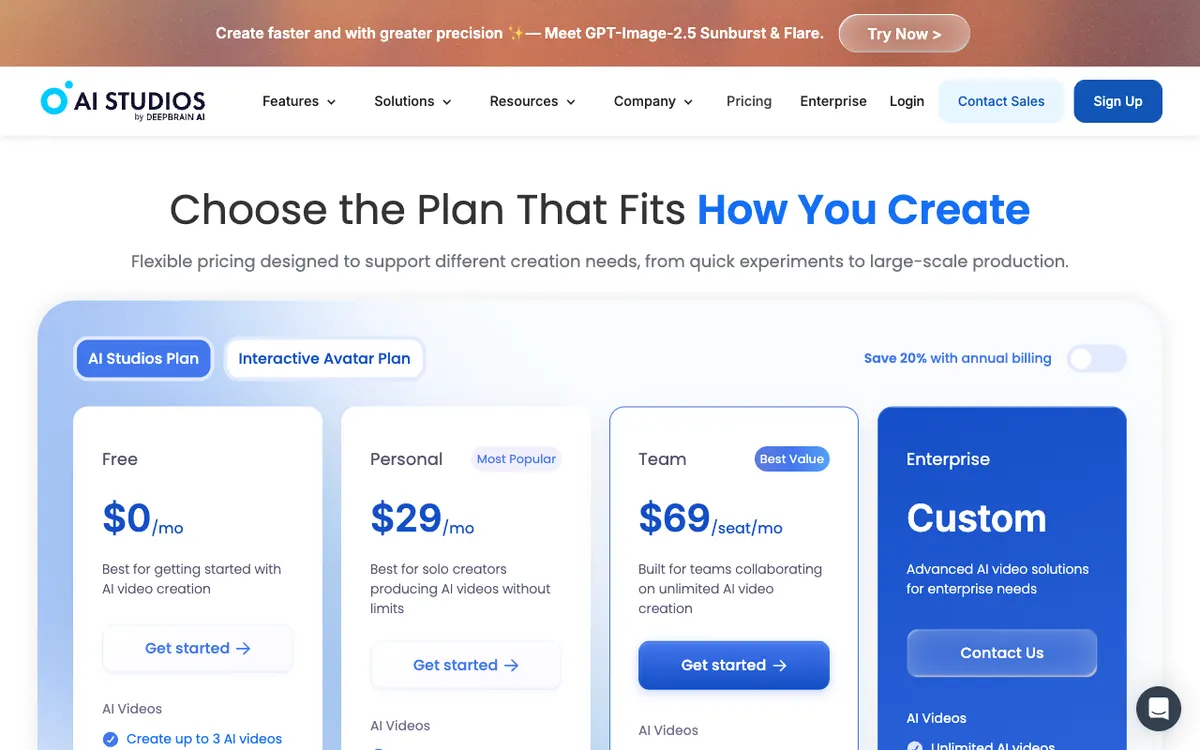 DeepBrain AI Studios pricing, billed monthly: Personal $29, Team $69 per seat (checked October 2026).
Here’s what you get, plan by plan:
| DeepBrain plan | Price (monthly / annual) | Video length | Custom avatars | Export |
|---|---|---|---|---|
| Free | $0 | 1 min, 3 videos/mo | 1 | 720p |
| Personal | $29 / $24 per month | 30 min | 3 | 1080p |
| Team | $69 / $55 per seat per month | 60 min | 5 | 4K |
| Enterprise | Custom | Unlimited | Unlimited | 4K |
The pinch points are plain once you lay them out. 4K and long videos are per-seat Team features, and AI dubbing is metered at 120 minutes a month on Personal.
Real-time interactive avatars sit on a separate plan from $99/month. If you want a single bill for presenter video, translation and live avatars, DeepBrain splits them.
What to look for in a DeepBrain AI alternative
Four things matter more than the avatar gallery.
Avatar realism. Watch a full 60-second render, not the hero clip. Hands, blinks and the pause between sentences give an avatar away faster than the face.
Custom avatars. If you want your own anchor or CEO on screen, check which plan includes a custom avatar and how many. The range runs from 1 on free plans to unlimited on Enterprise.
Languages. Voice languages and translation languages are often different numbers. DeepBrain lists 150+ for avatar voices and 73 for dubbing.
Plan limits. Minutes per month, max video length, seats, watermark and export resolution. A $29 plan with 15 minutes a month costs more per video than it looks.
1. Vidwip AI Video Dubbing: best when your presenter is a real person
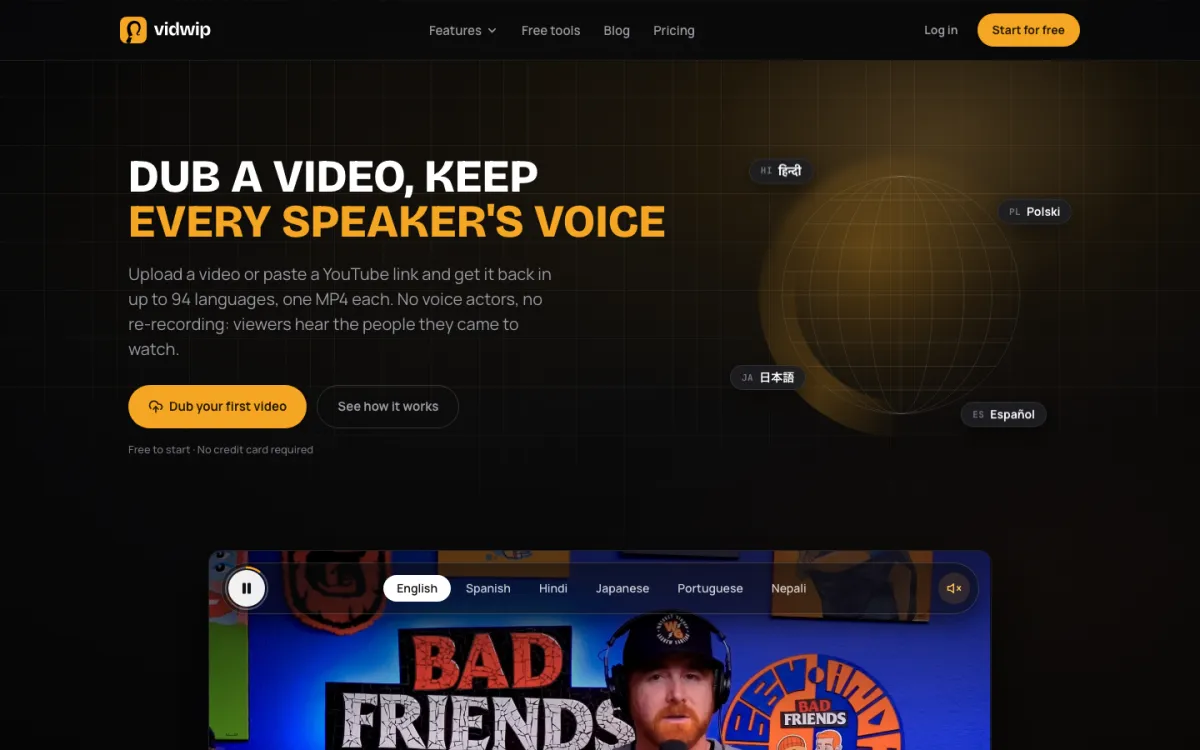 Vidwip AI Video Dubbing: upload a video, get it back in up to 94 languages, every speaker in their own voice.
Most DeepBrain alternatives swap one avatar for another. Vidwip AI Video Dubbing takes the other path: film a real presenter once, then dub that video into every language you need.
AI finds each speaker, copies their voice, translates what they say and voices it in the new language. The music and background sound stay, and every language comes back as its own MP4.
That matters for news-style content in particular. Viewers trust a real anchor or founder more than a stock avatar, and a dub keeps the same face and the same voice in Spanish, Hindi or Japanese.
You upload an MP4, MOV or WebM up to 2 GB and 30 minutes, or paste a YouTube link up to 10 minutes. Dubbing v1 covers 29 languages at $2.40 per minute per language, and the Advanced v2 model covers 94 languages at $6.00 per minute.
Free dubs into 1 language per run, Starter up to 5 and Pro up to 10. Dubs carry no watermark on any plan, and the picture keeps its source resolution.
No presenter at all? The AI Video Generator can make a short clip of a person saying your line, lips in sync, on Veo 3.1.
It isn’t an avatar library, though. You can’t reuse the same anchor across videos.
Pros
- Keeps a real presenter on screen, in their own cloned voice, in up to 94 languages
- Handles several speakers in one video, so interviews and panels work
- No watermark on dubs, on any plan
- Translated subtitles can be burned in, timed to the new voice
- Free to start, no credit card
Cons
- No avatar library and no custom avatar. You need real footage to start
- No lip sync. Mouths keep their original movement
- You can’t edit the translation before it’s voiced
- Pricing is per minute, per language, so long videos in many languages add up
Best for: teams with a real presenter, anchor or founder on camera who need the same video in many languages. Pricing: Free to start, no credit card. Starter $25/month (2,500 credits). Pro $99/month (10,000 credits). Enterprise custom (vidwip.com/pricing, checked October 2026).
2. Synthesia: best like-for-like swap for news-style presenters
 Synthesia: AI avatars and voiceovers in 140+ languages, aimed at business video.
Synthesia is the closest DeepBrain AI alternative for scripted presenter video. It does the same core job (script in, studio presenter out) with a larger enterprise footprint and 140+ languages and voices.
Starter is $29/month, or $18/month billed yearly, with 125+ avatars. Pro is $89/month, or $64/month yearly, with 180+ avatars and 5 personal avatars, so you can put your own anchor on screen.
The free Basic plan gives 10 minutes of video a month and 9 avatars. It carries a Synthesia watermark and doesn’t include downloads, so treat it as a test drive.
Dubbing is narrower than the voice list. Paid plans dub into 70+ languages, and 140+ dubbing outputs are an Enterprise feature.
Pros
- 140+ languages and voices on every plan
- 5 personal avatars on Pro, unlimited on Enterprise
- Clean, corporate presenter style that suits news desks and internal comms
- Interactive video and live “Sessions” for roleplay practice
Cons
- Free plan watermarks and blocks downloads
- Starter adds only about 12 minutes a month on top of the free 10 when billed monthly
- Personal avatars start on Pro, not Starter
- Dubbing tops out at 70+ languages below Enterprise
Best for: teams that want a direct DeepBrain replacement for polished presenter video, with a custom avatar of their own anchor. Pricing: Free (10 min/month). Starter $29/month ($18 billed yearly). Pro $89/month ($64 billed yearly). Enterprise custom (synthesia.io/pricing, checked October 2026).
3. HeyGen: best custom video avatar of yourself
 HeyGen: talking-head video from a script, starring a stock avatar or a custom one built from your own footage.
HeyGen is the pick when the presenter should be you. Its Creator plan ($29/month, or $24 billed yearly) includes a custom video avatar with your own voice and likeness, plus 700+ stock avatars and unlimited photo avatars.
Languages jump to 175+ on paid plans, against 30+ on free. Pro ($49/month) adds the newest avatar models and 4K export, and Business ($149/month plus $20 per extra seat) adds 5 custom avatars and 60-minute videos.
Credits are the catch. HeyGen doesn’t publish a credits-to-minutes conversion, and cost varies by model and length, so budgeting a series takes a trial run.
The free plan gives 3 watermarked videos a month, up to 1 minute each.
Pros
- Custom video avatar on the $29 Creator plan
- 175+ languages on paid plans, with lip-synced video translation
- 700+ stock avatars, unlimited photo avatars on paid plans
- 4K export from Pro
Cons
- Credit-based pricing with no published minutes conversion
- Free plan is capped at 3 one-minute videos, watermarked
- Videos are capped at 30 minutes below Business
- Extra seats cost $20 each on Business
Best for: founders, creators and sales teams who want a lifelike avatar of themselves without a studio shoot. Pricing: Free. Creator $29/month ($24 billed yearly). Pro $49/month. Business $149/month + $20/seat. Enterprise custom (heygen.com/pricing, checked October 2026).
4. Colossyan: best for training and enterprise learning teams
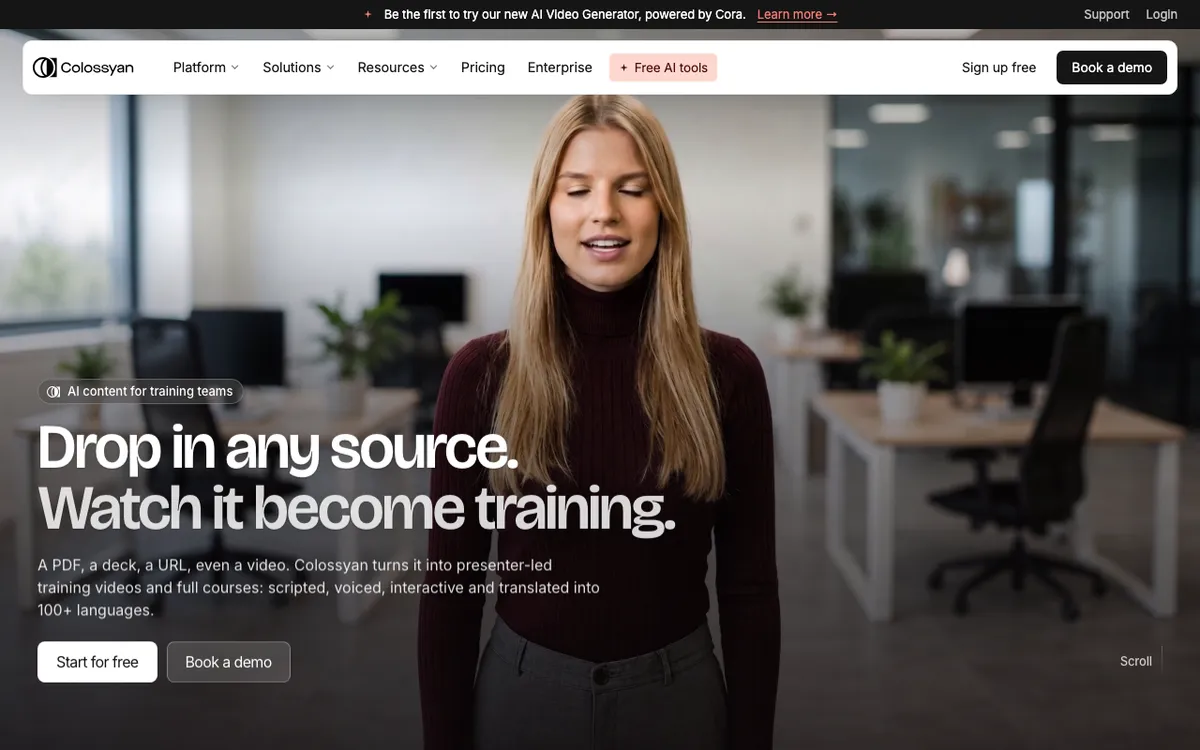 Colossyan: turns a PDF, deck or URL into presenter-led training video and full courses.
Colossyan is the DeepBrain AI alternative for L&D. Where DeepBrain sells avatar video broadly, Colossyan builds the course around it: interactive video, quizzes, a course builder and SCORM export.
The free Starter plan is generous on paper: 20 minutes a month, 300+ stock avatars, 120+ languages and 15 custom avatars. It keeps a watermark, though, and has no SCORM export.
Professional is $59/month billed yearly. It removes the watermark, gives 30 minutes a month on the standard NEO avatars and 10 on the newer NEO2, and adds 20 custom avatars and 5 cloned voices.
4K export and a studio-filmed avatar are Enterprise only. Colossyan doesn’t list a monthly price for Professional.
Pros
- 300+ stock avatars and 120+ languages on every plan
- 15 custom avatars even on the free plan
- Course builder, interactive video and SCORM built in
- Unused drafts don’t count toward minutes
Cons
- Free plan keeps the watermark
- Professional is priced yearly only on the pricing page
- 30 minutes a month on Professional is tight for weekly production
- 4K and studio avatars need Enterprise
Best for: training teams that want avatar video and course authoring in one tool. Pricing: Free Starter (20 min/month, watermark). Professional $59/month billed yearly. Enterprise custom (colossyan.com/pricing, checked October 2026).
5. D-ID: cheapest way into custom avatars
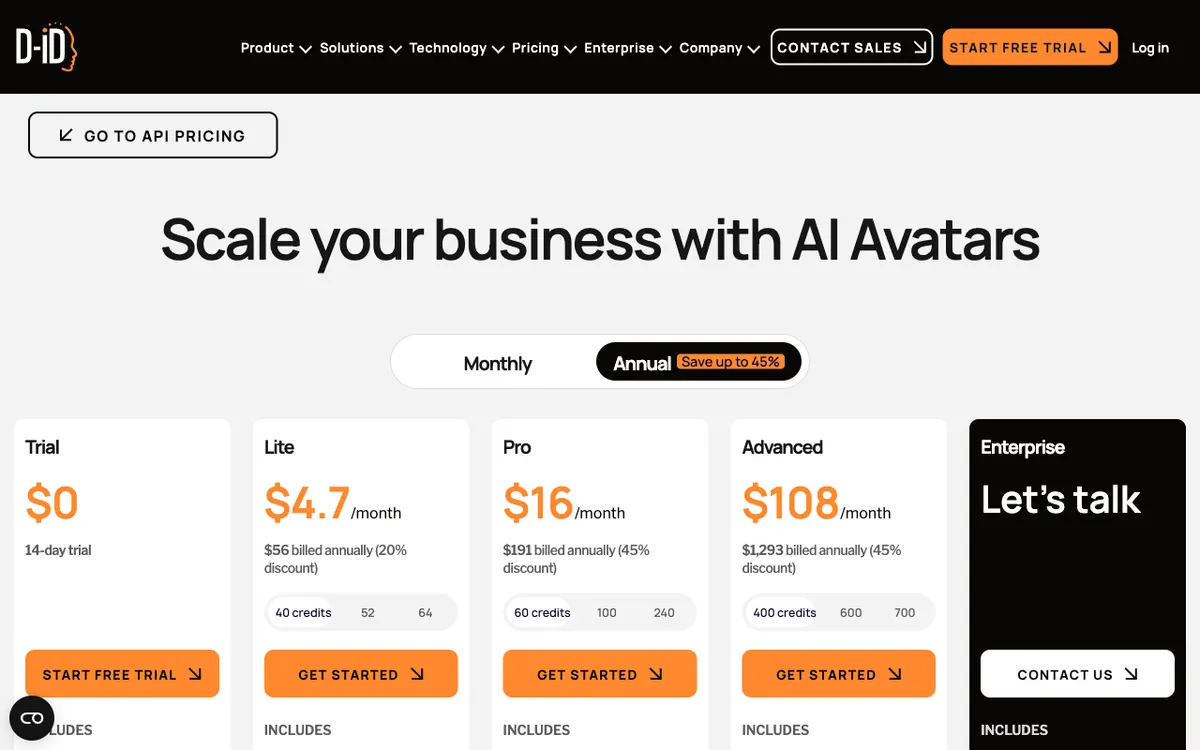 D-ID: photo and video avatars, personal avatars and agents, billed yearly from $4.70/month.
D-ID is the budget DeepBrain AI alternative. It started with talking photos (upload a face, get a speaking video) and now covers video avatars, personal avatars and conversational agents.
The Pro plan is the sweet spot at $16/month billed yearly ($191 a year). It includes 15 minutes a month, 3 personal avatars, 1 voice clone, premium voices and a commercial-use license.
The cheaper Lite plan ($56 a year) carries a D-ID watermark, and the 14-day trial gives 3 minutes with a full-screen one. Advanced ($108/month billed yearly) raises you to 100 minutes and 5 personal avatars.
Videos run up to 30 minutes on every plan. Video translation outputs 30+ languages, with translated videos capped at 5 minutes below Enterprise.
Pros
- 3 personal avatars on a $16/month (yearly) plan
- 100+ stock avatars, plus photo avatars from any image
- API access draws from the same minute balance
- Conversational agents for interactive use
Cons
- Lite and Trial output carries a watermark
- Minutes don’t roll over, and each video rounds up to the next 15 seconds
- Translation is 30+ languages, capped at 5-minute videos below Enterprise
- Studio avatars are Enterprise only
Best for: small teams and solo creators who want a custom avatar for the least money. Pricing: 14-day trial. Lite $4.70/month, Pro $16/month, Advanced $108/month, all billed yearly. Enterprise custom (d-id.com/pricing, checked October 2026).
6. Elai: best per-minute pricing
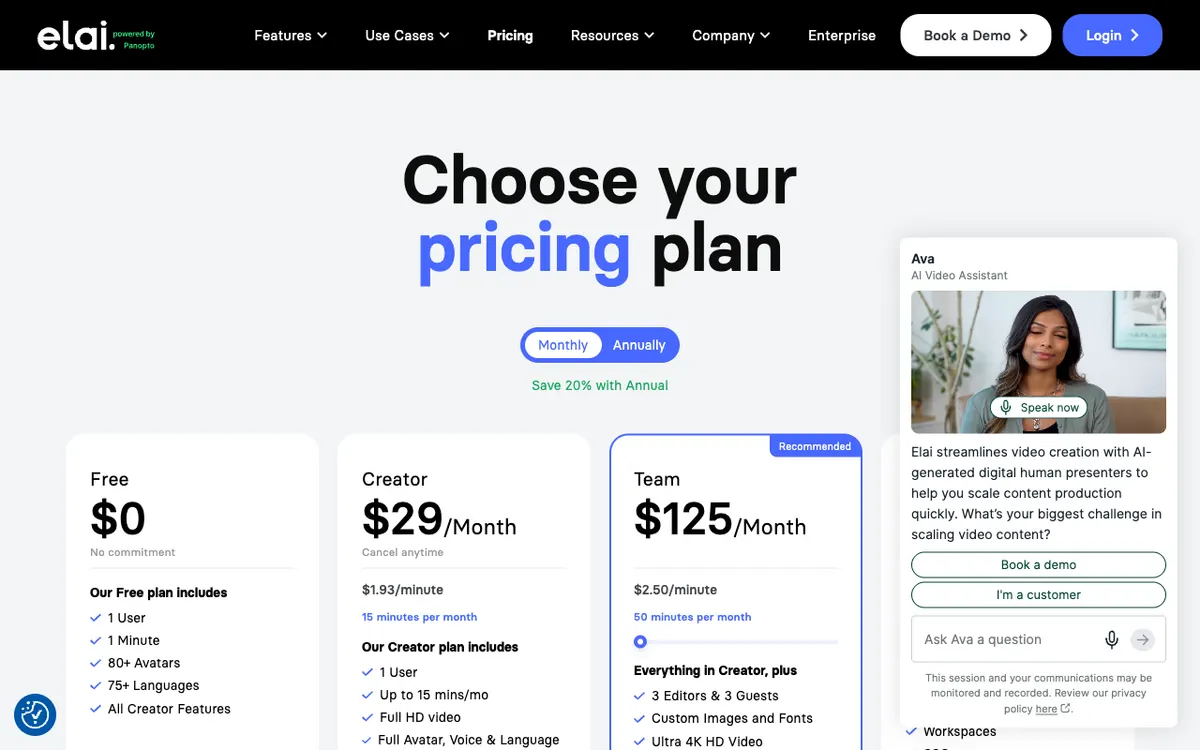 Elai: avatar video priced by the minute, now part of Panopto.
Elai is the DeepBrain AI alternative for teams who think in minutes, not seats. Creator costs $29/month, or $23 billed yearly, for 15 minutes, which works out to $1.93 a minute.
Extra minutes are $2 each on paid plans.
Team is $125/month, or $100 yearly, for 50 minutes, 3 editors and 4K export. An annual Team plan includes 1 selfie avatar and 1 voice clone.
Custom avatars are sold as add-ons on other plans. A selfie avatar from a phone video is $199 a year, and a studio avatar is $500 a year.
Elai is now part of Panopto, the video platform, which suits teams already hosting training there. Its plan cards list 80+ avatars and 75+ languages.
Pros
- Clear per-minute pricing with $2 top-ups
- 4K export and 3 editors on Team
- Selfie and studio avatars available as add-ons on any plan
- Panopto ownership fits existing Panopto customers
Cons
- Free plan is 1 minute total
- 15 minutes a month on Creator is tight
- 80+ avatars is a smaller library than DeepBrain’s
- Language count reads 75+ on plan cards and 100+ elsewhere on the page
Best for: small teams that want predictable per-minute costs and an optional custom avatar. Pricing: Free (1 min). Creator $29/month ($23 billed yearly). Team $125/month ($100 billed yearly). Enterprise custom (elai.io/pricing, checked October 2026).
7. Tavus: best for real-time conversational avatars
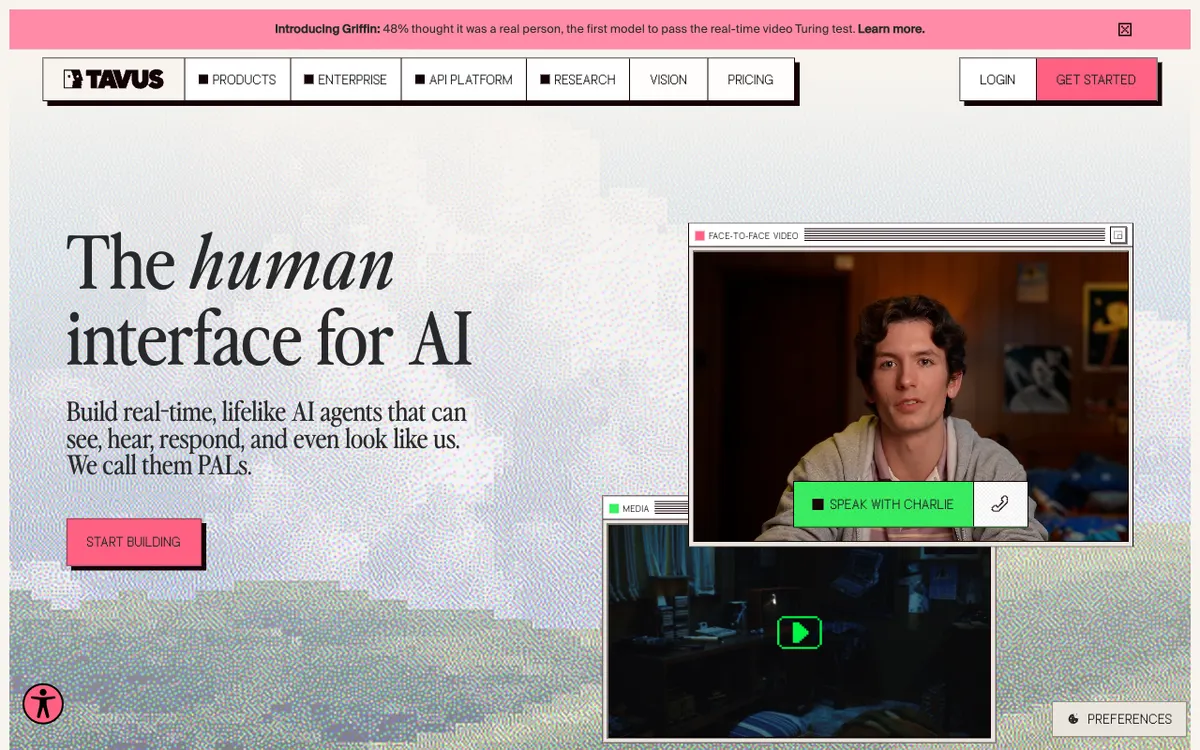 Tavus: real-time AI humans for developers, plus async avatar video generation.
Tavus competes with DeepBrain’s Interactive Avatar plan, not its studio. It’s built for developers who want a lifelike face that listens and talks back in real time, inside an app, kiosk or support flow.
Pricing is metered in conversation minutes. Starter is $22/month for 60 minutes and 1 custom face, and Builder is $59/month for 175 minutes and 3 custom faces.
Async video generation (a classic avatar MP4) is included too: 5 minutes a month on Starter, 15 on Builder. A custom face trains from one image or two minutes of video.
The free plan gives 20 conversation minutes a month and stock faces, with no video generation. Tavus supports 42+ languages.
Pros
- Real-time conversational avatars with an API
- Custom faces from a single image or 2 minutes of footage
- Pay-as-you-go overage, so sessions don’t stop mid-month
- Cheaper entry than DeepBrain’s $99 interactive plan
Cons
- Built for developers, not a drag-and-drop studio
- Only 5 to 15 minutes of async video a month on the entry plans
- 42+ languages is fewer than Synthesia or HeyGen
- Growth jumps to $397/month
Best for: product teams building a live AI presenter, tutor or support agent. Pricing: Free (20 conversation min). Starter $22/month. Builder $59/month. Growth $397/month. Business $975/month (tavus.io/pricing, checked October 2026).
DeepBrain AI alternatives compared
| Tool | Avatars | Custom avatar | Languages | Free plan | Paid from |
|---|---|---|---|---|---|
| Vidwip AI Video Dubbing | None (real footage) | No, keeps your real presenter | 94 (v2 dubbing) | Free to start, no watermark on dubs | $25/month |
| Synthesia | 125+ (Starter), 180+ (Pro) | 5 on Pro | 140+ | 10 min/month, watermark | $29/month |
| HeyGen | 700+ stock | 1+ on Creator | 175+ (paid) | 3 one-minute videos, watermark | $29/month |
| Colossyan | 300+ stock | 15 free, 20 on Professional | 120+ | 20 min/month, watermark | $59/month yearly |
| D-ID | 100+ stock | 3 on Pro | 30+ (translation) | 14-day trial, 3 min | $4.70/month yearly |
| Elai | 80+ | Add-on, or 1 on annual Team | 75+ | 1 minute | $29/month |
| Tavus | 10 to 100+ stock faces | 1 on Starter | 42+ | 20 conversation min | $22/month |
| DeepBrain AI (for reference) | 100+ stock, 2,000+ AI-generated | 3 on Personal | 150+ voices, 73 dubbing | 3 one-minute videos, 720p | $29/month ($24 yearly) |
How to choose the right DeepBrain AI alternative
Your presenter is a real person you can film? Skip the avatar. Vidwip AI Video Dubbing puts the same face and voice in up to 94 languages, from $2.40 per minute per language.
You want the closest swap for a news-style anchor? Pick Synthesia. Pro’s 5 personal avatars and 140+ languages cover a virtual anchor desk.
You want an avatar of yourself on a small budget? HeyGen Creator includes a custom video avatar for $29/month. D-ID Pro gives you 3 personal avatars for $16/month billed yearly.
You’re building training courses? Colossyan bundles avatars, interactivity and SCORM. Elai suits smaller teams who’d rather pay per minute.
You need the avatar to talk back live? Tavus is built for that, from $22/month.
A note on Hour One: it was a common pick for virtual newsrooms, but Wix bought it in May 2025, according to Wix’s annual report. Its site didn’t load when we checked, so it isn’t on this list.
Related reading
Comparing avatar tools more broadly? Our Synthesia alternatives, HeyGen alternatives and Colossyan alternatives roundups rank the same field for different jobs.
If you want a single character to talk inside a generated shot, see our Veo 3.1 review. If mouths matching the new language matters to you, read AI video dubbing with lip sync before you pick a tool.
Final verdict
DeepBrain AI is still a capable avatar studio, especially for virtual anchors. Most teams leave over plan shape: per-seat Team pricing for 4K and long videos, and a dubbing list half the size of its voice list.
Synthesia is the safest swap for presenter video, HeyGen is the best custom avatar of yourself, and D-ID is the cheapest.
If your presenter is real, keep them. Dub the video you already have into up to 94 languages and let every viewer hear the same person, in their own language.