
If the output is a finished video, Vidwip runs ElevenLabs v3 voices in its voiceover and dubbing tools — same model, one credit balance. Cartesia and Deepgram Aura are the cheapest at roughly $1.62/hr for API use. Fish Audio clones a voice from 10 seconds of audio for $11/month. WellSaid Labs is the enterprise pick for consistent studio voices, and Murf gives creators the most emotional control.
ElevenLabs set the bar for AI voice in 2024 and raised it again in 2025 with Eleven v3. The voice quality is real. So is the pricing gap between the Creator plan and what a high-volume podcast or dubbing pipeline actually costs. That gap is why teams go looking for ElevenLabs alternatives.
The alternatives in this post are not inferior. They are different. Vidwip puts ElevenLabs v3 inside a video workflow. Cartesia is faster. Fish Audio is cheaper for voice cloning. WellSaid Labs sounds more consistent in enterprise environments. Deepgram bills by the character with no subscription. And Rask AI handles entire dubbed videos in 135+ languages.
Each price below was checked against the vendor’s own pricing page in October 2026.
TL;DR — nine ElevenLabs alternatives at a glance
| Tool | Best for | Starting price | Voice cloning |
|---|---|---|---|
| Vidwip | ElevenLabs v3 inside a video editor | Free to start, no card | Speaker cloning (dubbing) |
| Murf AI | Creators, marketers, e-learning | $0.01/min API | Yes (paid plans) |
| WellSaid Labs | Enterprise, publishers, studios | $19/mo (20 min) | Not listed |
| Cartesia | Developers, real-time apps | $5/mo Pro | Yes (Pro+) |
| Fish Audio | Budget voice cloning | $0 (7 min/mo free) | Yes (free tier) |
| Rask AI | Video dubbing, 135+ languages | $39/mo Creator | Yes (32 languages) |
| Descript | Podcast/video editors | $16/mo Hobbyist | Yes (Hobbyist+) |
| Deepgram Aura | API developers, pay-as-you-go | $200 free credit | No |
| OpenAI TTS | OpenAI ecosystem devs | $15/M chars (tts-1) | No |
What to look for in an ElevenLabs alternative
Four things actually change the output you ship.
Voice realism. Does the voice carry emotion, pace, and breath? Or does it flatten every sentence to the same pitch? The gap between a good model and a mediocre one is obvious to any listener. Realism is the first thing to test before you commit to a plan.
Billing model. Character-based billing (like ElevenLabs) is predictable. Minute-based billing (WellSaid Labs) lets you generate freely and only pay when you download. API overage rates are what decide whether a busy month stays affordable.
Voice cloning rights. Many tools include voice cloning but restrict commercial use to paid plans, or prohibit cloning third-party voices entirely. Read the terms before you clone someone’s voice for a product.
Language coverage. ElevenLabs v4 covers 90+ languages. If your audience is outside that list, you need a tool that covers the gap. If you are dubbing video, you also need the translated audio to sync with the picture.
1. Vidwip — ElevenLabs v3 inside a video editor
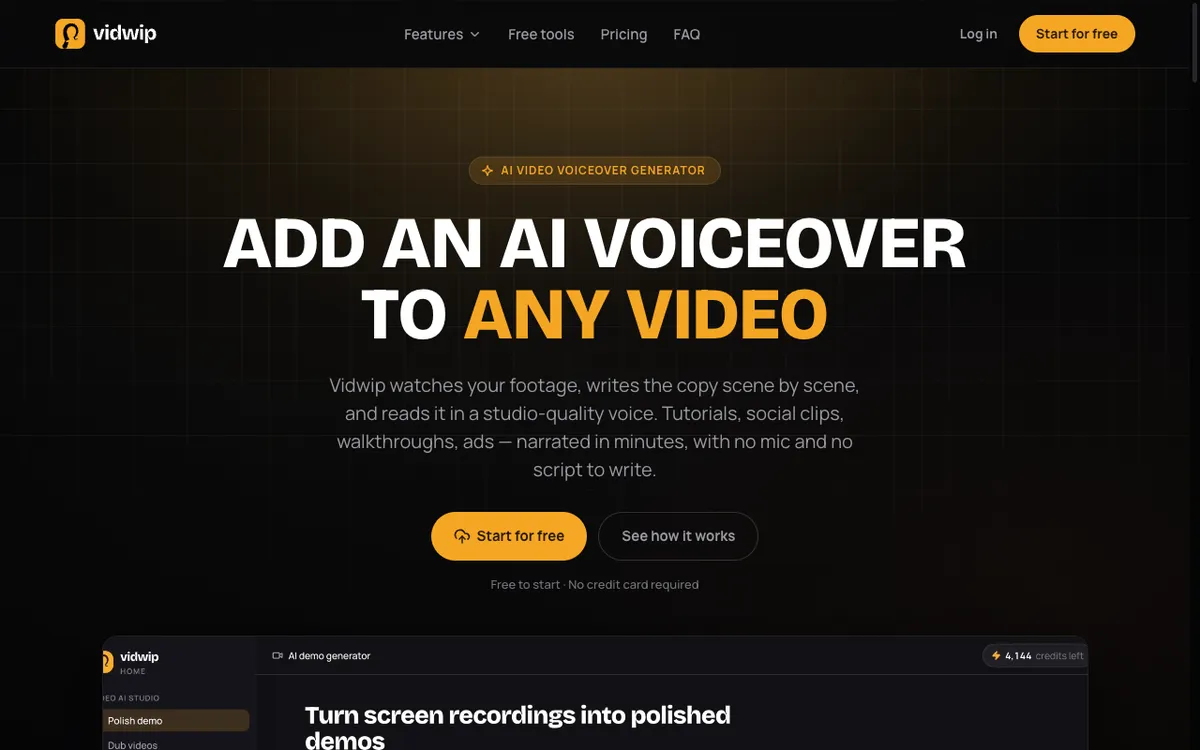 Vidwip — ElevenLabs v3 voices for narration and dubbing, delivered as a finished video
Vidwip is an AI creative studio that runs ElevenLabs voices inside its video tools. You get back a narrated or dubbed video, not an audio file to sync by hand.
If your output is a video, the question is not whether to use ElevenLabs. It is whether to run it inside a tool that also handles the picture.
AI Video Voiceover runs ElevenLabs v3 voices directly. You upload a video, AI writes a script from what it sees on screen, and ElevenLabs v3 voices it with word-level timing. 190+ voices native to 23 languages, each able to speak all 74, at 60 credits per finished minute ($0.60). No mic, no re-recording.
AI Video Dubbing uses ElevenLabs Dubbing to clone every speaker in the video and re-voice them in up to 94 languages, one MP4 per language. v1 at $2.40/min per language, v2 at $6.00/min per language.
AI Dubbing does the same for audio files — podcasts, interviews, voiceovers — at $2.40/min per language on v1. The output is a 192 kbps MP3 per language, ready for your podcast host.
All three tools run on the same credit balance, and Vidwip is free to start with no credit card.
The difference from ElevenLabs directly: Vidwip adds the video layer. Script writing, timing, captions in 8 styles, a share link, and an iframe embed all come with the render. You do not need ElevenLabs plus a video editor plus a sync tool. It is one step.
Pros
- ElevenLabs v3 voices rendered straight into a finished video
- AI writes the narration from what it sees on screen, so there is no script to draft
- Dubbing clones every speaker from your file, in up to 94 languages on v2
- Audio dubbing returns a 192 kbps MP3 per language for podcasts
- One credit balance across voiceover, video dubbing and audio dubbing
Cons
- 190+ voices for voiceover, against ElevenLabs’ 10,000+, with no custom voices
- Voice cloning only happens inside dubbing; you can’t clone your own voice for narration
- The voiceover replaces the original soundtrack, and its script is read-only once rendered
- No lip sync on dubs: the picture stays untouched
Best for: Creators, product teams, and course makers who need ElevenLabs voice quality in a finished video — narration, dubbing, or both — without assembling a separate workflow.
Pricing: Free to start, no credit card. Starter $25/mo (2,500 credits), Pro $99/mo (10,000 credits). AI Video Voiceover: 60 credits/min ($0.60). AI Video Dubbing v1: 240 credits/min/language ($2.40). AI Dubbing v1: 240 credits/min/language ($2.40). See Vidwip pricing.
2. Murf AI
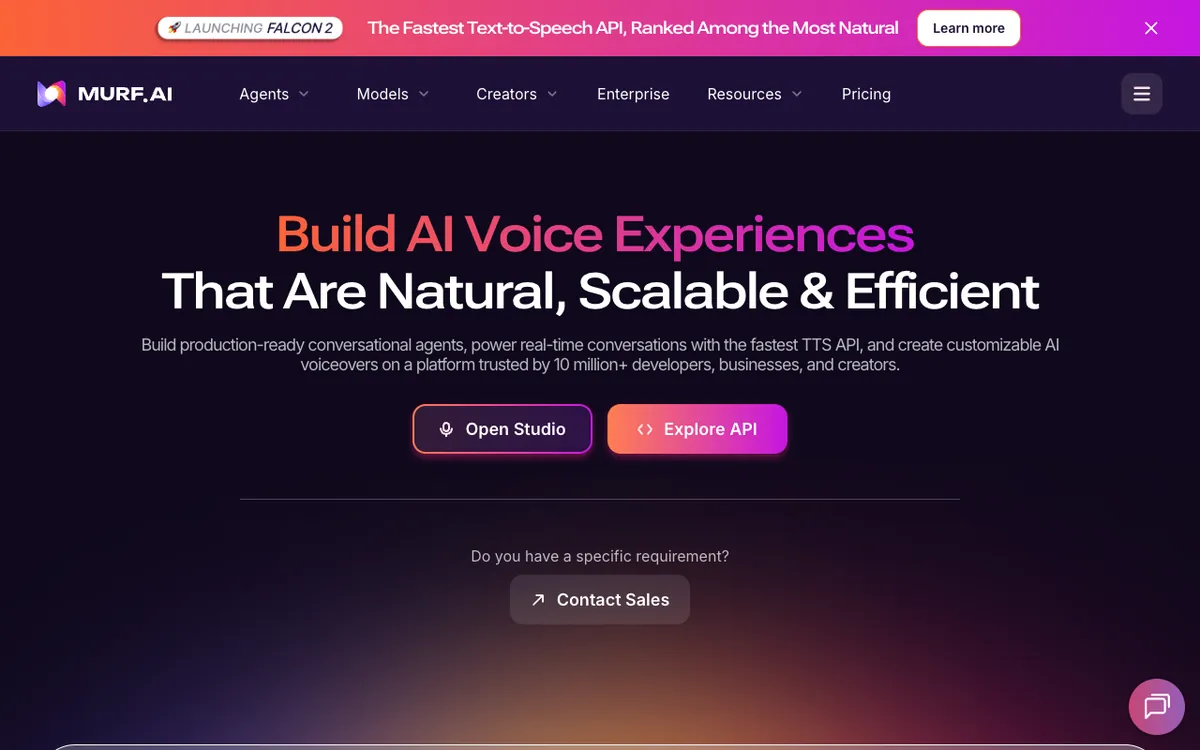 Murf AI — AI voiceover studio with 200+ voices and emotion controls
Murf is the most fully featured creator-facing voiceover studio in this list. It puts pitch control, pace adjustment, and emphasis in the browser with no API required. You write your script, pick a voice, and preview before you commit a character.
The Falcon 2 API is the standout for high-volume developers: a flat $0.01 per generated minute with no confusing tier structure, and a 3-month incubator grant of 50 million characters for early-stage startups (checked October 2026 from murf.ai).
Where Murf falls behind ElevenLabs is context awareness. ElevenLabs Eleven v3 adapts delivery to the emotional cues in the surrounding text. Murf requires you to set those controls manually — which is more work but also more control.
Pros
- Studio controls (pitch, pace, emphasis, pause) in the browser, no API needed
- 200+ voices across 35+ languages
- Team collaboration workspace on all paid plans
- Startup Incubator grant: 50M API characters free over 3 months
Cons
- Voice realism lags ElevenLabs v3 on natural conversational delivery
- No built-in video editor — audio exports only
- Free plan (10 minutes) carries no commercial licence
Best for: Content creators, marketers, and e-learning teams who want fine-grained voice control without touching an API.
Pricing: Falcon 2 API at $0.01/min. Studio plans from free (10 min, no commercial licence) up to paid tiers — see murf.ai for current plan prices (October 2026).
3. WellSaid Labs
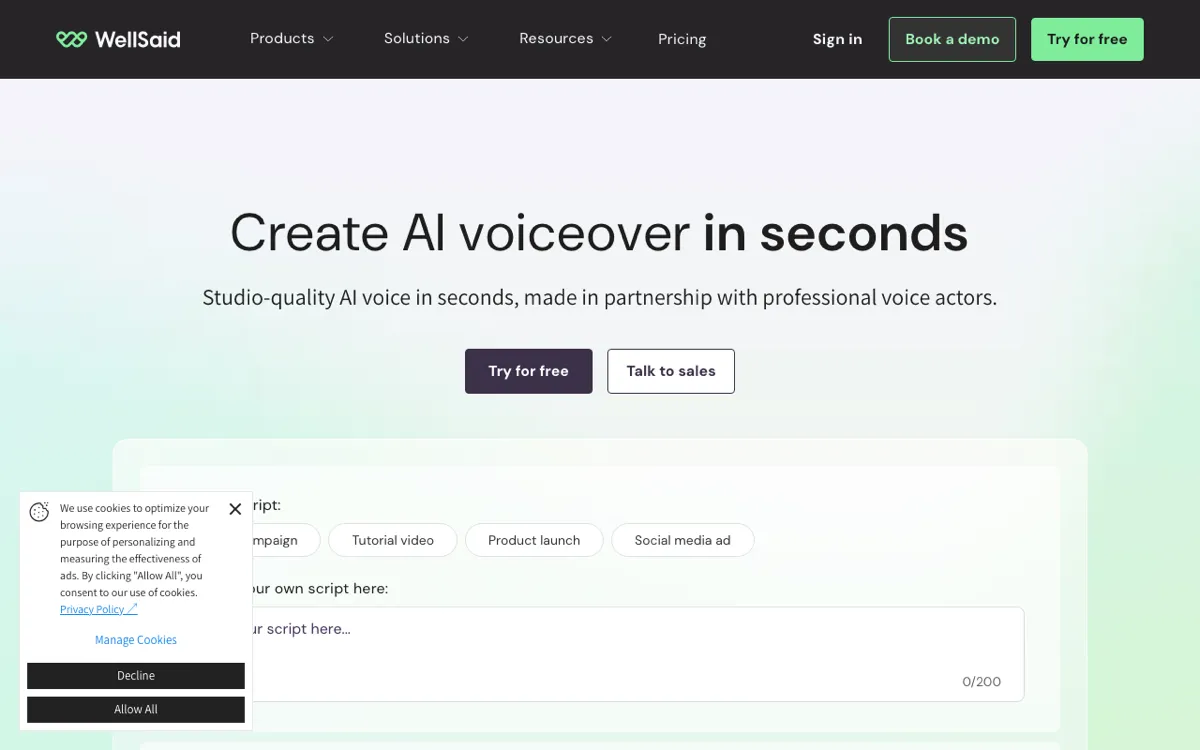 WellSaid Labs — enterprise studio TTS with consistent, broadcast-quality voices
WellSaid Labs targets enterprise teams and publishers who need the same voice to sound identical across thousands of episodes, not just one. The voice roster is smaller than ElevenLabs — but each voice was built in partnership with a real person, which gives WellSaid a consistency that larger libraries often lack.
The billing model is unusual: generation is unlimited on paid plans. You only pay for the audio you download. That is genuinely useful for teams that regenerate lines repeatedly and only finalize a fraction of what they produce.
The free trial gives 3 downloaded minutes per month with no credit card. That is enough to hear whether the quality matches your use case before you pay.
Pros
- Unlimited generation on paid plans — download only what you keep
- Consistent, broadcast-quality voices built with real voice actors
- Team collaboration, shared workspaces, multi-seat plans
- No credit card needed for the free trial
Cons
- Smaller voice library than ElevenLabs (no community or instant clone voices)
- Expensive per downloaded minute vs. API alternatives ($19/mo for 20 min)
- No voice cloning listed on the pricing page (checked October 2026)
- Not suited for high-volume API use cases
Best for: Enterprise teams — publishers, e-learning studios, healthcare companies — who need brand-voice consistency across thousands of audio assets.
Pricing: $0 free (3 downloaded min/mo, no card), $19/mo Starter (20 min), $49/mo Pro (180 min), Business from $160/mo/user (annual) at 2,880 min/year. Checked October 2026 from wellsaid.io.
4. Cartesia
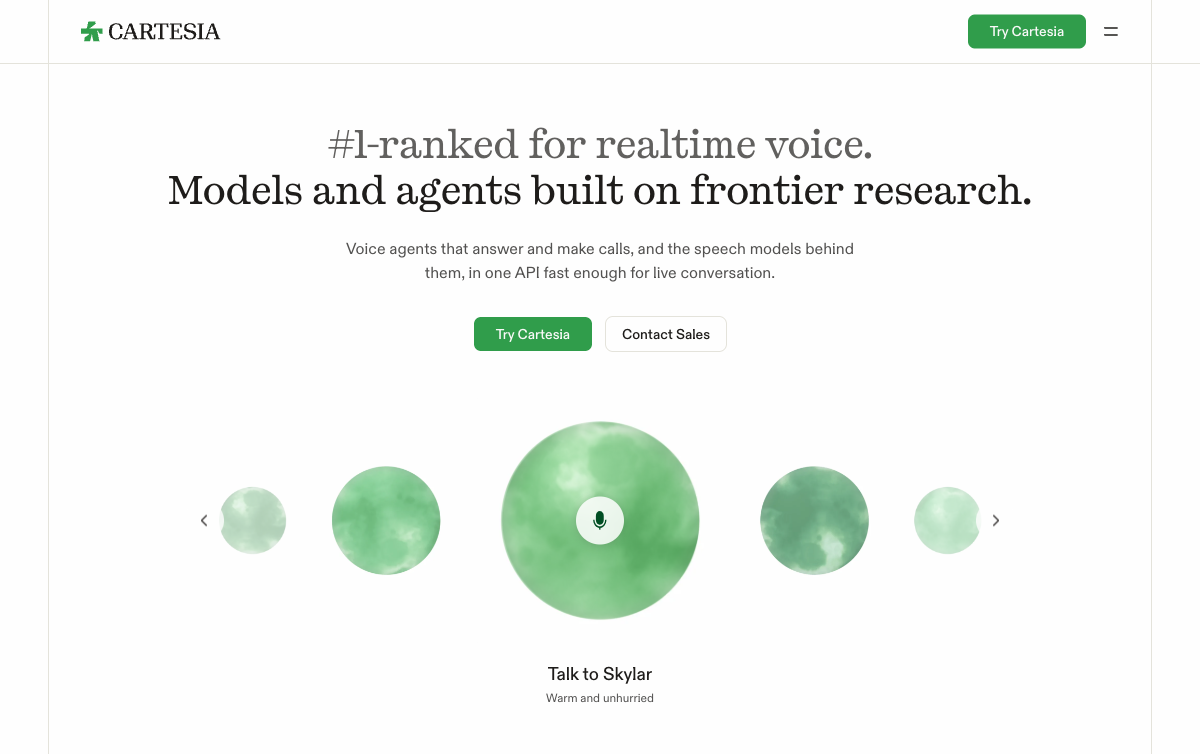 Cartesia — ultra-low-latency voice API for real-time apps
Cartesia is not a creator tool. It is an API built for products that need voice to feel instant. First-chunk latency sits around 71 milliseconds on Cartesia’s Sonic model, which is the number that matters for conversational AI, voice assistants, and anything where a half-second pause kills the experience.
Voice quality is competitive with ElevenLabs Turbo v2.5, not ElevenLabs v3. If you need the highest realism, ElevenLabs still leads. If you need your app to feel snappy and your budget is tight, Cartesia’s $49/month Startup plan gives 1.25 million credits — roughly 1,667 minutes of TTS at about $1.76 per audio hour.
Voice cloning is available from the Pro plan upward ($5/mo), with Professional Voice Clone slots from Startup ($49/mo).
Pros
- ~71ms first-chunk latency — genuinely fast for real-time use
- Competitive pricing: ~$1.76/audio hour on Startup
- Clean REST API with Python and TypeScript SDKs
- Voice cloning on Pro ($5/mo) and above
Cons
- No browser Studio — API only
- Voice expressiveness lags ElevenLabs v3 on narrative content
- Free tier (20K credits/mo, ~27 min) does not include voice cloning
Best for: Developers building voice into real-time apps — conversational AI, voice assistants, customer service bots.
Pricing: $0 free (20K credits/mo, ~27 min, no cloning), $5/mo Pro (100K credits/~133 min, instant voice cloning), $49/mo Startup (1.25M credits/~1,667 min, 2 professional clone slots). Checked October 2026 from cartesia.ai.
5. Fish Audio
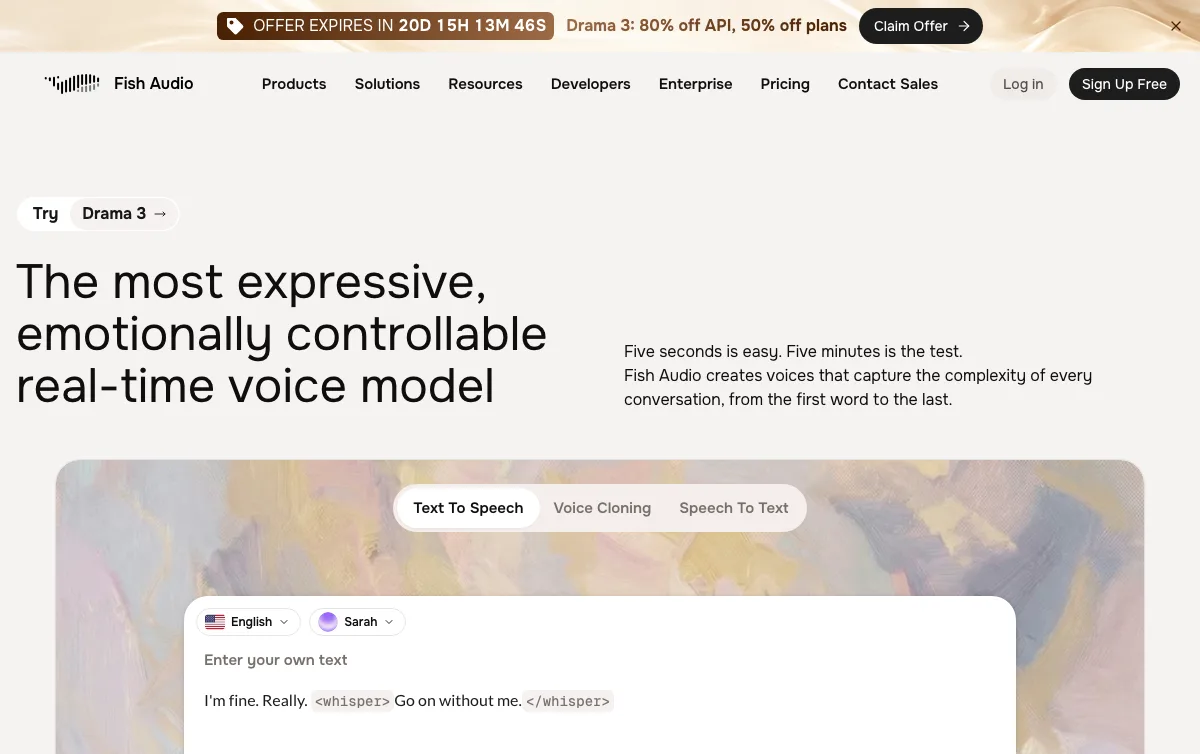 Fish Audio — community voice platform with voice cloning from 10 seconds of audio
Fish Audio is where you go when you want voice cloning at the lowest possible cost. The platform lets you clone a voice from as little as 10 seconds of source audio, and the community library holds thousands of user-created voices. If the voice you need exists in that library, you pay nothing to use it.
The Plus plan at $11/month gets you 250,000 credits — roughly 200 minutes of generated audio — with a 15,000-character input limit per generation. That works out to about $2.39 per audio hour, compared to $9.86 per hour on ElevenLabs Creator.
The free tier offers 8,000 credits per month (about 7 minutes), with voice cloning listed as a feature. The FAQ creates some ambiguity around commercial use on the free tier, so verify their terms before distributing free-tier audio commercially.
Pros
- Voice cloning from ~10 seconds of audio
- Large community library of user-created voices
- Very low cost: ~$2.39/audio hour on Plus plan
- 30,000-character input limit per generation on Pro (vs. ElevenLabs’ 5,000)
Cons
- Community-generated voice quality is inconsistent
- Commercial-use rights on the free tier need clarification
- No video editor integration — audio exports only
- Less context-aware delivery than ElevenLabs v3
Best for: Creators and developers who need voice cloning at low cost and are comfortable navigating a community-driven voice library.
Pricing: $0 free (8K credits/mo, ~7 min, cloning included), $11/mo Plus (250K credits/~200 min, 15K chars/gen), $75/mo Pro (2M credits/~1,620 min, 30K chars/gen, 5 professional clone slots). Checked October 2026 from fish.audio.
6. Rask AI
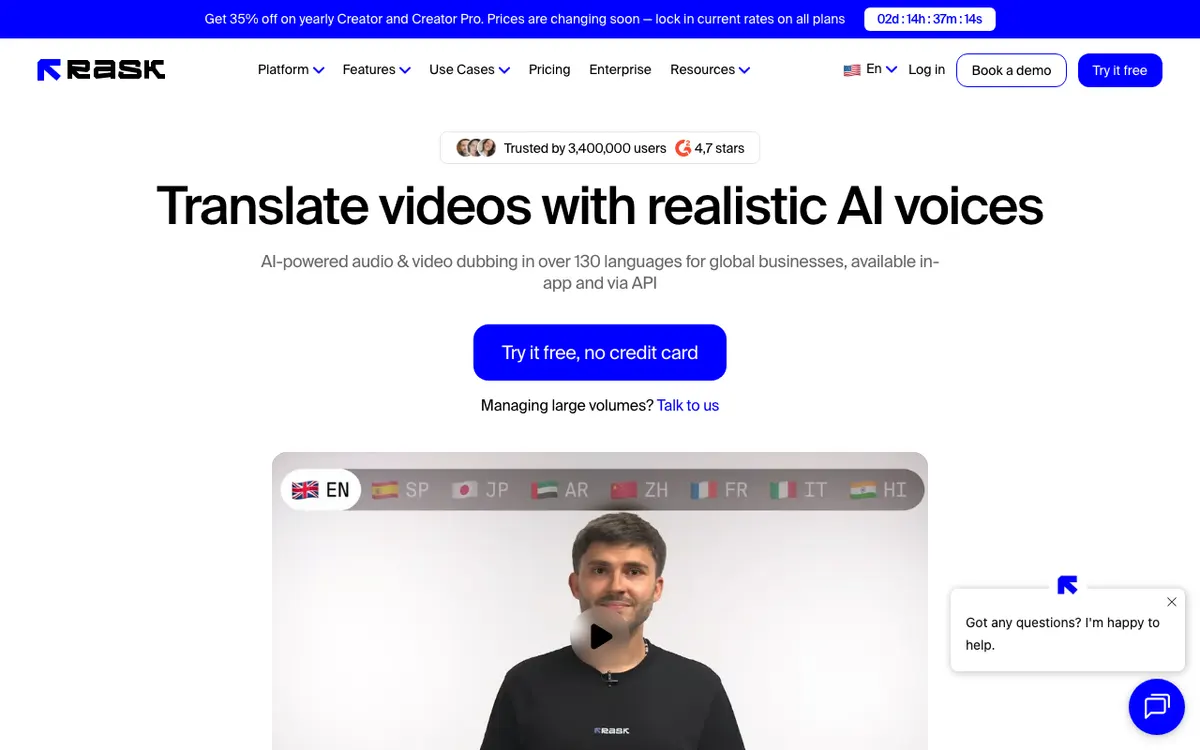 Rask AI — AI video dubbing and localization in 135+ languages
Rask AI is not a TTS tool. It is a video dubbing and localization platform that sits in the same conversation as ElevenLabs because ElevenLabs Dubbing Studio is one of the main reasons people look at Rask. Both tools let you upload a video and get it back in another language with voice cloning. The difference is audience and workflow.
Rask is built for video localization teams: a browser editor, translation review, dubbing in 135+ languages, and voice cloning in 32 of them. ElevenLabs Dubbing Studio is more developer-accessible with an API but narrower in its editor tools.
Where Rask falls short is cost. At $39/month for 25 minutes of dubbing, you are paying $1.56 per minute — more expensive than ElevenLabs Dubbing at roughly $0.55/min on the Creator plan. Rask makes sense for the translation editor and the 135-language reach; it does not make sense on pure per-minute cost.
Pros
- 135+ languages for translation, 32 languages for voice cloning
- Built-in translation editor to fix the translation before voicing
- Speaker voice cloning included — each speaker stays themselves
- 3-minute free trial, no credit card required
Cons
- $1.56/min is expensive vs. ElevenLabs Dubbing at ~$0.55/min
- Inconsistent pricing on the public page (FAQ and card figures conflict — verify current prices at rask.ai before buying)
- Not a standalone TTS tool — video input required
- No audio-only dubbing workflow
Best for: Video localization teams that need a translation editor and need to reach markets beyond ElevenLabs’ 90-language list.
Pricing: $0 free (3 min trial), $39/mo Creator (25 min), $99/mo Creator Pro (100 min), $249/mo Business (250 min). Pricing inconsistencies noted on the page — check rask.ai directly. Checked October 2026.
7. Descript
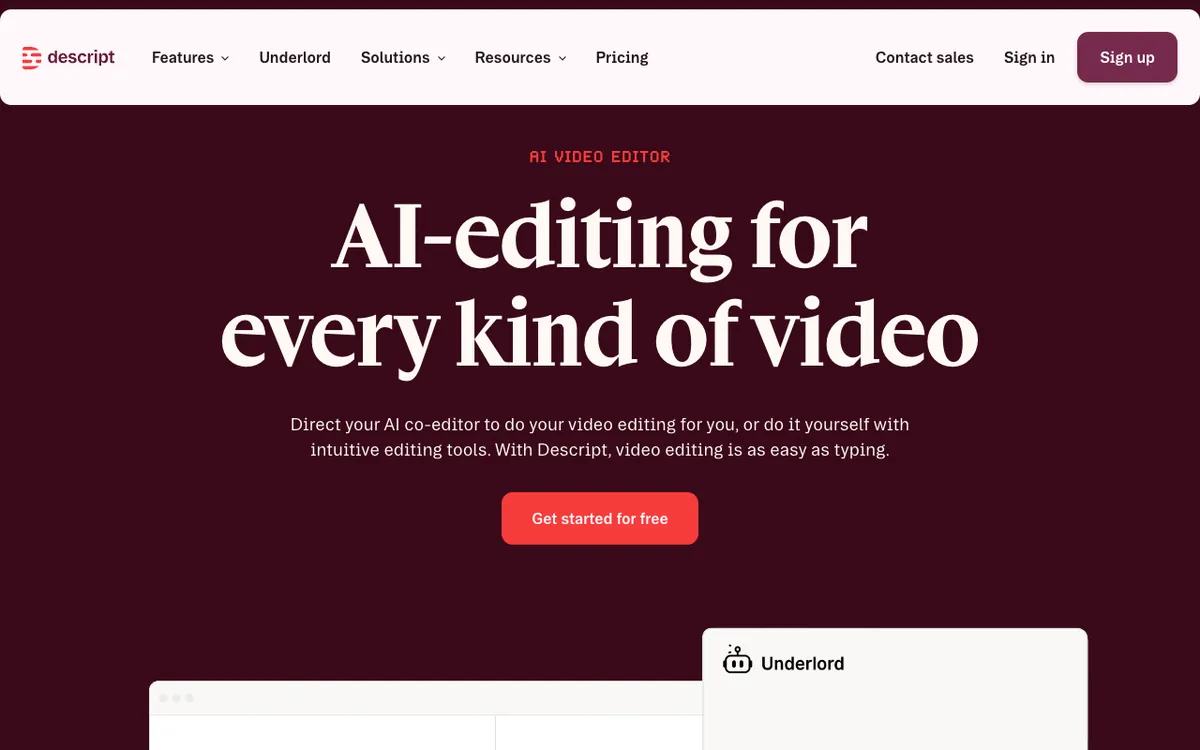 Descript — video and podcast editor with built-in AI voice cloning
Descript does not compete with ElevenLabs on standalone TTS. It competes on the workflow around it. If you record your own voice and want to fix a mispronounced word or a stumbled line without a re-record, Descript’s custom voice clones let you type the correction and the AI voices it in your cloned voice.
That is a specific, valuable use case — and a different one from generating voiceover from scratch. ElevenLabs gives you richer standalone TTS. Descript gives you voice cloning built into the editor where you cut your podcast or video.
The Hobbyist plan at $16/month (annual) includes 10 hours of media per month and custom voice clones. The Creator plan at $24/month (annual) extends that to 30 hours. Both use AI credits for voice actions — the page does not publish per-action credit costs, so test the free tier (100 one-time credits, 1 hour of media) before upgrading.
Pros
- Voice cloning for overdubbing your own recordings — fix lines without re-recording
- Full video and podcast editor built in
- 1 hour free per month with 100 AI credits, no credit card required
- Team collaboration on Creator and Business plans
Cons
- Not designed for standalone TTS at scale
- AI credit costs per voice action are not published — hard to budget before you try
- Voice realism for cloned overdubs lags ElevenLabs v3 on expressiveness
- Per-media-hour limits apply (not per-generated-minute)
Best for: Podcasters and video editors who want to fix lines in their own cloned voice without leaving their editing workflow.
Pricing: $0 free (1 hr media/mo, 100 one-time AI credits), $16/mo Hobbyist annual (10 hr, voice clones), $24/mo Creator annual (30 hr), $50/mo Business annual (40 hr). Checked October 2026 from descript.com.
8. Deepgram Aura
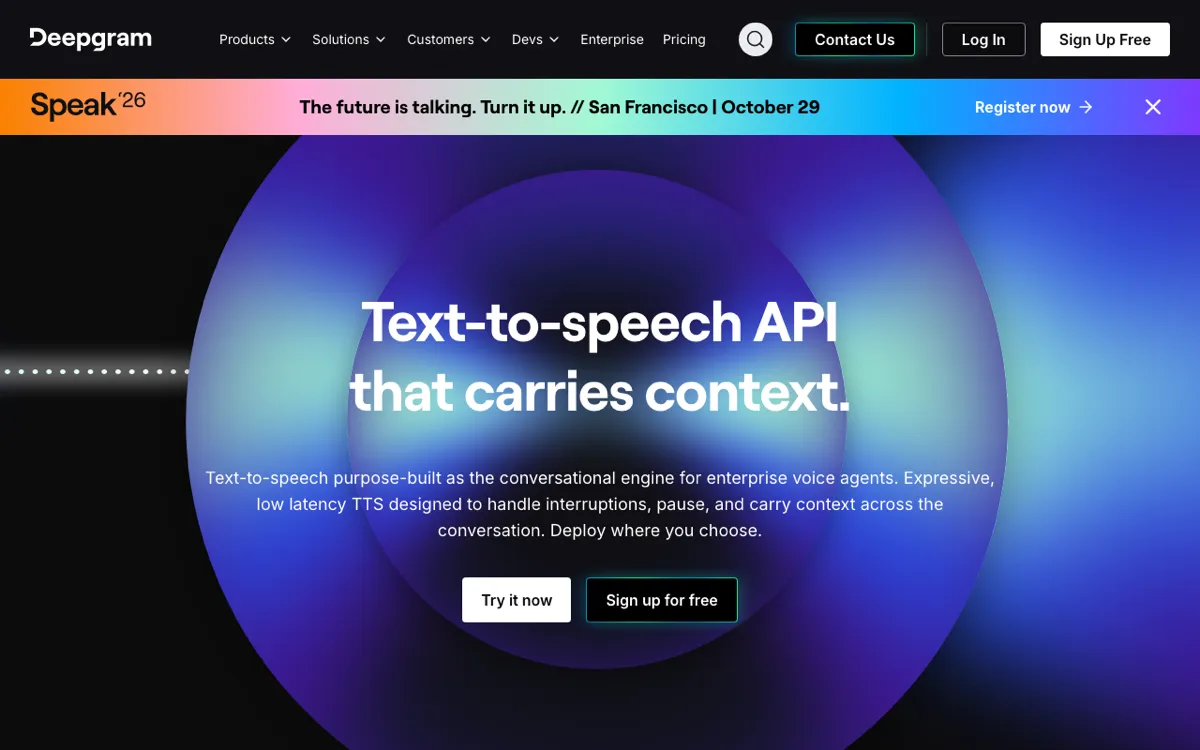 Deepgram Aura — pay-as-you-go TTS API with no subscription required
Deepgram Aura is the most straightforward pricing model in this list: no subscription, no monthly minimum, no credits to manage. You call the API, pay per character, and that is it. New accounts get $200 in free credit, which does not expire until you use it.
Aura-2 costs $0.030 per 1,000 characters. At roughly 54,000 characters per hour of audio, that is about $1.62 per hour — one tenth of ElevenLabs Creator at $9.86/hr. Aura-1 costs $0.015/1K chars, cutting it to $0.81/hr.
The catch is voice selection. Aura has a limited set of voices compared to ElevenLabs’ 10,000+, and it does not offer voice cloning. For developers who need a reliable, cheap TTS API and do not need custom voices, Aura is hard to beat on cost.
Pros
- Pay-as-you-go, no subscription required
- $200 free credit, no expiry
- ~$1.62/hr on Aura-2 — among the lowest in this list
- Clean REST API with Python, JavaScript, Go, and Rust SDKs
Cons
- No voice cloning
- Smaller voice library than ElevenLabs
- No browser Studio — API only
- Voice expressiveness is behind ElevenLabs v3 on emotional content
Best for: Developers who need a reliable, low-cost TTS API at volume with pay-as-you-go billing and no subscription commitment.
Pricing: $200 free credit (no expiry, no subscription), $0.030/1K chars Aura-2 ($1.62/audio hr), $0.015/1K chars Aura-1 ($0.81/audio hr). Growth plan from $4K/year with 10% savings. Checked October 2026 from deepgram.com.
9. OpenAI TTS
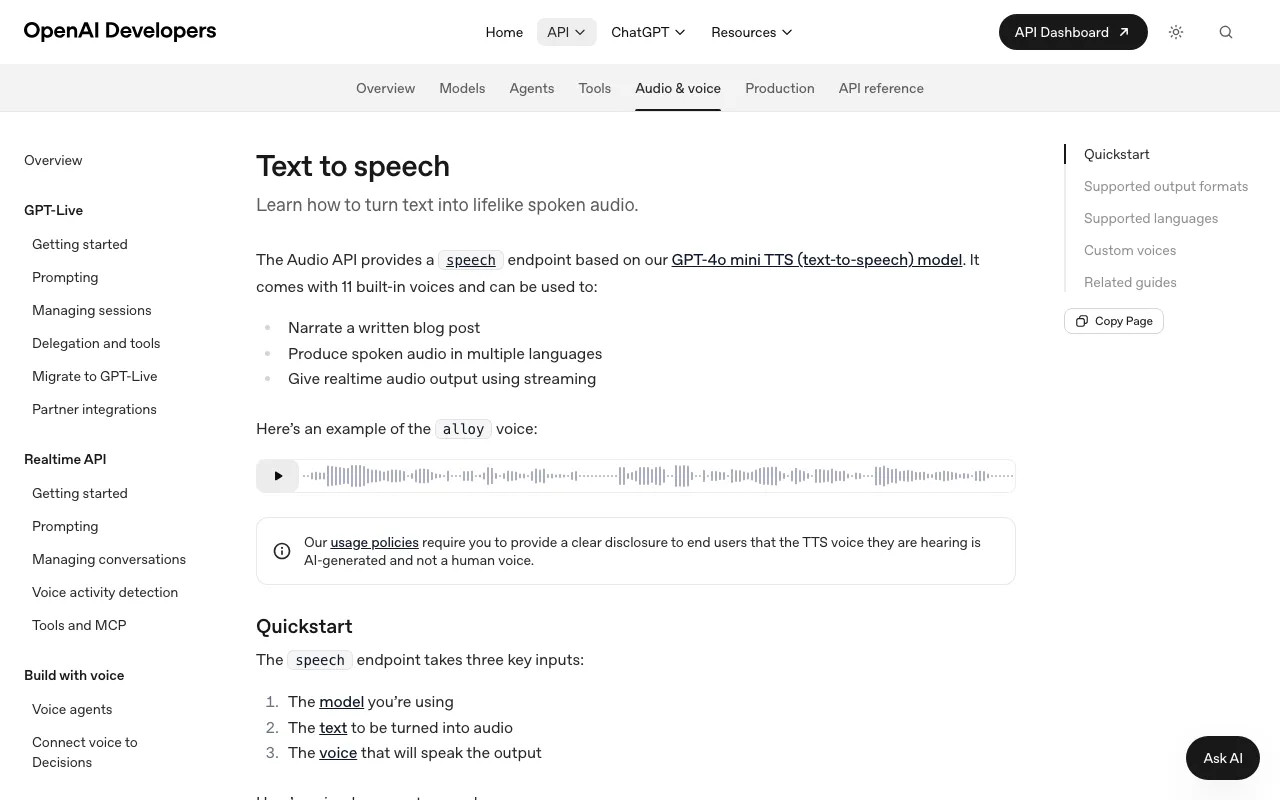 OpenAI TTS — pay-per-character TTS built into the OpenAI API
OpenAI TTS is the quietest tool in this list. It is not marketed as a voice product — it is a capability bundled inside the API you are probably already using. If you are already paying for GPT or Whisper, adding TTS requires no new account, no new SDK, and no new billing integration.
The pricing is simple: tts-1 at $15 per million characters ($0.81/hr) and tts-1-hd at $30 per million characters ($1.62/hr). The gpt-4o-mini-tts model goes further — it takes instructions and adapts delivery to context, similar to ElevenLabs v3’s expressiveness — at $12 per million audio output tokens.
Six built-in voices (alloy, echo, fable, onyx, nova, shimmer) cover a reasonable range but cannot be customized or cloned. There is no Studio, no browser UI, and no voice cloning.
Pros
- Already in the OpenAI ecosystem — no new account or billing setup
- tts-1 at ~$0.81/audio hr is competitive
- gpt-4o-mini-tts responds to tone instructions, not just text
- Straightforward character-based pricing
Cons
- Only 6 voices, no cloning, no customization
- API only — no browser Studio
- tts-1 voice quality is noticeably behind ElevenLabs v3 on naturalness
- Not suitable as a standalone voiceover product for creators
Best for: Developers already on OpenAI’s platform who need TTS for app features without adding a separate service.
Pricing: tts-1 $15/M chars ($0.81/audio hr), tts-1-hd $30/M chars ($1.62/audio hr), gpt-4o-mini-tts $12/M audio output tokens. Checked October 2026 from platform.openai.com.
ElevenLabs alternatives compared side by side
| Tool | Voices | Languages | Voice cloning | Cost per audio hour | Free tier |
|---|---|---|---|---|---|
| ElevenLabs | 10,000+ | 90+ | Yes (Starter+) | ~$9.86 (Creator) | 10K chars/mo |
| Vidwip | 190+ (ElevenLabs v3) | 74–94 | Speaker cloning | $0.60–$2.40/min | Free to start, no card |
| Murf AI | 200+ | 35+ | Yes (paid) | $0.60 (API) | 10 min, no commercial |
| WellSaid Labs | Studio voices | Not published | Not listed | ~$16.33 (Pro) | 3 min/mo |
| Cartesia | Not published | Not published | Yes (Pro+) | ~$1.76 (Startup) | 20K credits/mo |
| Fish Audio | 1,000s (community) | Not published | Yes (free tier) | ~$2.39 (Plus) | 7 min/mo |
| Rask AI | Voice cloning | 135+ (translation) | Yes (32 langs) | ~$93 (dubbing) | 3 min trial |
| Descript | Custom clones | Not published | Yes (Hobbyist+) | Variable (credits) | 1 hr media/mo |
| Deepgram Aura | Not published | 36 | No | ~$1.62 (Aura-2) | $200 free credit |
| OpenAI TTS | 6 built-in | Not published | No | ~$0.81 (tts-1) | Pay-as-you-go |
Costs per audio hour are calculated at roughly 54,000 characters per hour of speech. Rask AI’s per-hour figure reflects its dubbing rate, not a standalone TTS rate. All prices checked October 2026.
How to pick the right tool
Pick Vidwip if the output is a video — narrated, dubbed, or both — and you want ElevenLabs v3 voice quality without building a separate assembly line for script, voice, sync, and export.
Pick Murf AI if you are a creator who wants emotion and pitch controls in a browser, not an API. The studio UI and the team workspace matter more to you than cost per hour.
Pick WellSaid Labs if you are an enterprise team — publisher, healthcare, education — who needs the same voice to sound identical across thousands of audio assets, and you generate more than you finalize.
Pick Cartesia if you are building a product that needs voice to feel instantaneous. Sub-100ms latency at $1.76/audio hour is the specific combination that Cartesia is optimized for.
Pick Fish Audio if you need cheap voice cloning and you are comfortable with community-generated voice quality. At $11/month for 200 minutes with cloning included, it is the lowest-cost entry point to a cloned voice.
Pick Rask AI if you are localizing video into 10 or more languages and you need a translation editor before the voice runs. The per-minute cost is high, but the 135-language reach and the in-browser editor justify it for teams with a real localization workflow.
Pick Descript if you are a podcaster or video editor who wants to fix mispronounced words in your own recorded voice without re-recording a session.
Pick Deepgram Aura if you need pay-as-you-go TTS at scale with no subscription. The $200 free credit, no-expiry model is genuinely generous for testing at real volume.
Pick OpenAI TTS if you are already in the OpenAI ecosystem and you want to add speech to an app without a separate service or billing account.
Related guides
- The 5 Best AI Video Dubbing Tools Compared for 2026
- AI Video Dubbing: What It Is and How It Works
- AI Video Voiceover: How to Add Narration Without a Mic
- Free AI Video Dubbing Tools Ranked for 2026