
The best AI world model in 2026 is Google Genie 4 on capability: native audio, live prompt steering and the most realistic worlds. But it is a research preview for trusted testers. Of the six, only Marble (public, paid plans from $20 a month), Odyssey-3 (public browser preview) and two open-weight models (Tencent HY-World 1.5 and Skywork Matrix-Game 4.0) are open to everyone today. Runway GWM Worlds 2 is request-access only.
The best AI world model in 2026 is Google Genie 4 on capability, but you can’t use it yet. The best AI world models you can open today are World Labs Marble, Odyssey-3 and two open-weight models from Tencent and Skywork.
A world model generates a place you can move through, frame by frame, instead of a clip you watch. This ranking covers six of them, scored on realism, interactivity, session length, native audio and access, with access stated plainly for each.
We read each vendor’s own pages, docs and repos on November 6, 2026. We didn’t run hands-on tests, so quality claims are the makers’ own, and we say so.
TL;DR: the best AI world models at a glance
| # | Model | Access today | Session length | Native audio | Best for |
|---|---|---|---|---|---|
| 1 | Google Genie 4 | Research preview, trusted testers | A few minutes (press: up to 2) | Yes | Realism and live steering |
| 2 | Runway GWM Worlds 2 | Research preview, request form | Not capped, per Runway | Yes (48 kHz) | Audio plus long sessions |
| 3 | Odyssey-3 | Public browser preview, API by request | Not published | Not stated | Trying a live world today |
| 4 | World Labs Marble | Public, free and paid plans | Persistent exportable worlds | No | 3D assets and game pipelines |
| 5 | Tencent HY-World 1.5 | Open weights, community license | Long-horizon streaming | Not mentioned | Self-hosting with big GPUs |
| 6 | Skywork Matrix-Game 4.0 | Open weights, Apache-2.0 | Not published | Not mentioned | Playable game prototypes |
How we ranked them
We ranked on capability first, then noted who can actually use each model. That is why a research preview sits at number one and a public product sits at number four.
The five criteria:
- Realism: how convincing and consistent the generated world looks, as the maker describes it.
- Interactivity: whether you steer with controls, text prompts or both.
- Session length: how long a world holds together.
- Native audio: whether sound is generated with the picture.
- Access: public, waitlist, research preview or open weights.
Marble and Matrix-Game aren’t the same kind of tool as Genie. Marble builds persistent 3D worlds you export, and Matrix-Game pairs a game engine with a neural renderer. We include them because people searching for world models want both kinds.
1. Google Genie 4
Google Genie 4 is DeepMind’s real-time world model, announced October 27, 2026, with native audio, live text steering and the most realistic worlds of the six. It is also the hardest to get into.
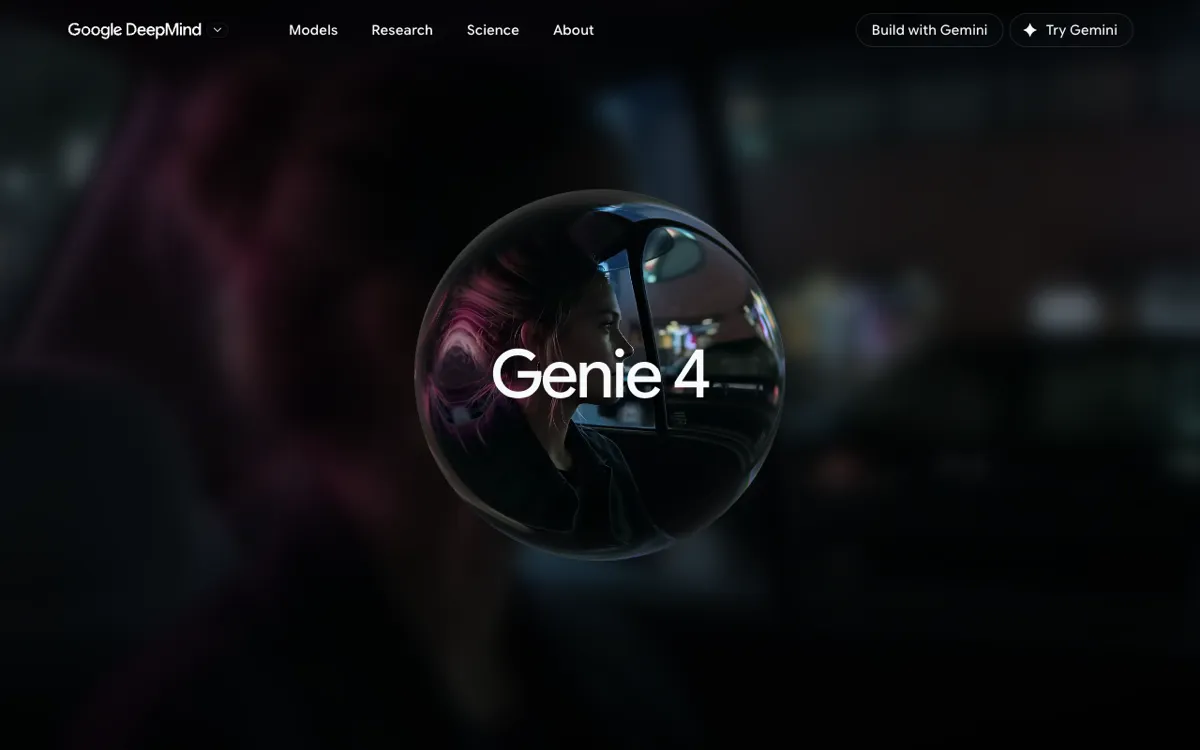 The Genie 4 page on DeepMind’s site, where the waitlist link lives.
DeepMind calls it its first real-time world model to generate audio natively: music, ambient sound and characters who talk back. You steer a running world with text prompts, such as changing the weather or adding a person. Our Genie 4 explainer covers the details.
Pros
- Native music, ambience and dialogue, which no public model here matches.
- Mid-session prompt steering while the world keeps running.
- Gemini models anchor realism and keep scenes coherent, per DeepMind.
Cons
- Research preview for trusted testers only. No price or general release date.
- DeepMind says sessions run “a few minutes”; TechCrunch reports up to two minutes.
- No resolution or frame rate published. Detail and object permanence can drift after prompt edits.
Best for: Watching where interactive worlds are heading, and game or robotics teams who can join the Gemini API early-access path. Access: Research preview. Wider access comes first to Google AI Ultra subscribers in Project Genie and early-access Gemini API partners. There is a waitlist link.
2. Runway GWM Worlds 2
Runway GWM Worlds 2 is a research-preview world model that streams interactive worlds at 720p, 24 fps with generated 48,000 Hz audio. Runway announced it September 3, 2026.
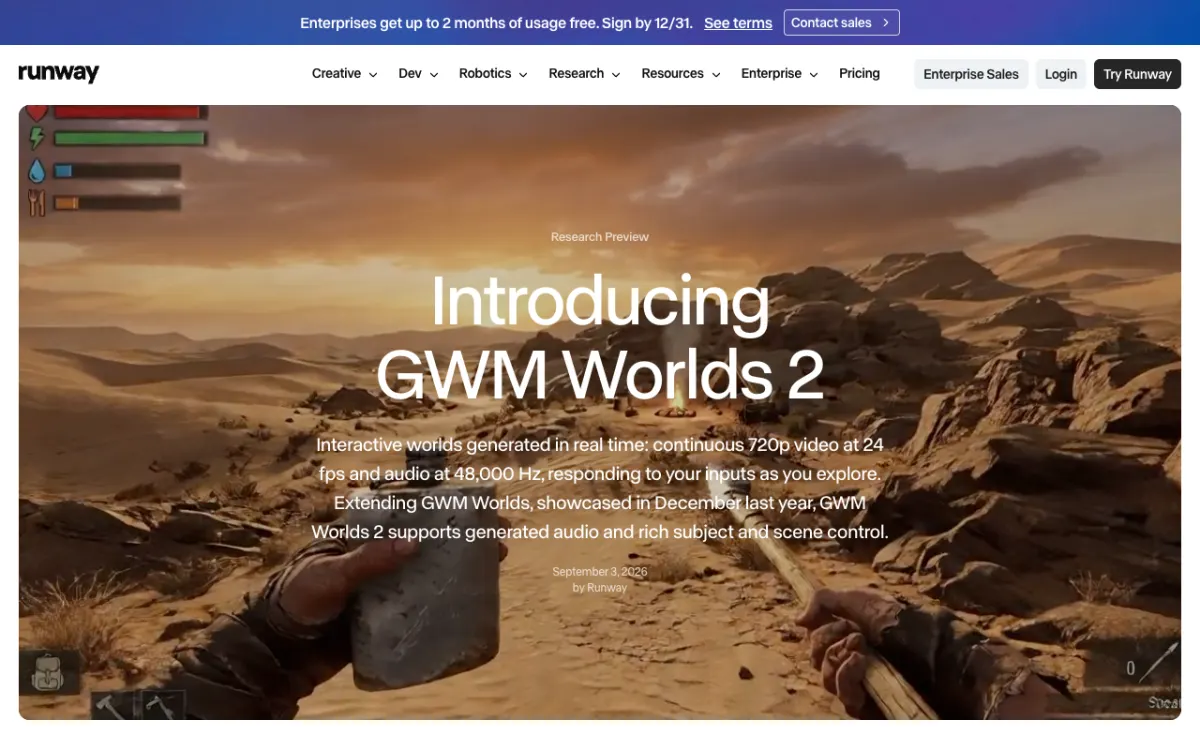 Runway’s GWM Worlds 2 announcement, with the request-access form below the fold.
Runway’s announcement says worlds respond to your inputs as you explore and supports generated audio plus subject and scene control. It adds that sessions aren’t restricted to a fixed duration and can “generate indefinitely”. That is the most generous session claim here, though it is Runway’s own and unverified by us.
Pros
- Audio and picture together, the only other model here that documents it.
- Published specs: 720p, 24 fps, 48 kHz.
- No stated session cap.
Cons
- Gated: you fill in a form with a business email and company details.
- No public pricing or API listed.
- Runway’s earlier GWM Worlds was a December 2025 showcase, so the product line is still early.
Best for: Studios and game teams who want audio-backed worlds and can pass Runway’s partner screening. Access: Research preview. Request access through the form on Runway’s page.
3. Odyssey-3
Odyssey-3 is Odyssey’s foundation world model, and it has a public browser preview anyone can try. It is the easiest way to feel a live, generated world today.
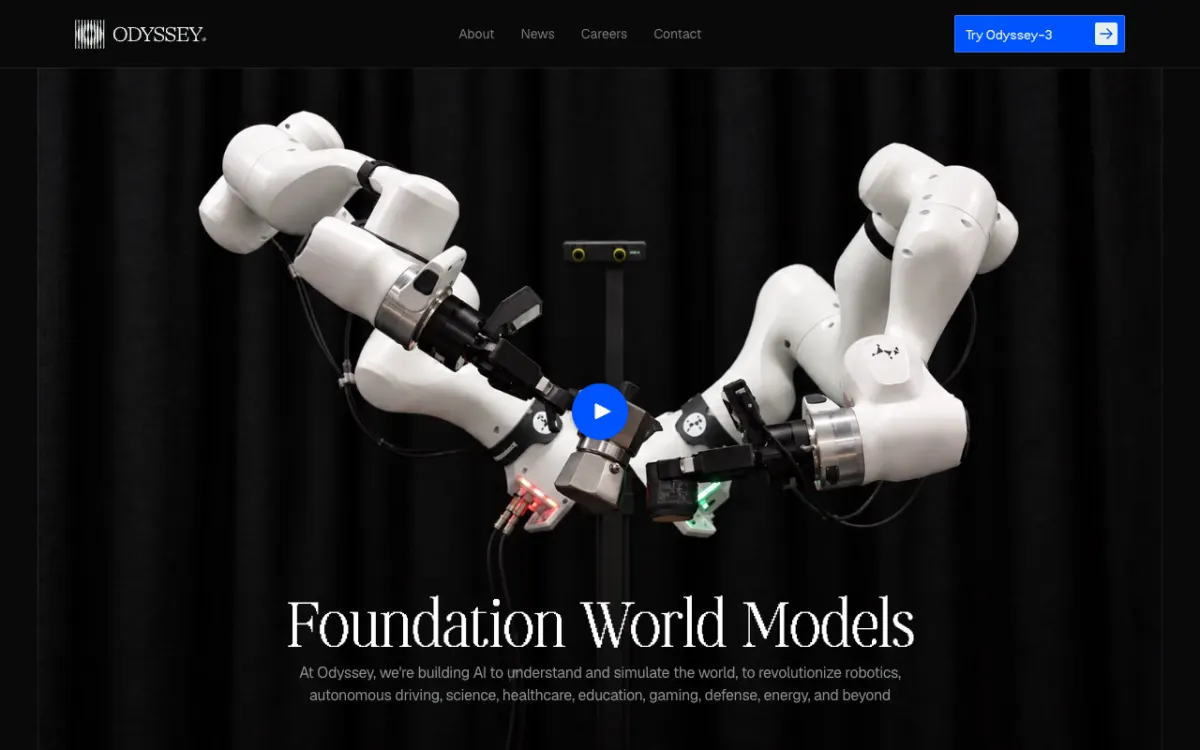 Odyssey’s homepage, with the Try Odyssey-3 button top right.
Odyssey calls Odyssey-3 its most powerful world model yet and links the preview at experience.odyssey.systems. OrcaRouter’s write-up of the October 8, 2026 launch lists first-person and third-person navigation, 832 x 480 for the base model and 1280 x 720 for a Pro variant. We couldn’t confirm those figures on Odyssey’s own site, so treat them as secondary.
Pros
- Open to the public in a browser, no application.
- Navigation modes plus free camera movement, per the launch coverage.
- Odyssey’s other models target robotics and driving, which signals serious backing ($310M Series B, per its site).
Cons
- No published session length, audio, pricing or weights.
- API access is by contact form, not self-serve.
- Resolution and frame rate come from secondary coverage.
Best for: Anyone who wants to try an interactive world model right now. Access: Public research preview in the browser. API by request.
4. World Labs Marble
World Labs Marble generates persistent 3D worlds from text, images, video or rough 3D layouts, and it is the only model here built to export. It became generally available on November 12, 2025.
 Marble’s app welcome screen, listing Explore, Create, Worlds and Studio.
According to World Labs, you can export Gaussian splats, triangle meshes (collider and high-quality) and videos with camera control. Its Chisel mode lets you block out a scene with simple 3D shapes, then add a text prompt for style. It isn’t real-time like Genie: you generate a world, then explore and export it.
Pros
- Real exports: Gaussian splats, meshes, camera-controlled video.
- Multimodal input and editing, including world expansion on Pro.
- Public, with a free tier.
Cons
- Not a live, steerable simulation, and no audio.
- Free plan caps you at 4 world generations.
- Plan credits don’t roll over month to month.
Best for: Game developers, 3D artists and filmmakers who need a world they can bring into an engine. Pricing: Free (up to 4 world generations); Standard $20 a month with 20,000 credits and up to 12 generations; Pro $35 a month with up to 25 (per World Labs’ billing docs, checked November 2026). A single-image world costs about 1,580 credits.
5. Tencent HY-World 1.5 (WorldPlay)
Tencent HY-World 1.5, also called WorldPlay, is an open-weights interactive world model that streams video at 24 FPS from keyboard and mouse input. The release and technical report landed December 17, 2025.
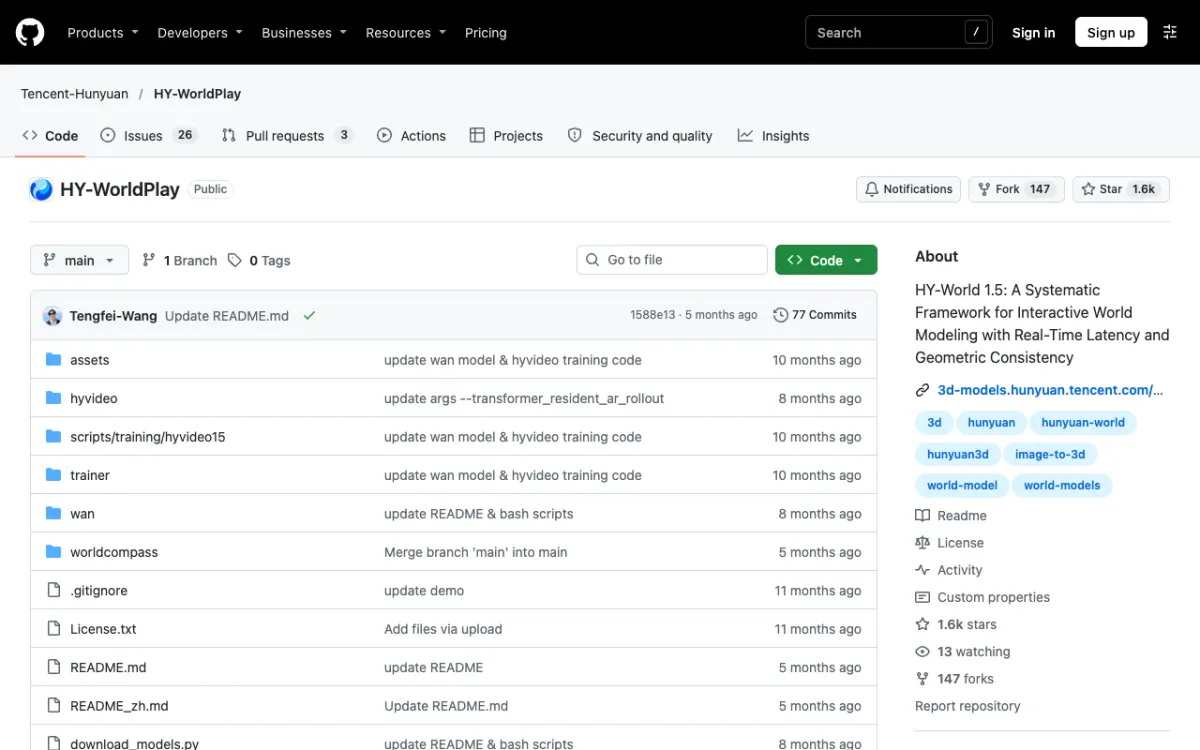 The HY-WorldPlay repository on GitHub.
The repo says it uses memory and reinforcement learning to keep scenes geometrically consistent over long sequences. Checkpoints are on Hugging Face. Hardware is heavy: the distilled model for 125 frames needs 28 GB of GPU memory with 8-way sequence parallelism and 72 GB on one GPU.
Pros
- Open weights and inference code, plus training code.
- Real-time 24 FPS streaming, per Tencent.
- Works from a single image or text prompt.
Cons
- The license excludes the EU, UK and South Korea, bars using outputs to train other models, and needs a Tencent license above 1 million monthly active users.
- Needs a separate HunyuanVideo-1.5 base model and a large GPU for the full-quality path.
- Audio isn’t mentioned.
Best for: Researchers and studios outside the excluded regions who want to self-host and fine-tune. Access: Open weights under the Tencent community license. See our open-source AI video models guide for how these licenses compare.
6. Skywork Matrix-Game 4.0
Skywork Matrix-Game 4.0 is an Apache-2.0 open model that turns a game engine’s low-poly frames into detailed visuals in real time. It was released October 15, 2026.
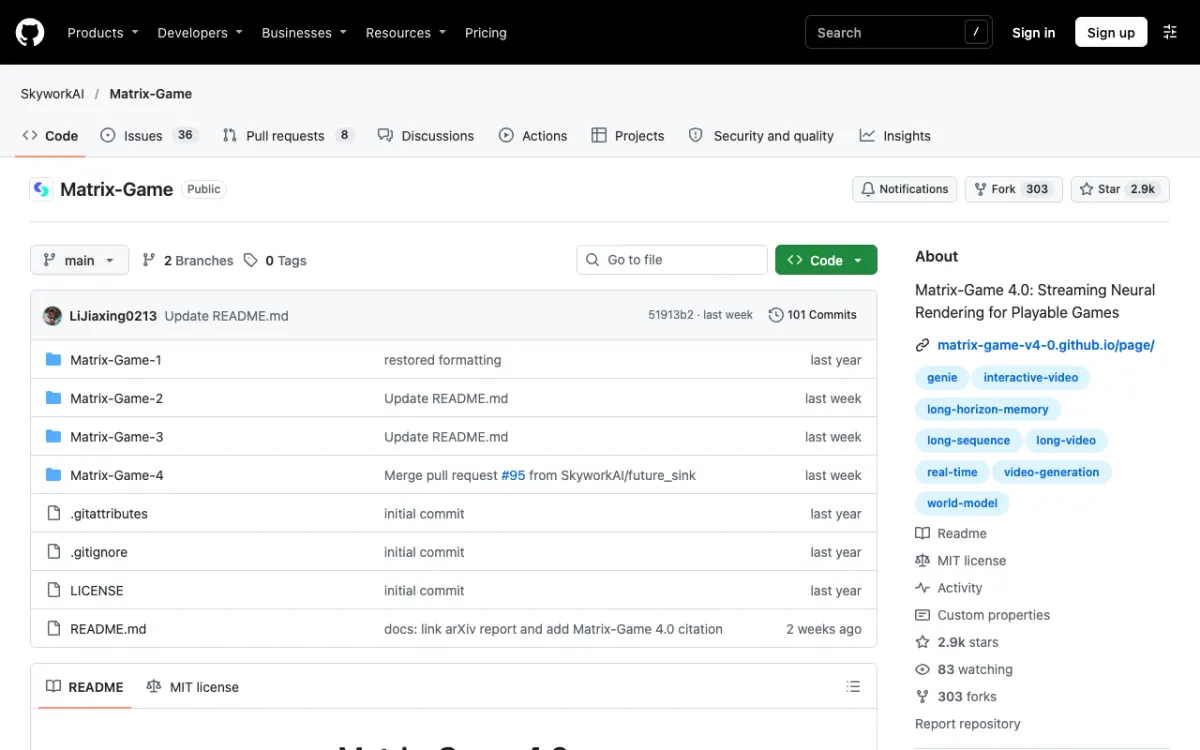 The Matrix-Game repository on GitHub, titled “Matrix-Game 4.0: Streaming Neural Rendering for Playable Games”.
The Matrix-Game README says the engine handles gameplay, physics and input while a few-step causal video model renders the frames. Skywork reports up to 67 FPS on an RTX 5080 and 58 FPS on an RTX 5070 Ti at 864 x 480, as steady-state figures with fixed prompts. Matrix-Game 3.0 came out March 27, 2026.
Pros
- Runs on consumer GPUs: single-GPU paths for A100, RTX 5090, RTX 5080 and RTX 5070 Ti.
- Apache-2.0, with no territory limits stated.
- A browser demo is described in the README.
Cons
- Released weights cover only three scenes: Medieval Castle, Ancient Egypt and City Racing.
- It leans on a game engine, so it isn’t a text-to-any-world model.
- Audio and session length aren’t mentioned.
Best for: Developers prototyping playable AI-rendered games on a single consumer GPU. Access: Open weights on Hugging Face (Apache-2.0 for v4).
Left out: Decart, NVIDIA Cosmos, Microsoft Muse and Dynamics Lab
Four names come up in every world-model list. We left them out for stated reasons.
- Decart Oasis 3 launched June 10, 2026 with API access from day one. Decart positions it for autonomous driving and physical AI at 22 FPS, not creative worlds. Decart’s Lucy line edits live video instead.
- NVIDIA Cosmos is an open world foundation model for robotics and driving. It predicts video rather than letting you play in it, and its Predict2.5 repo is in limited maintenance as work moves to Cosmos 3.
- Microsoft Muse (WHAM) is a February 2025 research model with open weights. We found no 2026 update, so we didn’t rank it.
- Dynamics Lab Mirage 2 launched in August 2025. We couldn’t confirm it is still live, so it isn’t listed.
How to choose the right world model
Pick by the job, not the rank.
- You want the most advanced, and can wait: join the Genie 4 waitlist and watch Project Genie.
- You want to try one today: open Odyssey-3’s preview.
- You need assets for a game or film: use Marble. It is the one that exports.
- You want to self-host: Matrix-Game 4.0 for consumer GPUs and a clean license, HY-World 1.5 if you have the hardware and sit outside the excluded regions.
- You need audio: Genie 4 or Runway GWM Worlds 2, both gated.
World models vs AI video models
A world model reacts to you, and a video model hands you a finished clip. If you need footage for a timeline today, a video model is the practical tool.
Our Google Veo alternatives and Sora alternatives guides cover the clip generators.
Conclusion
Genie 4 leads on capability, Runway GWM Worlds 2 is the other model with documented audio, and neither is open to the public. Odyssey-3 and Marble are the two you can use today, and Matrix-Game 4.0 and HY-World 1.5 are the ones you can run yourself.
Expect this ranking to move fast. Genie 4’s Project Genie rollout is the next thing to watch, and we’ll update when access opens.