
The best open-source AI video models in 2026 are LTX-2.5 (synced audio, worldwide license, free under $10M revenue), MiniMax H3 (the top-rated open model, but its license excludes the US, EU, UK and South Korea) and Kandinsky 6.0 (MIT, 44 kHz audio, runs on a 16 GB GPU), with Wan 2.2 the Apache 2.0 pick for silent clips. Wan 3.0 has no public weights; Vidwip runs it hosted, with no GPU needed.
The best open-source AI video models in 2026 are LTX-2.5, MiniMax H3 and Kandinsky 6.0 Video. All three make sound with the picture, and you can download the weights today.
The catch is the license. Only some of these models are open source in the strict sense, and one of the strongest is off-limits in the US, EU, UK and South Korea.
This guide ranks seven open-weight video models on quality, license terms, VRAM and audio. We read every license file, model card and repo on Hugging Face and GitHub on November 2, 2026; we didn’t run our own render tests.
One hosted option comes first, for readers without a big GPU. It isn’t an open model, and its entry says so.
TL;DR: the best open-source AI video models at a glance
| # | Model | License | Audio | Smallest GPU the maker documents | Best for |
|---|---|---|---|---|---|
| 1 | Vidwip AI Video Generator (hosted) | Not open; runs Wan 3.0 and 15 more | 14 of 16 models | None, runs in your browser | Skipping the GPU |
| 2 | LTX-2.5 | LTX-2.x Community (paid at $10M+ revenue) | Yes, synced | None published; FP8 and offload | Sound plus a worldwide license |
| 3 | MiniMax H3 | H3 Community (excludes US, EU, UK, South Korea) | 32 kHz stereo | 4 GPUs in the reference setup | Top quality, where licensed |
| 4 | Kandinsky 6.0 Video | MIT | 44 kHz, lip-sync | 16 GB (RTX 5060 Ti) | Permissive license with sound |
| 5 | Wan 2.2 | Apache 2.0 | No | 24 GB (5B model) | Silent clips, biggest community |
| 6 | HunyuanVideo 1.5 | Tencent Hunyuan Community (excludes EU, UK, South Korea) | No | 14 GB with offload | Lowest published VRAM floor |
| 7 | Ovi 1.1 | Apache 2.0 | Yes | 24 GB with FP8 | 10-second clips with sound |
| 8 | LongCat-Video | MIT | No | Not published | Minutes-long video |
Short version: pick LTX-2.5 if you want sound and a license that works everywhere. Pick Kandinsky 6.0 for MIT terms on a 16 GB card, Wan 2.2 for Apache 2.0 silent clips, and Vidwip if you’d rather not run a GPU at all.
Open source vs open weights: read the license first
Every model below publishes its weights, so you can download it and run it on your own hardware. That doesn’t make them all open source.
Wan 2.2 and Ovi ship under Apache 2.0, and Kandinsky 6.0 and LongCat-Video under MIT. Those are standard open-source licenses, with no revenue caps and no territory limits.
The rest use custom community licenses. They’re free for most people, with strings attached:
- LTX-2.5: companies with $10 million or more in annual revenue need a paid license from Lightricks
- MiniMax H3: no use in the US, EU, UK or South Korea, written approval above $20 million in yearly revenue, and “MiniMax H3” shown in any commercial product that uses it
- HunyuanVideo 1.5: no use in the EU, UK or South Korea, and a separate license for companies whose products had over 100 million monthly active users on the release date
Training rules differ too. A model you train on LTX-2.5 output counts as a derivative and inherits the LTX license, while MiniMax and Tencent ban using their models or outputs to improve any other AI model.
None of this is legal advice. Read the license file linked in each section before you ship.
How we ranked these open-source video models
We didn’t hand-test seven models. Our handful of prompts would measure our taste, not the models.
We used four public signals instead:
- Quality: the Artificial Analysis text-to-video leaderboard, where voters pick between two clips without knowing which model made them
- License: the license file in each repo, read in full
- Hardware: the VRAM and GPU notes each maker publishes
- Audio and specs: clip length, resolution and sound, from each model card
On November 2, 2026, the leaderboard’s with-audio table listed 31 models. MiniMax H3 (768p) ranked #3 at 1,161 Elo, the top open-weight entry, and LTX-2.5 Fast ranked #25 at 947.
Wan 3.0 held #1 at 1,175, but it isn’t open. Kandinsky 6.0, Wan 2.2, HunyuanVideo 1.5, Ovi and LongCat-Video weren’t ranked, so for those we lean on license and hardware.
1. Vidwip AI Video Generator (no GPU needed)
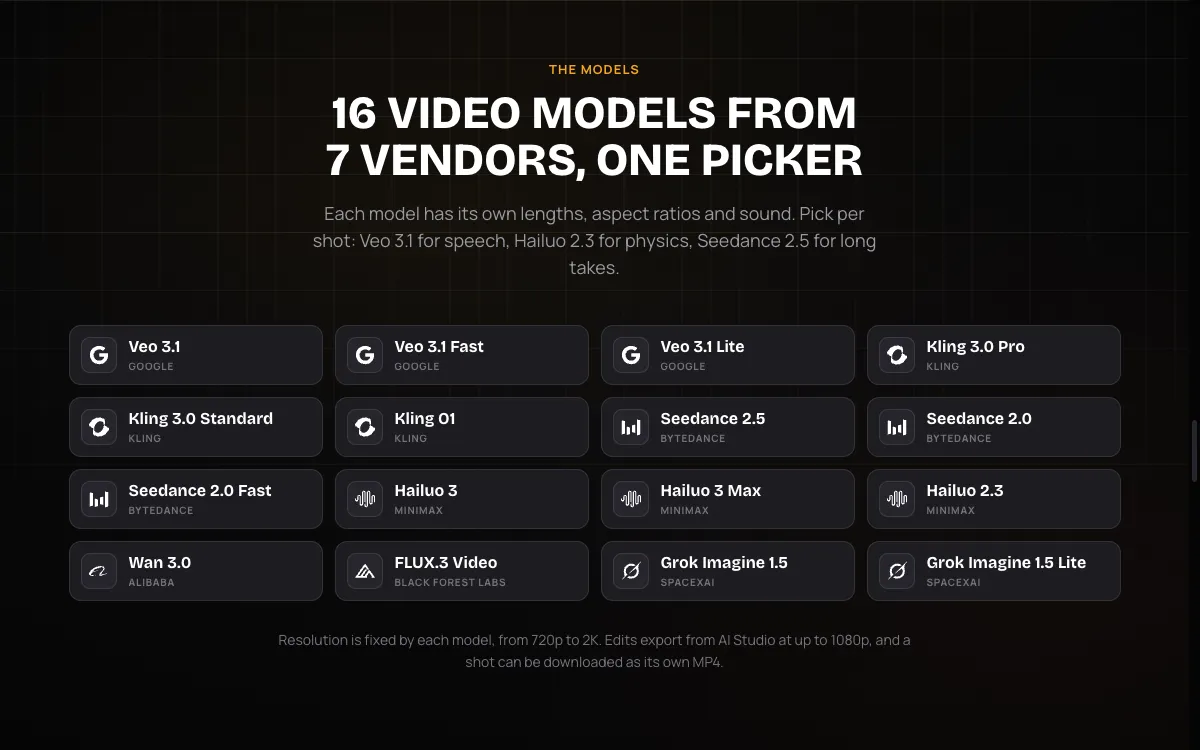 Vidwip AI Video Generator: 16 hosted video models, Wan 3.0 among them, in one picker
Vidwip AI Video Generator is a hosted text-to-video and image-to-video tool, not an open-source model. It’s here for one reason: it runs Wan 3.0, the newest Wan, without a GPU on your desk.
That matters because Wan 3.0’s weights aren’t public. As of November 2, 2026, Alibaba’s Wan-AI page on Hugging Face stops at Wan 2.2 for general video, so a hosted service is the only way to use 3.0.
Wan 3.0 also tops the Artificial Analysis with-audio leaderboard at 1,175 Elo. In Vidwip it makes shots of 2 to 30 seconds at 720p, with sound, in five aspect ratios.
It’s one of 16 models in the picker, alongside Veo 3.1, Kling 3.0 Pro, Seedance 2.5, Hailuo 3, FLUX.3 Video and Grok Imagine 1.5. Vidwip’s character swap also runs MiniMax H3 (#3 below) at 2K, a resolution the open H3 release doesn’t reach on its own.
Every shot lands on the AI Studio timeline. You cut clips together there, regenerate one shot in place, and export.
Pros
- No GPU, no CUDA setup, no multi-gigabyte weight downloads
- Runs Wan 3.0, which has no public weights
- 16 models on one credit balance, and no paid plan locks a model
- Shots from 1 to 30 seconds, with sound on 14 of 16 models
- No watermark on exports, on any plan
Cons
- Not open source: no weights, no LoRA training, no offline use
- You pay per second of video: Wan 3.0 costs 28 credits a second
- Edits export at up to 1080p, with no 4K
- Your prompts and media are processed in the cloud, not on your own hardware
Best for: creators who want the newest Wan, plus Veo, Kling and Seedance, without buying or renting a GPU. Pricing: AI video needs a paid plan. Starter $25/month ($20 yearly) for 2,500 credits, Pro $99/month ($79 yearly) for 10,000. See Vidwip pricing, or every model it runs on the models page.
2. LTX-2.5
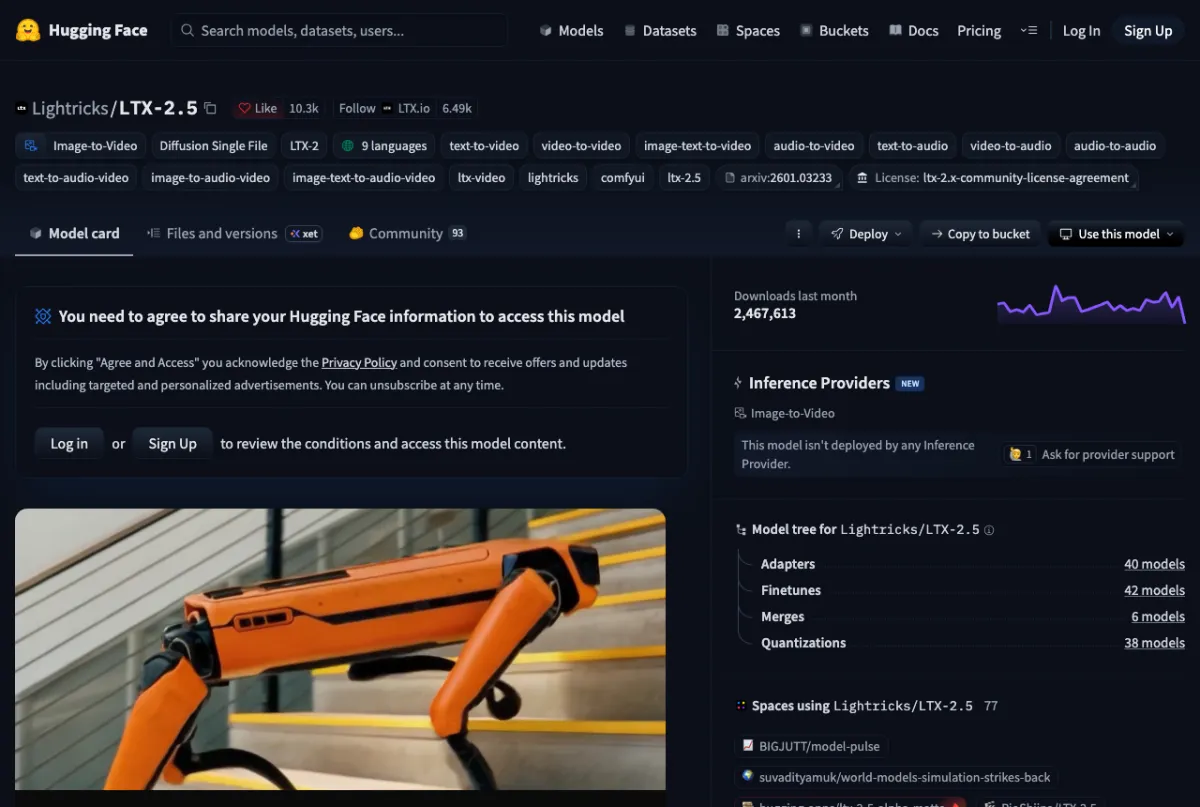 LTX-2.5 on Hugging Face: Lightricks’ 22B audio-video model, 2,467,613 downloads last month
LTX-2.5 is Lightricks’ open-weight audio-video model and the best all-round pick for most people. It makes video and synced sound in one pass, and its license works in every country.
The core is a 22B-parameter transformer with a Gemma 4 12B text encoder bundled in. The LTX-2 repo adds pipelines for audio-to-video, retakes of one time range, SDR-to-HDR, and Dub-It, which rephrases dialogue while matching the speaker’s voice and lips.
Resolution scales to 4K: the production DFR pipeline renders UHD at 3840×2176. Lightricks publishes no VRAM floor, but documents FP8 quantization with CPU or disk offload for smaller cards, plus an NVFP4 checkpoint for Blackwell GPUs.
Expect a big download. The quick-start weights come to roughly 66 GiB, and you accept the license on Hugging Face before you can pull them.
The community is already deep. The model page shows 2,467,613 downloads in the last month, with 40 adapters and 42 fine-tunes built on it.
On Artificial Analysis, LTX-2.5 Fast ranks #25 with audio at 947 Elo, well below MiniMax H3. You trade some peak quality for a license you can use anywhere.
Pros
- Synced audio and video from one model
- Worldwide license, free for companies under $10 million in revenue
- Up to 4K with the DFR pipeline, plus HDR and EXR output
- Extra pipelines: audio-to-video, retake, video-to-video LoRAs, Dub-It
- 40 adapters and 42 fine-tunes on Hugging Face already
Cons
- Paid license once your company reaches $10 million in annual revenue
- About 66 GiB of weights for the quick-start pipeline
- No official minimum VRAM figure
- #25 on Artificial Analysis, far below MiniMax H3’s #3
Best for: indie studios and startups that need sound and a license that holds in the US and EU. License: LTX-2.x Community License, dated August 11, 2026. Free weights; a paid Commercial Use Agreement applies at $10 million or more in annual revenue. Checked November 2, 2026.
Lightricks also runs a hosted app, LTX Studio. Our LTX Studio alternatives guide compares it with other hosted tools.
3. MiniMax H3
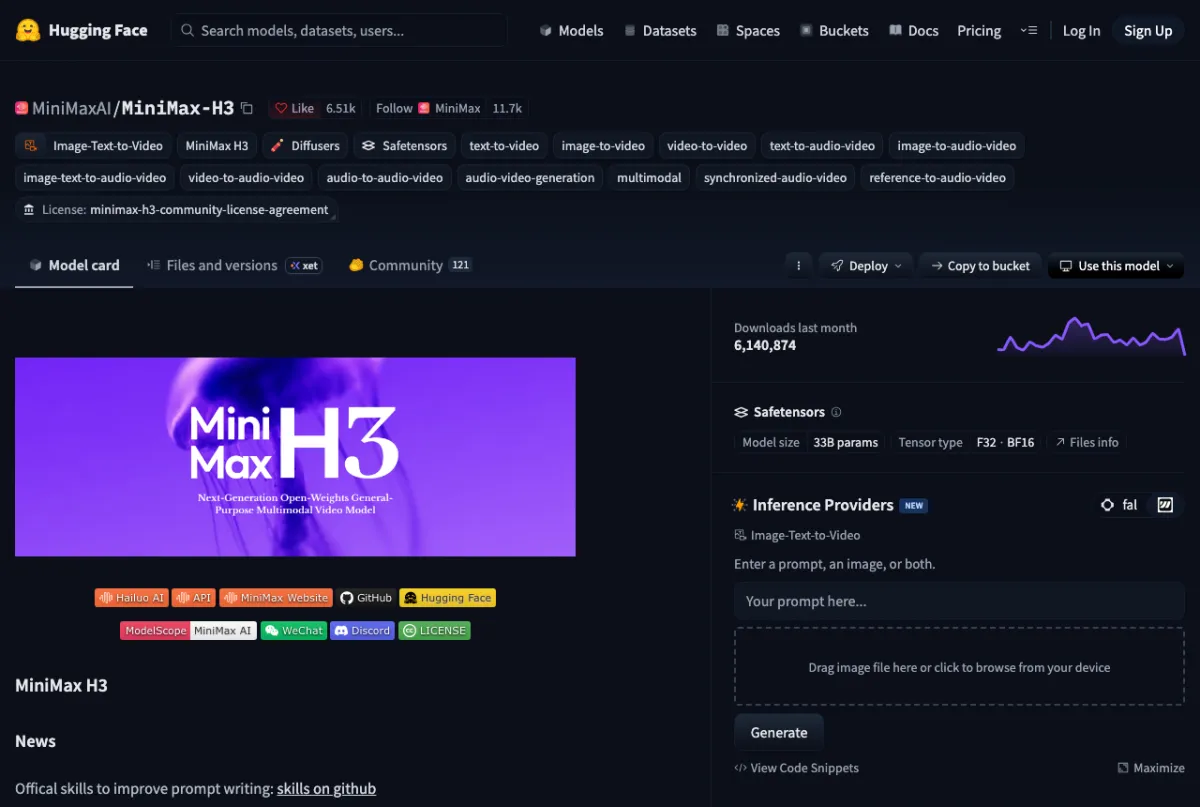 MiniMax H3 on Hugging Face: 33B parameters, 6,140,874 downloads last month
MiniMax H3 is the highest-rated open-weight video model you can download. It ranks #3 on the Artificial Analysis with-audio leaderboard at 1,161 Elo, the top open-weight entry.
H3 is a 33B dense transformer that generates video and 32 kHz stereo sound together. Clips run 4 to 15 seconds at 24 fps, with stable dialogue in 11 languages.
The weights landed on Hugging Face in early August 2026, and the license is dated August 2. They come as two checkpoints: one for text and first-or-last-frame video, and one for reference video from up to 9 images, 3 video clips and 3 audio clips.
Not everything is open. Local H3 renders at 768p, while the 2K regeneration stage and the Context-IR prompt system stay behind MiniMax’s API.
Hardware is heavy. MiniMax’s reference SGLang setup spreads one job across 4 GPUs, though community quantizations such as GGUF and NVFP4 builds are on Hugging Face.
The license is the real limit. It excludes the United States, the European Union, the United Kingdom and South Korea outright, and people there have to apply to MiniMax for a separate license.
Demand is huge anyway. H3 logged 6,140,874 Hugging Face downloads in the last month, more than any other model on this list.
Pros
- #3 on Artificial Analysis with audio, the top open-weight entry
- Native 32 kHz stereo sound, with dialogue in 11 languages
- Rich references: up to 9 images, 3 videos and 3 audio clips
- Runs in SGLang, vLLM, diffusers and ComfyUI
Cons
- License excludes the US, EU, UK and South Korea
- Open release stops at 768p; 2K and the prompt system are API-only
- Commercial products must display “MiniMax H3”, and need written approval above $20 million in revenue
- Bans using H3 or its outputs to improve any other AI model
- Reference deployment uses 4 GPUs
Best for: teams outside the excluded regions that want the best open-weight quality and have multi-GPU servers. License: MiniMax H3 Community License Agreement, dated August 2, 2026. Free weights within the licensed territory. Checked November 2, 2026.
Want H3 without the hardware? Our Hailuo AI alternatives guide covers MiniMax’s hosted studio and its rivals.
4. Kandinsky 6.0 Video
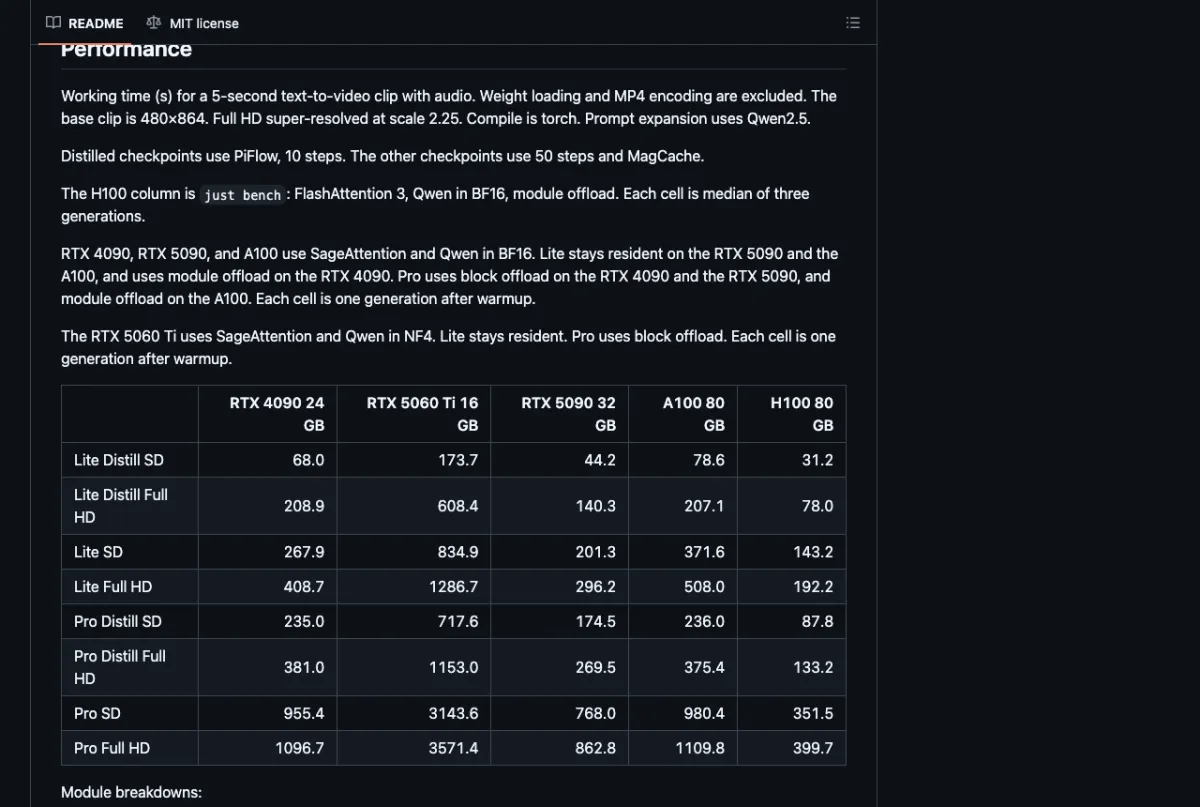 Kandinsky 6.0: seconds per 5-second clip with audio, from a 16 GB RTX 5060 Ti to an H100
Kandinsky 6.0 Video is the best open-source pick if you want sound and a truly permissive license. Kandinsky Lab open-sourced it under MIT on October 6, 2026.
It comes in two sizes: Lite at 3B parameters and Pro at 29B. Both make 5-second clips with synchronized 44 kHz audio, including lip-sync, from text or an image.
The base clip is 480×864, and a separate super-resolution model lifts it to 1080p. An October 25 update added first-and-last-frame, audio-driven and video-to-audio modes.
It also has the clearest hardware data of any model here. Kandinsky’s benchmarks run both sizes on a 16 GB RTX 5060 Ti, Lite fully loaded and Pro with block offload.
Speed is the trade-off. On an RTX 4090, a distilled Lite clip takes 68 seconds, while Pro at Full HD takes 1,096.7 seconds, about 18 minutes.
Pros
- MIT license: no revenue cap, territory limit or use restrictions
- 44 kHz audio with lip-sync, generated with the picture
- Runs on a 16 GB consumer GPU, per Kandinsky’s own benchmarks
- Lite and Pro sizes, each with a 10-step distilled version
- Supported in diffusers, ComfyUI, vLLM-Omni, SGLang and FastVideo
Cons
- 5-second clips only
- 480×864 base resolution; 1080p needs the separate upscaler
- Not on the Artificial Analysis leaderboard yet, so no blind-vote score
- Pro is slow on consumer cards: about 18 minutes per Full HD clip on an RTX 4090
Best for: developers who need sound plus a license their legal team won’t question, on a single consumer GPU. License: MIT, on the GitHub repo and the Hugging Face model cards. A free Hugging Face Space runs Pro Distill if you want to try it first. Checked November 2, 2026.
5. Wan 2.2
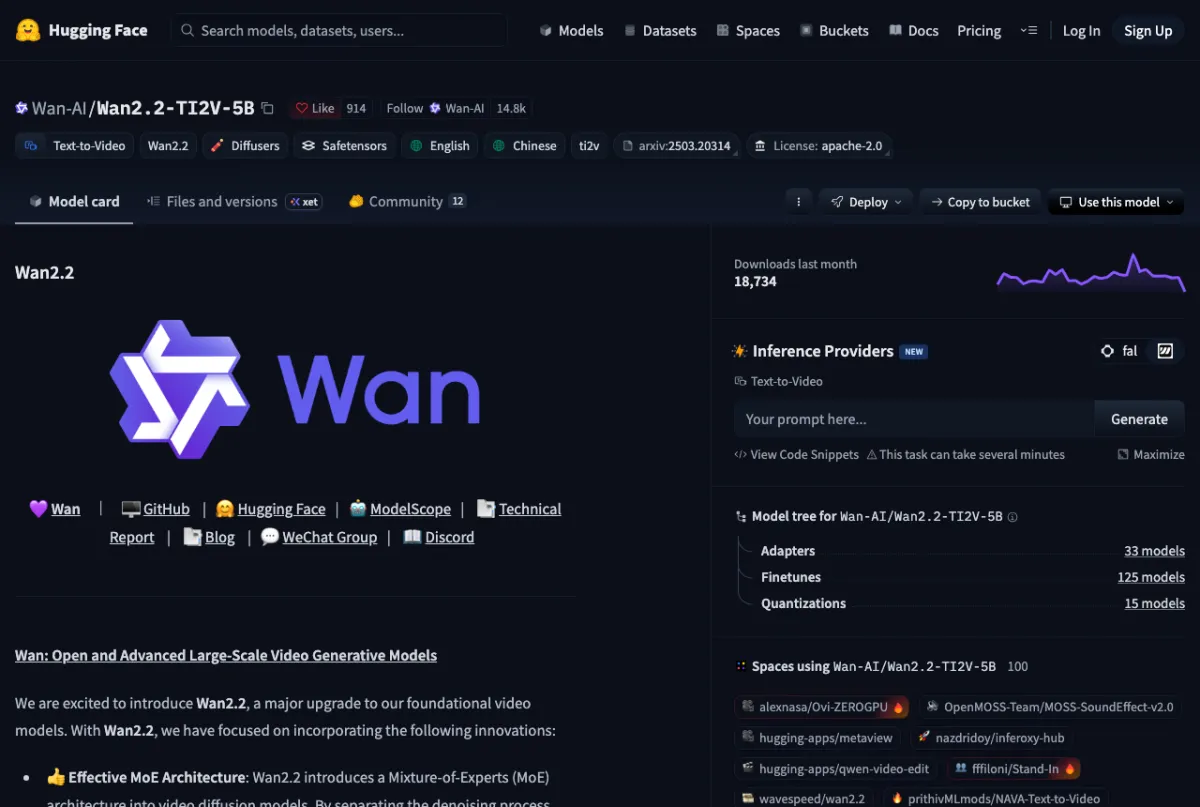 Wan 2.2 TI2V-5B on Hugging Face: Apache 2.0, 720p at 24 fps on a 24 GB card
Wan 2.2 is Alibaba’s last open-weight Wan release, and still the default Apache 2.0 video model. It came out on July 28, 2025.
It ships in two sizes. TI2V-5B does text and image to video at 720p and 24 fps on one 24 GB card like the RTX 4090, while the 27B mixture-of-experts A14B models need at least 80 GB on a single GPU.
Clips run 5 seconds, and there’s no sound. Wan 2.2’s S2V model drives video from an audio file you supply; it doesn’t generate audio.
The community is its biggest strength. The Wan 2.2 GitHub repo has over 18,000 stars, the most of any model here, and Hugging Face lists 125 fine-tunes of the 5B model alone.
Don’t expect newer Wan versions here. Wan 2.5, 2.6, 2.7 and 3.0 have no public weights, and Alibaba’s open releases since have been character-animation models such as Wan2.2-Animate-2 and Wan-Dancer.
Pros
- Apache 2.0: commercial use anywhere, with no revenue cap
- 5B model runs 720p at 24 fps on a 24 GB GPU
- Text-to-video and image-to-video in one 5B model
- Biggest community: 18,000+ GitHub stars and 125 fine-tunes of the 5B model
Cons
- No audio generation
- 5-second clips
- A14B models need 80 GB of VRAM on a single GPU
- Over a year old, and every newer Wan version is closed
Best for: commercial products that need silent clips under a standard open-source license. License: Apache 2.0. Checked November 2, 2026.
6. HunyuanVideo 1.5
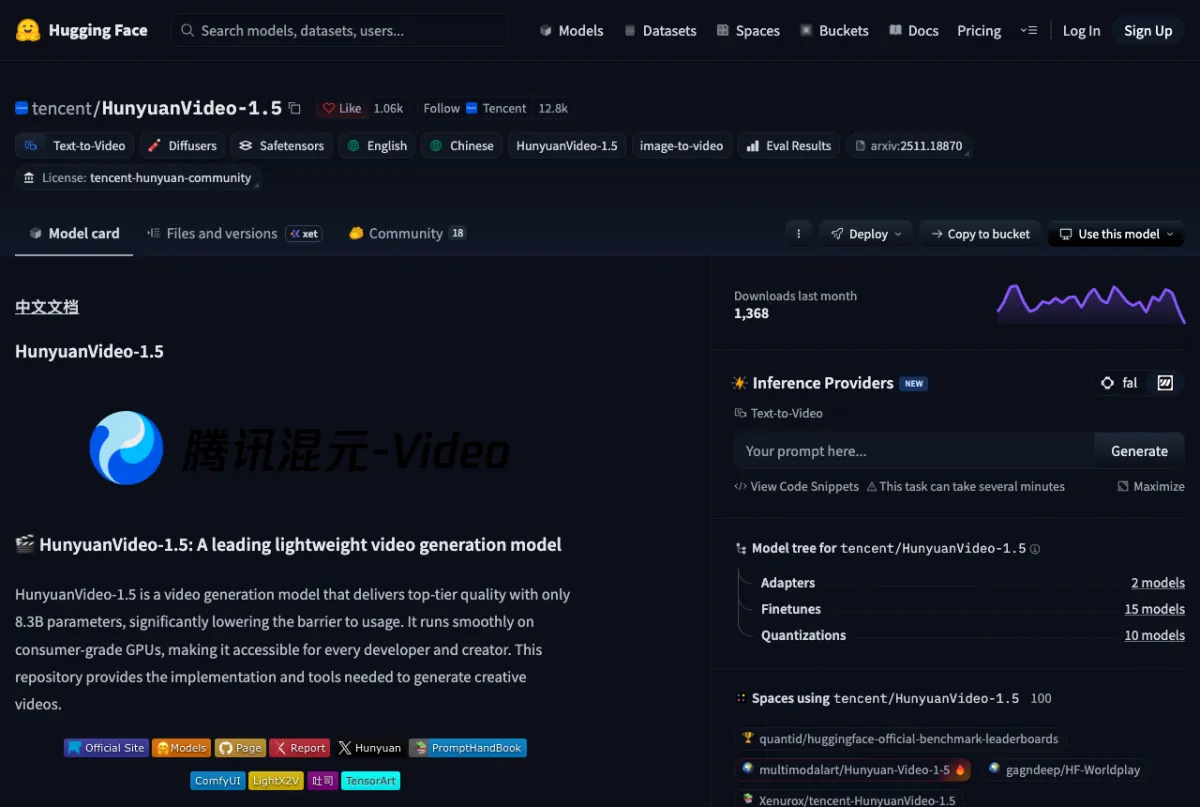 HunyuanVideo 1.5 on Hugging Face: Tencent’s 8.3B model, 14 GB minimum with offloading
HunyuanVideo 1.5 is Tencent’s lightweight video model and the lowest-VRAM option on this list. Tencent released the weights in November 2025.
It has 8.3B parameters and needs at least 14 GB of GPU memory with model offloading. It renders at 480p or 720p, and a step-distilled super-resolution model takes output to 1080p.
The 480p image-to-video model also has a step-distilled version. Tencent says it cuts end-to-end time on an RTX 4090 by 75%.
There’s no audio. The license also excludes the EU, the UK and South Korea.
Pros
- 14 GB minimum VRAM with offloading
- 1080p through a step-distilled super-resolution model
- Step-distilled 480p image-to-video, up to 75% faster on an RTX 4090
- Training code and LoRA tuning scripts released
Cons
- No audio
- License excludes the EU, UK and South Korea
- Companies past 100 million monthly active users need a separate license
- Not ranked on Artificial Analysis
Best for: hobbyists and small teams outside the EU, UK and South Korea with a 16 GB card. License: Tencent Hunyuan Community License, release date November 21, 2025. Checked November 2, 2026.
7. Ovi 1.1
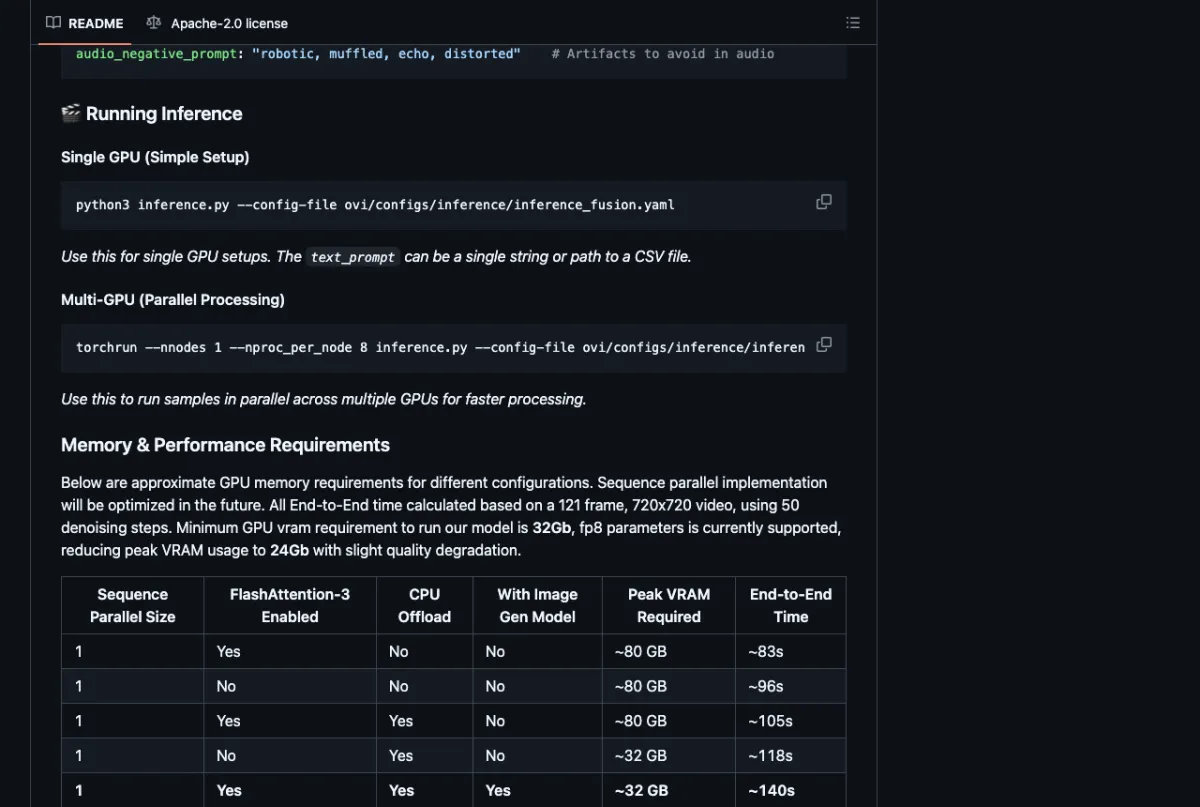 Ovi on GitHub: Character.AI’s audio-video model, 32 GB minimum or 24 GB with FP8
Ovi is Character.AI’s open audio-video model, built with Yale. It’s the pick for 10-second clips with sound under Apache 2.0.
Ovi pairs a video branch initialized from Wan 2.2 with a 5B audio branch trained from scratch. The 11B model generates speech and sound effects with the picture, from text or from text plus an image.
Version 1.1, released November 10, 2025, makes 5- or 10-second clips at 960×960 and 24 fps. It handles 9:16, 16:9, 1:1 and other aspect ratios.
It needs at least 32 GB of VRAM. FP8 weights with CPU offload bring that down to 24 GB, with slight quality loss, per the repo.
Pros
- Apache 2.0, with sound
- 10-second clips, double Kandinsky 6.0’s length
- Runs on 24 GB with FP8 weights
- Prompt tags for speech and audio descriptions
Cons
- 960×960 is the top resolution
- 32 GB minimum at full precision
- No code updates since November 2025
- Not ranked on Artificial Analysis
Best for: builders who need speaking characters with sound under a permissive license. License: Apache 2.0. Checked November 2, 2026.
8. LongCat-Video
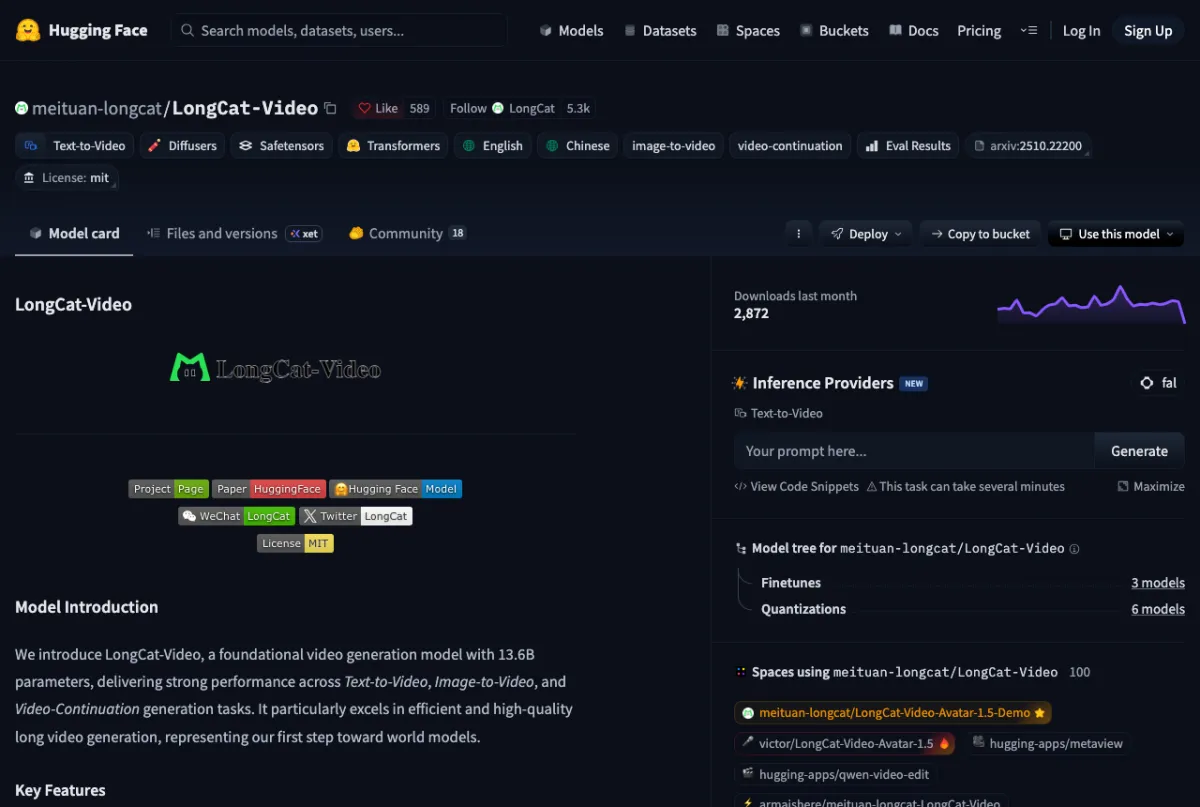 LongCat-Video on Hugging Face: Meituan’s 13.6B model, MIT licensed
LongCat-Video is Meituan’s 13.6B open model, and the one to pick for long takes. It was pretrained on video continuation, so it can extend a clip to minutes without color drift, per its model card.
One model handles text-to-video, image-to-video and video continuation. It renders 720p at 30 fps, using a coarse-to-fine pass and block sparse attention to keep that fast.
It’s silent, and the card doesn’t list a VRAM figure. Its GitHub repo has over 9,300 stars, and the MIT license is as open as Kandinsky’s.
Pros
- MIT license
- Minutes-long video through continuation
- 720p at 30 fps
- Text, image and continuation in one model
Cons
- No audio
- No published VRAM requirement
- Released in October 2025, before this year’s audio models
- Not ranked on Artificial Analysis
Best for: long scenes, loops and extended takes where a 5-second clip won’t do. License: MIT. Checked November 2, 2026.
Open-source AI video models comparison table
| Model | Maker | Released | Size | License | Audio | Output | Clip length | VRAM (per the maker) |
|---|---|---|---|---|---|---|---|---|
| Vidwip (hosted) | Vidwip | — | — | Not open | 14 of 16 models | 720p–2K per model, 1080p export | 1–30 s | None |
| LTX-2.5 | Lightricks | Aug 2026 | 22B | LTX-2.x Community | Synced | Up to 4K (DFR) | 121-frame examples at 24 fps | Not published |
| MiniMax H3 | MiniMax | Aug 2026 | 33B | H3 Community | 32 kHz stereo | 768p locally, 2K by API | 4–15 s | 4 GPUs (reference) |
| Kandinsky 6.0 | Kandinsky Lab | Oct 2026 | 3B / 29B | MIT | 44 kHz, lip-sync | 480×864, 1080p upscale | 5 s | Runs on 16 GB |
| Wan 2.2 | Alibaba | Jul 2025 | 5B / 27B MoE | Apache 2.0 | No | 720p, 24 fps | 5 s | 24 GB / 80 GB |
| HunyuanVideo 1.5 | Tencent | Nov 2025 | 8.3B | Tencent Hunyuan Community | No | 480p/720p, 1080p upscale | 121 frames by default | 14 GB |
| Ovi 1.1 | Character.AI | Nov 2025 | 11B | Apache 2.0 | Yes | 960×960, 24 fps | 5 or 10 s | 32 GB, 24 GB FP8 |
| LongCat-Video | Meituan | Oct 2025 | 13.6B | MIT | No | 720p, 30 fps | Minutes | Not published |
Where each license lets you work
| Model | Territory | Revenue or size limit | Training on outputs |
|---|---|---|---|
| LTX-2.5 | Worldwide | Paid license at $10M+ annual revenue | Models trained on outputs inherit the LTX license |
| MiniMax H3 | Excludes US, EU, UK, South Korea | Written approval above $20M yearly revenue | Banned for improving other models |
| Kandinsky 6.0 | Worldwide | None | No restriction |
| Wan 2.2 | Worldwide | None | No restriction |
| HunyuanVideo 1.5 | Excludes EU, UK, South Korea | Separate license above 100M monthly active users | Banned for improving other models |
| Ovi 1.1 | Worldwide | None | No restriction |
| LongCat-Video | Worldwide | None | No restriction |
Popular video models that didn’t make this list
Several names you’ll see in “open-source” roundups don’t have public weights. We checked each maker’s Hugging Face and GitHub pages on November 2, 2026.
- Wan 2.5, 2.6, 2.7 and 3.0: no weights on Alibaba’s Hugging Face or GitHub pages. Wan 3.0 is the #1 model on Artificial Analysis, and you can only use it hosted.
- Veo 3.1, Kling 3.0, Seedance 2.5 and FLUX.3 Video: no public weights either. Our best text-to-video AI tools guide compares where to run them.
- MAGI-2 Preview: this one is open. Sand AI’s MAGI-2 Preview is Apache 2.0, makes 10-second clips with sound refined to 1080p, and ranks #15 with audio at 1,044 Elo, above LTX-2.5.
MAGI-2 Preview missed our list on hardware alone. It’s a 114B mixture-of-experts model with 6B active parameters, its weights total about 307 GB, and it needs 8 Hopper GPUs to run.
If you moved here after Sora shut down, our Sora alternatives and Runway alternatives guides cover the hosted options.
How to choose the right open-source video model
- You sell in the US or EU and need sound. Go with LTX-2.5 while you’re under $10 million in revenue, or Kandinsky 6.0 if you want MIT terms.
- You want the best open quality and you’re outside the excluded regions. Go with MiniMax H3, on a multi-GPU server.
- You have one 16 GB card. Go with Kandinsky 6.0, or HunyuanVideo 1.5 if you’re outside the EU, UK and South Korea.
- You need Apache 2.0 for a product. Go with Wan 2.2 for silent clips, or Ovi 1.1 for clips with sound.
- You need long takes. Go with LongCat-Video.
- You don’t want to run a GPU at all. Go with Vidwip, which runs Wan 3.0 and 15 other models in the browser.
Final verdict
The best open-source AI video models in 2026 finally make sound. LTX-2.5 is the safest all-rounder, MiniMax H3 has the best quality where its license reaches, and Kandinsky 6.0 brings MIT terms and 44 kHz audio to a 16 GB card.
Wan 2.2 is still the Apache 2.0 workhorse for silent clips. Just don’t wait for Wan 3.0 weights: as of today, Alibaba hasn’t released them.
If you’d rather skip the drivers and downloads, generate your shots on Vidwip. AI video needs a paid plan, from $25 a month.