
HeyGen is the closest D-ID swap for photo animation, with Avatar IV, videos up to 30 minutes and a $29/month Creator plan. Tavus leads for streaming conversational agents via API. Vidwip's AI Video Generator skips photo upload entirely — Veo 3.1 makes the shot, voice and lip-sync from your prompt.
D-ID’s core product is simple: upload a photo, give it a script, get a talking video. It still does that reliably, and it has since added V4 Expressive Visual Agents for real-time conversations and a developer API. The D-ID alternatives below either do that core job better or cover what D-ID can’t.
Three things push teams to look for alternatives.
The minute caps are tight. D-ID’s Pro plan includes 15 minutes per month at $16/month on annual billing. That buys about fifteen 60-second videos — not a lot for a content team producing at scale. The trial carries a full-screen watermark, and commercial use starts on Pro. And expressiveness, while strong for presenters, lags behind newer portrait models like HeyGen’s Avatar IV and Runway’s GWM-1 avatars for dramatic character work.
This guide covers seven alternatives across three jobs: photo animation, shot generation, and streaming agents. Every price was checked against the vendor’s own page in October or November 2026.
TL;DR — the 7 best D-ID alternatives at a glance
- Vidwip AI Video Generator — Veo 3.1 generates a shot with its own speech from a prompt, no photo required. Plans start at $25 a month.
- HeyGen — the closest drop-in for photo animation. Avatar IV, videos up to 30 minutes. Creator $29/month.
- Runway Characters — API-first, pay as you go. One image makes a live agent or a rendered video, about $0.20 a minute.
- Synthesia — 180+ avatars, course builder, SCORM export on Enterprise. Starter $29/month.
- Tavus — streaming conversational agents via WebRTC API. Free tier includes 20 minutes. Builder $59/month.
- DeepBrain AI (AI Studios) — 2,000+ avatars, 150+ languages, interactive agent plans. Personal $24/month.
- Captions — phone-first creator app with avatars, AI Twin and Lipdub. Max $24.99/month.
What D-ID does — and where it falls short
D-ID is an AI video platform with three products in one account: a video studio for photo and script-based talking videos, V4 Expressive Visual Agents for live customer interactions, and a developer API that shares the same minute balance.
Its studio accepts a photo or a short video clip as the base, adds text-to-speech or an uploaded audio track, and returns a talking video. Language support varies by plan — the site advertises 120+ languages, but the plan comparison table at checkout lists output in 30+ languages.
The pricing model is distinctive and actually useful. D-ID sells minutes, not credits. The Pro plan at $16/month (annual billing) includes 15 minutes a month, which works out to about $1.06 per finished minute. That number is easy to budget. The Advanced plan at $108/month includes 100 minutes — $1.08 per minute, roughly the same rate.
The limits are also where the tool shows its age. Fifteen minutes is a month of content for a founder making one explainer, not for a team running product pages and support flows. D-ID’s pricing page shows the full plan details.
How to choose a D-ID alternative
Settle three questions before picking:
- Photo or prompt? Photo-animation tools (HeyGen, Runway Characters, Synthesia, DeepBrain AI) take a face and a script. Generation tools (Vidwip with Veo 3.1) take a description and make the face, voice and movement together. The outputs look different.
- Studio or API? If you’re building an app or a live agent, you need an API with predictable rate limits and stream support. Tavus, Runway Characters and DeepBrain AI’s interactive tier are the API-first options. HeyGen and Synthesia have APIs but their studios are the primary surface.
- How many minutes do you need? D-ID’s math is clean — others’ credit systems hide the per-minute cost. Work backwards from your monthly video volume before comparing plan prices.
1. Vidwip AI Video Generator — best for talking characters inside a full scene
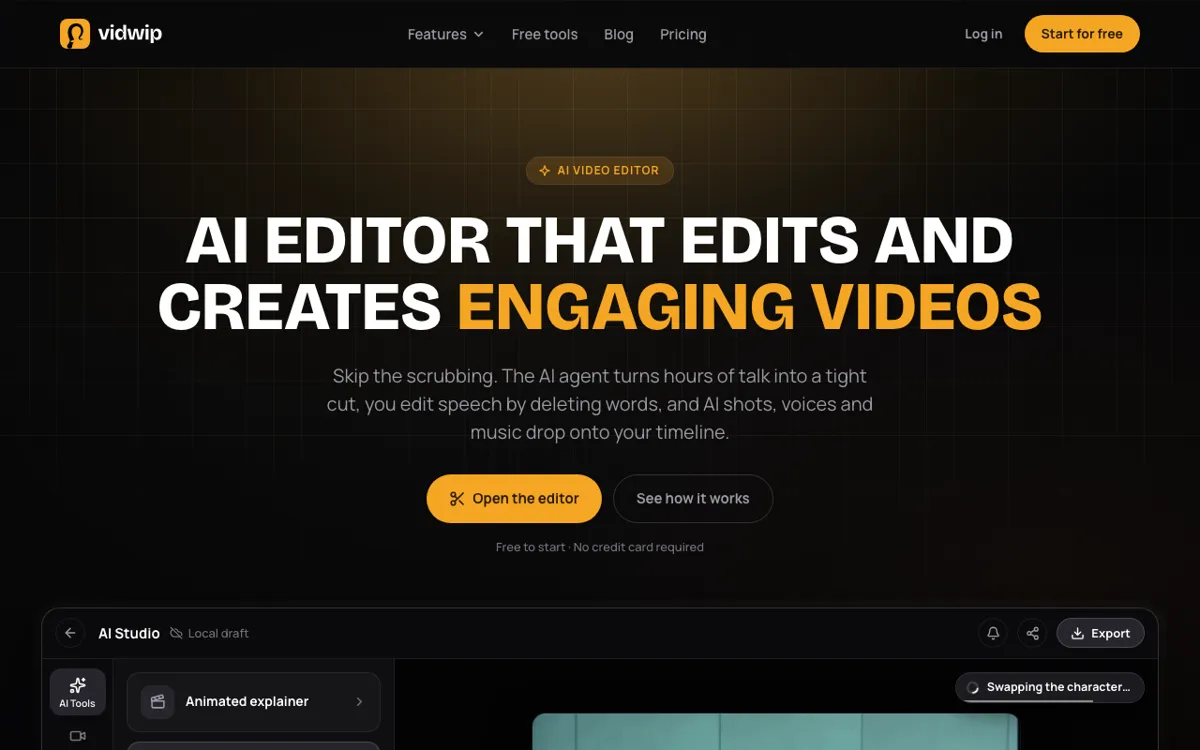 Vidwip AI Video Generator — 16 video models in one picker, including Veo 3.1 for shots with speech baked in.
Vidwip’s AI Video Generator takes a different path to a talking person on screen.
You don’t need a headshot. You describe the character, the setting and what they say — up to 1,500 characters — and Google’s Veo 3.1 generates the shot, the voice and the lip movement together in one pass. No audio track in. No face upload. The model makes all three.
The result sits on a timeline alongside 15 other video models. Veo 3.1, Kling 3.0, Seedance 2.5, Hailuo 3 and eleven more all live in the same picker, so one brief can spawn shots from multiple models for comparison.
Where it fits: short scenes, vertical ad hooks, story clips where the character needs to move through a space, not just face the camera. Where it doesn’t: a 10-minute presenter video from one headshot — that workflow belongs to photo-animation tools.
Edits export at up to 1080p. There’s no batch of variations per run.
Pros
- Veo 3.1 generates speech and lip-sync together — no voice track to source separately
- 16 video models and 9 image models in one tool, all drawing from the same credit balance
- Unlimited projects saved automatically (since October 2026)
- Free to start, no credit card, no watermark on any plan
Cons
- No photo-to-talking-head mode and no avatar library (a photo can start a shot, but it won’t read a script)
- Veo 3.1 makes 4 to 8 second shots — not suited for 10-minute lectures
- Output framing is scene-directed, not locked to a presenter-to-camera format
Best for: ad creatives, SaaS teams and story-format creators who want a talking character inside a moving scene, generated from a prompt.
Pricing: AI video needs a paid plan. Starter $25/month (2,500 credits). Pro $99/month (10,000 credits). Credits are shared across all tools. See vidwip.com/pricing.
2. HeyGen — best for photo-to-talking-head at scale
 HeyGen — Avatar IV animates a photo to a script, with videos up to 30 minutes on paid plans.
HeyGen is the most direct D-ID replacement for photo-animation work. Its Avatar IV model takes a single photo, a text script or an audio upload, and returns a talking video with matching lip movement. Paid plans include unlimited photo avatars, which is more flexible than D-ID’s per-plan limits.
The scale advantage over D-ID is the video length. D-ID’s Pro plan caps you at 15 minutes total per month. HeyGen’s Creator plan ($29/month) allows individual videos up to 30 minutes long. That’s long enough for a course module or a product walkthrough in a single generation.
HeyGen is also the broader platform. Voice cloning, a template library, PowerPoint import, a screen recorder and 175+ translation languages all live in the same account.
Pros
- Avatar IV is available on every plan, including the limited free tier
- Videos up to 30 minutes on Creator and Pro — no per-month minute cap
- 700+ avatars on paid plans, voice cloning and 1,000+ AI voices included
- Pro exports in 4K
Cons
- Credit-based pricing makes cost per minute harder to predict than D-ID’s minute plans
- Free plan caps at 3 videos a month, each up to 1 minute, and adds watermarks
- No streaming agent mode — HeyGen is a video studio, not a live-conversation tool
Best for: marketers, founders and educators who need a presenter from a photo, at longer lengths than D-ID’s Pro plan allows.
Pricing: Free (3 videos/month, 1 min max, watermarked). Creator $29/month (600 credits, up to 1080p, 30 min max). Pro $49/month (1,000 credits, 4K, 30 min max). Checked October 2026 on HeyGen’s pricing page. For more options, see our HeyGen alternatives guide.
3. Runway Characters — best for API-first developers
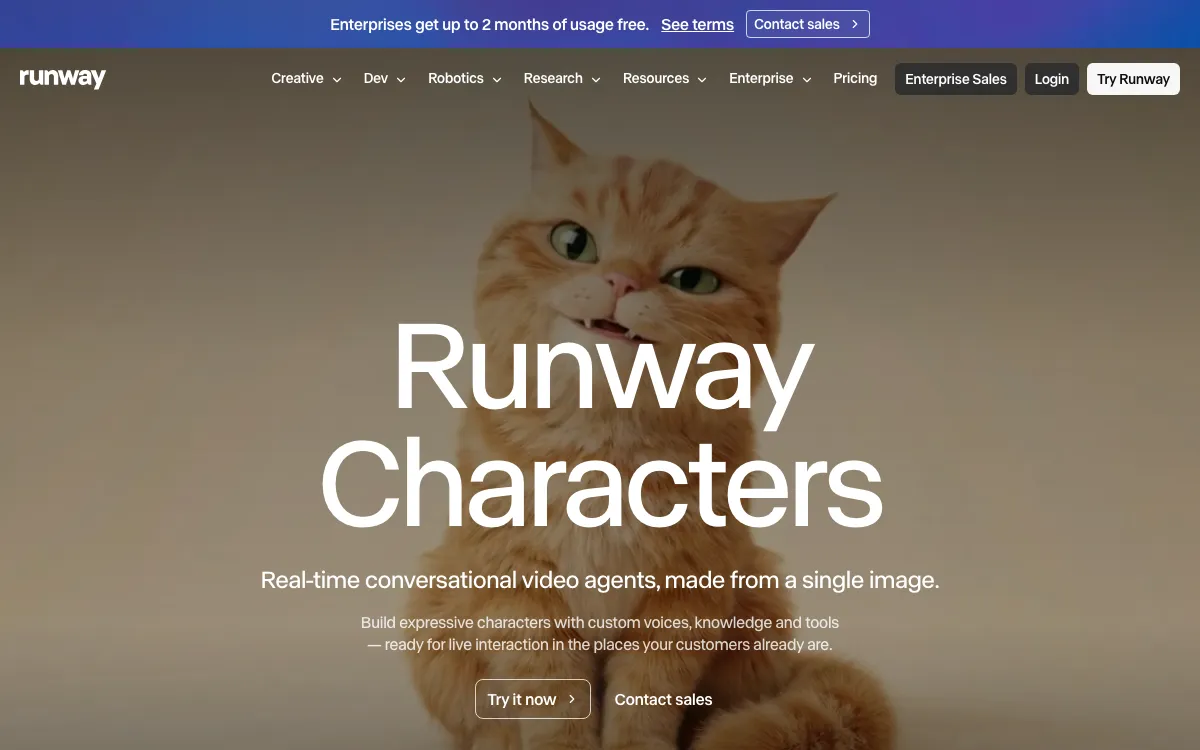 Runway Characters — live video agents and rendered avatar videos from one image, billed by the second through the Runway API.
Runway Characters turns a single reference image into a talking character, running on Runway’s GWM-1 model. It covers both of D-ID’s jobs through one API: live conversations over WebRTC, and rendered videos of the avatar speaking.
The billing is the most developer-friendly of the seven. You buy credits at $0.01 each in the developer portal and spend them as you go, with no monthly minute allowance to run out of.
A live session costs 2 credits upfront, then 2 credits per 6 seconds, which works out to about $0.20 a minute. A rendered video costs 1 credit per 3 seconds, the same rate, and a text script adds 1 credit per 50 characters for speech.
That’s well under the $1.06 a minute on D-ID’s Pro plan. The limit: credits and most of the tooling sit in Runway’s developer platform, so it suits teams who can write code.
Pros
- About $0.20 a minute, live or rendered, before speech generation for text scripts
- One image is enough, photoreal or animated, human or not
- Preset voices, or design a voice from a prompt or clone one from a sample
- Knowledge docs, tool calling, and webcam or screen vision in live sessions
- Embeds through a widget, the React SDK or LiveKit Agents, and joins Zoom, Meet and Teams
Cons
- Live sessions default to 5 minutes, and the API caps them at 30
- Uses Runway Dev credits, and Runway’s consumer pricing page doesn’t list Characters
- Runway doesn’t list supported languages on its product or pricing pages
- The lowest API usage tier caps spend at $100 a month
Best for: developers building live agents or video pipelines from one image, who want per-second pricing instead of a minute plan.
Pricing: API credits at $0.01 each. Live sessions: 2 credits upfront, then 2 credits per 6 seconds. Rendered avatar videos: 1 credit per 3 seconds. Text scripts add 1 credit per 50 characters, with a 2-credit minimum per video. Checked November 2026 on Runway’s API pricing page. For more options, see our Runway alternatives guide.
4. Synthesia — best for L&D and corporate video
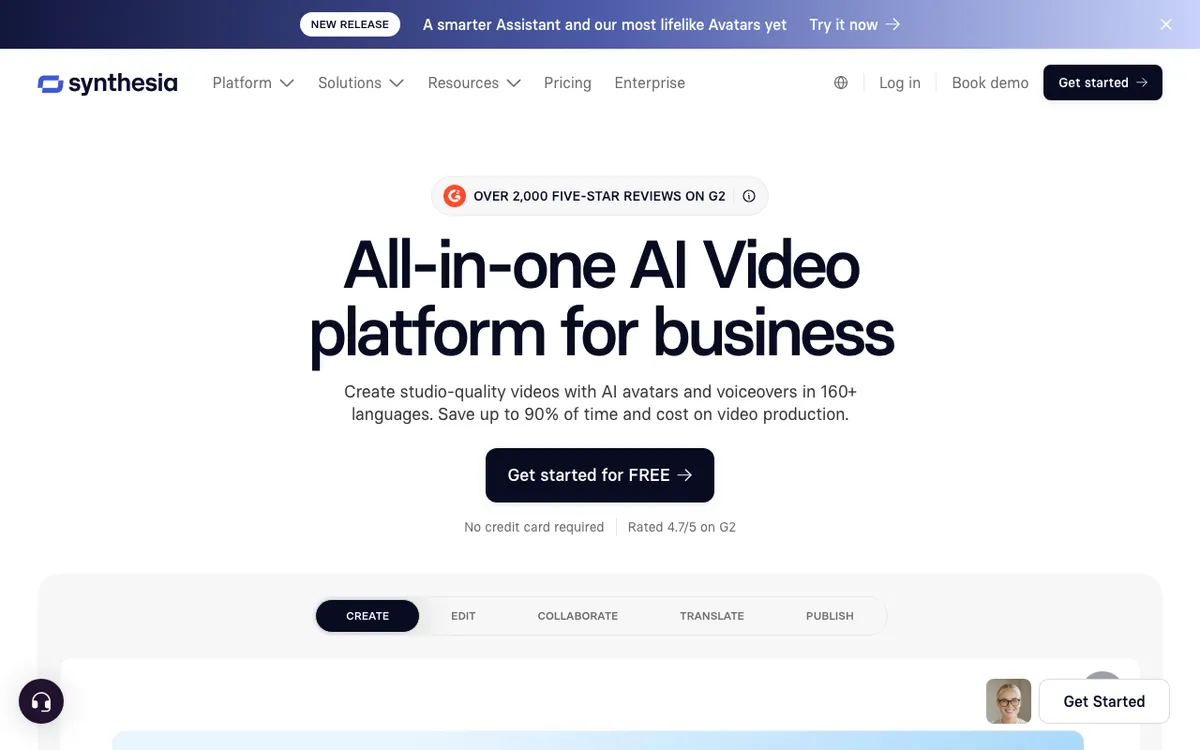 Synthesia — 180+ avatars, a course builder, and SCORM export for learning teams.
Synthesia is the default choice for L&D teams that need presenter-style video at volume. Its Basic plan gives 10 free minutes of video or dubbing, with 9 AI avatars and no credit card required. Starter at $29/month adds 125+ avatars and removes the watermark.
What sets Synthesia apart from D-ID: video length and the course builder. Individual videos can run much longer than D-ID’s per-request caps, and Enterprise adds SCORM export for uploading finished courses directly to an LMS. For a training team, that workflow matters more than per-minute pricing.
The avatar quality is strong but deliberately conservative — presenters are corporate-polished, not dramatically expressive. The dubbing feature translates existing videos to 100+ languages directly from the editor, which D-ID does not offer in the same integrated way.
Pros
- 10 free minutes on the Basic plan — the most generous free tier in this list
- Course builder and SCORM export (Enterprise) for L&D teams
- Built-in dubbing and translation in 100+ languages without leaving the editor
- 1,250 to 6,000 credits per month on Starter and Pro plans
Cons
- Avatars are polished and professional but not suited for expressive character work
- Starter plan limits personal avatars to 3; Pro allows 5
- Basic plan adds a Synthesia watermark to all exports
Best for: L&D teams and marketing departments producing presenter-style video at volume with translation baked in.
Pricing: Basic free (10 min video/dubbing, 9 avatars, watermarked). Starter $29/month (1,250 credits, 125+ avatars). Pro $89/month (6,000 credits, 180+ avatars). Checked October 2026 on Synthesia’s pricing page. For more options, see our Synthesia alternatives guide.
5. Tavus — best for streaming conversational agents
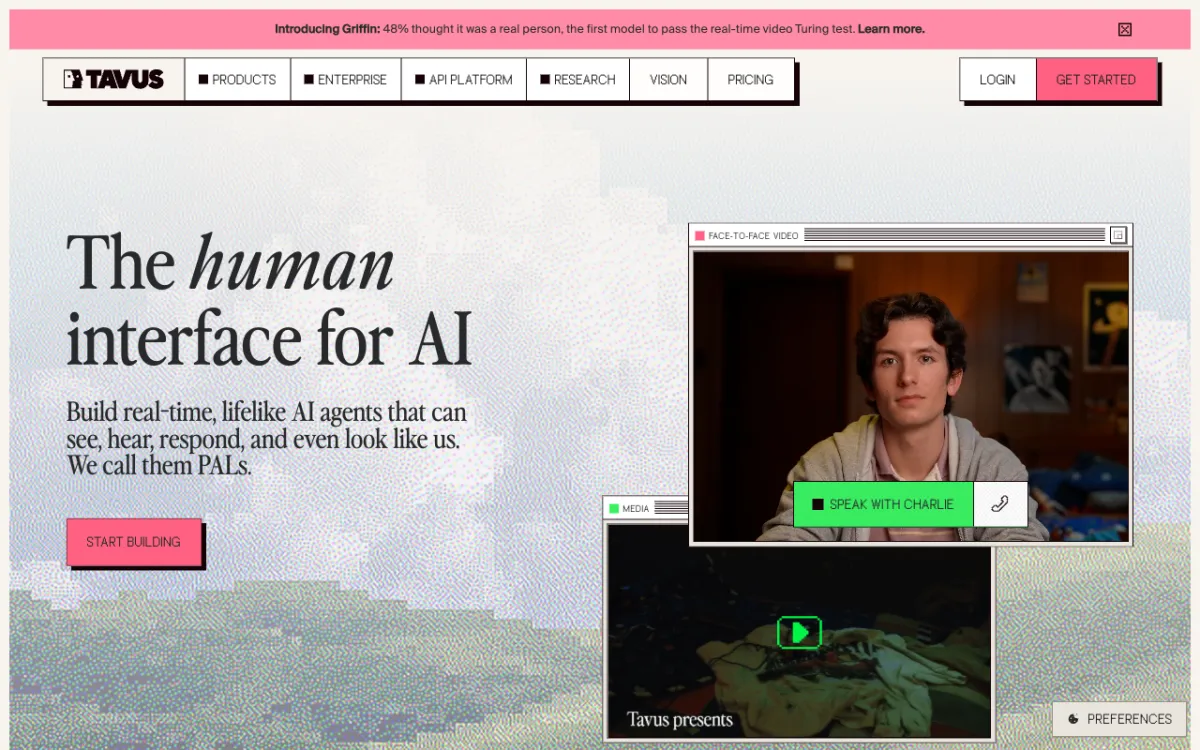 Tavus — a Conversational Video Interface (CVI) platform built for real-time streaming agents via WebRTC API.
Tavus is purpose-built for the streaming agent use case that D-ID’s Visual Agents also serve. Its Conversational Video Interface (CVI) delivers a real-time talking avatar over WebRTC — low latency, turn-taking, knowledge base and function calling included at the API level.
The developer tier is the product. Every plan from free upward gets API access. The free tier includes 20 included CVI minutes and one concurrent session — enough to build and test a prototype without a credit card.
Custom replicas (faces trained on a 2-minute recording) are available from the Starter plan upward. Tavus’s Phoenix-4.5 and Griffin models are the latest avatars. The platform supports 42+ languages for conversations.
Unlike D-ID’s Visual Agents, Tavus is not bundled with a video studio. It’s an inference and streaming API, not a content creation tool.
Pros
- API on every plan, including the free tier
- Real-time WebRTC sessions with turn-taking, memory and function calling
- Custom face replicas from a 2-minute video clip, from Starter upward
- Max 60-minute sessions on the paid developer tiers (Grid B)
Cons
- No video studio — Tavus is a streaming API, not a content creation tool
- Overage billing on Builder and Growth plans adds cost unpredictability
- Free tier caps concurrent sessions at 1, which limits realistic load testing
Best for: developers building customer-facing live agents, sales demo bots, virtual tutors or AI support interfaces.
Pricing: Free (20 CVI min included, 1 concurrent session). Starter $22/month (60 min CVI, 1 custom face). Builder $59/month + overage (175 min CVI, 3 custom faces). Growth $397/month + overage (1,300 min CVI, 7 custom faces). Checked October 2026 on Tavus’s pricing page.
6. DeepBrain AI (AI Studios) — best for high-volume avatar video
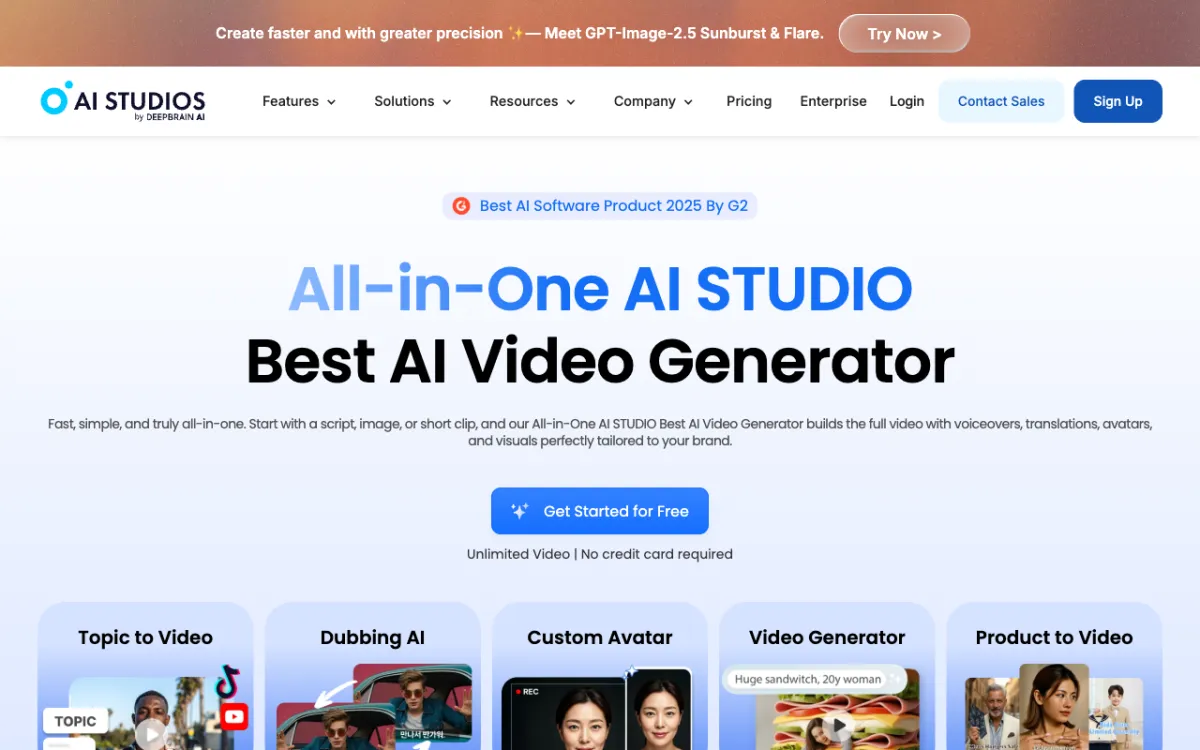 AI Studios (DeepBrain AI) — 2,000+ AI avatars, 150+ languages and a free tier with 3 videos.
DeepBrain AI operates under the AI Studios brand, and it spans both video creation and interactive agents in one account. The depth of avatars is the headline number: 2,000+ AI avatars across all plans, with 40+ stock options on the free tier and up to 155+ on Team and Enterprise.
The language coverage — 150+ for voiceovers and dubbing — is the widest in this list. For a team dubbing existing video into multiple markets, the AI dubbing feature handles the sync and translation without switching tools.
The pricing is also the most accessible entry point for a video creator. The Personal plan at $24/month delivers unlimited videos up to 30 minutes long, 3 custom avatars and 1080p export — more minutes per dollar than D-ID’s Pro plan for the same budget.
Interactive avatars run on a separate plan tier. The Standard plan at $99/month gives 100 credits, API access and sessions up to 20 concurrent users.
Pros
- Personal plan at $24/month gives unlimited videos up to 30 minutes — strong value vs D-ID’s 15 min/month
- 2,000+ AI avatars and 150+ languages on all plans
- AI dubbing feature handles translation and lip-sync inside the editor
- Free tier includes 3 videos (1 min each) and 720p export — no credit card required
Cons
- 4K export is Team ($55/seat/month) and above — Personal is capped at 1080p
- Interactive agent tier is a separate plan, not bundled with the video studio
- Watermark policy is not stated explicitly on the pricing page — verify before a campaign
Best for: teams creating avatar video at volume who need a low per-month price and wide language coverage.
Pricing: Free (3 videos, 1 min each, 720p). Personal $24/month (unlimited videos to 30 min, 1080p, 3 custom avatars). Team $55/seat/month (4K, up to 60 min per video). Interactive Avatar Standard $99/month (100 credits, API, up to 20 concurrent users). Checked October 2026 on AI Studios’s pricing page.
7. Captions — best for phone-first creators
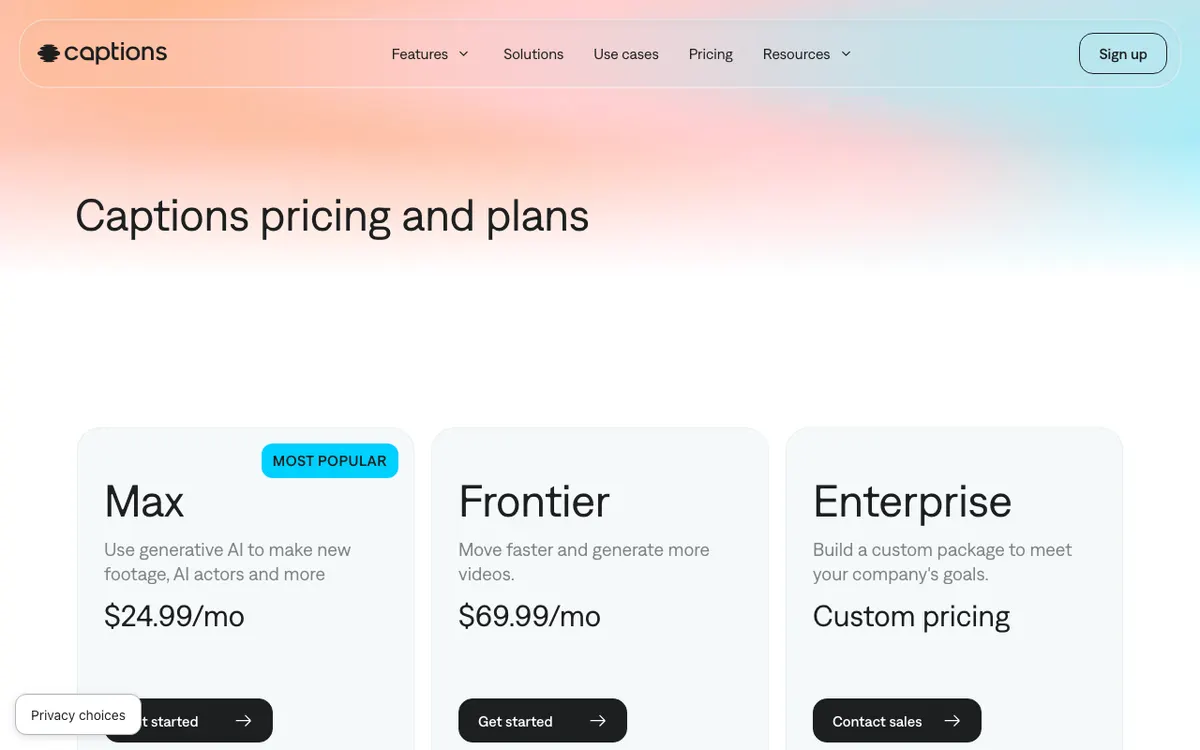 Captions — avatars, AI Twin and Lipdub in one mobile creator app, powered by Mirage Avatar X.
Captions (built by the company that rebranded as Mirage in late 2025) is a creator app for iOS, Android and web. It has grown beyond its auto-captioning origins to include AI avatars powered by the Mirage Avatar X model, an AI Twin feature that makes a digital version of you, and Lipdub, which translates a video with re-synced lips.
The workflow is phone-native. Pick an avatar, write a script, get a vertical video ready for Reels or TikTok in minutes. AI Twin lets creators publish in a language they don’t speak, using a face-matched digital clone.
Captions does not offer an API or a web studio first. If your output format is a 16:9 explainer video or a presenter slide deck, other tools in this list are better suited.
Pros
- AI Twin and Lipdub cover the “me, in another language” use case directly
- Avatars, editing, captions in 100+ languages and clipping in one app — no tool switching
- Built for vertical social video, the dominant format for short-form content in 2026
- Mirage reports 20M creators using the app
Cons
- No API and no web-first desktop studio — Captions is a phone app
- Free plan includes no AI usage credits; avatars and AI Twin require a paid plan
- Pricing shown is for iOS; web and Android pricing differs — verify before subscribing
Best for: solo creators who want a talking avatar and the edit done on a phone, optimised for social formats.
Pricing: Max $24.99/month (500 credits). Frontier $69.99/month (1,400 credits). Enterprise custom. Prices shown are iOS plans. Checked October 2026 on Captions’s pricing page.
D-ID alternatives: comparison table
| Tool | Photo animation | Streaming agents | API | Languages | Free tier | Starting price |
|---|---|---|---|---|---|---|
| Vidwip | No (prompt-gen) | No | No | N/A | Paid plans only | $25/mo |
| HeyGen | Yes (Avatar IV) | No | Yes | 175+ | 3 videos/mo | $29/month |
| Runway Characters | Yes (one image) | Yes | Yes | Not listed | Not listed | About $0.20/min |
| Synthesia | Yes | No | Yes | 100+ | 10 min/mo | $29/month |
| Tavus | No (replica) | Yes | Yes | 42+ | 20 CVI min | $22/month |
| DeepBrain AI | Yes | Yes (separate plan) | Yes | 150+ | 3 videos | $24/month |
| Captions | Yes (AI Twin) | No | No | 100+ | No credits | $24.99/month |
Which D-ID alternative should you pick?
You need a photo animator, similar to D-ID: HeyGen Avatar IV is the closest match in output quality and workflow. Synthesia fits if you also need course tools or SCORM export.
You want more video per dollar: DeepBrain AI’s Personal plan at $24/month gives unlimited videos up to 30 minutes. D-ID’s Pro plan at $16/month gives you 15 minutes total. For a content team, that math is straightforward.
You’re building a live agent: Tavus’s CVI is the purpose-built streaming API. DeepBrain AI’s Interactive Avatar Standard plan at $99/month is the alternative with a fully managed LLM and TTS included.
You’re a developer who wants API-first, pay-as-you-go: Runway Characters makes a live agent or a rendered video from one image, at about $0.20 a minute. Buy credits and pay for what you run.
You want to generate a shot where a character speaks — without uploading a face: Vidwip with Veo 3.1. The model makes the shot, voice and lip movement together from your description, without any source material. See our guide to AI video tools compared for the wider category.
You make vertical video on a phone: Captions, specifically for AI Twin and Lipdub in a mobile-first edit flow.
Final verdict
D-ID pioneered the talking-photo workflow and its pricing transparency — minutes, not credits — is still the clearest in this list. But at 15 minutes per month on Pro, it runs out quickly for a production team.
HeyGen closes the biggest gap: Avatar IV at the same quality level, 30-minute video ceilings, and 600+ credits a month for $29. That’s the upgrade path for most D-ID users.
Tavus is the streaming agent pick if you want to test first: its free tier lets you try the API before paying.
Vidwip earns a place here not as a photo animator — it isn’t one — but as the answer to a question D-ID can’t answer: what if you want a character speaking inside a scene you generated, without any source footage? Pick a plan and build the shot from a prompt.