
Hailuo 3 (MiniMax H3) is one of the strongest and cheapest 2K video models of 2026: 4 to 15 second clips with native stereo sound, up to 9 images, 3 videos and 3 audio clips as references, and editing, for $0.13 a second on MiniMax's API. The catches: only the 768p base model is open, its license excludes the US, EU, UK and South Korea, and Wan 3.0 and Seedance 2.5 now edge it on Artificial Analysis leaderboards.
This Hailuo 3 review answers one question: is MiniMax’s newest video model worth your money three months after launch? We read every spec, price and license clause on MiniMax’s own pages and priced it on five platforms on November 2, 2026.
We didn’t run our own generations for this review. Every claim below links to the vendor page or independent leaderboard it came from.
It’s for creators, ad teams and developers picking a video model. If you already know you want something else, our Hailuo AI alternatives list ranks seven rivals.
TL;DR: Hailuo 3 review verdict
Hailuo 3 (MiniMax H3) is a strong, low-cost 2K video model with sound. It makes 4- to 15-second clips with native stereo audio, takes up to 9 images, 3 videos and 3 audio clips as references, and costs $0.13 a second at 2K on MiniMax’s API.
| Category | Verdict | Why |
|---|---|---|
| Output | Strong | 2K at 24 fps, stereo sound, six aspect ratios |
| References and editing | Strong | 9 images, 3 videos, 3 audio clips, 12 files per request |
| Price | Strong | $0.13 a second at 2K, $0.08 at 768p on the API |
| Leaderboard standing | Good, slipping | 3rd in text to video, 4th in image to video, 5th in editing on Artificial Analysis |
| Open weights | Mixed | 768p base only; US, EU, UK and South Korea excluded |
| Clip length | Average | 15 seconds per generation, half of Seedance 2.5 and Wan 3.0 |
Use it for ads, product shots and branded clips where you need 2K, sound and tight control from references. Skip it if you need takes longer than 15 seconds, or want to self-host in the US or EU without applying to MiniMax.
What is Hailuo 3?
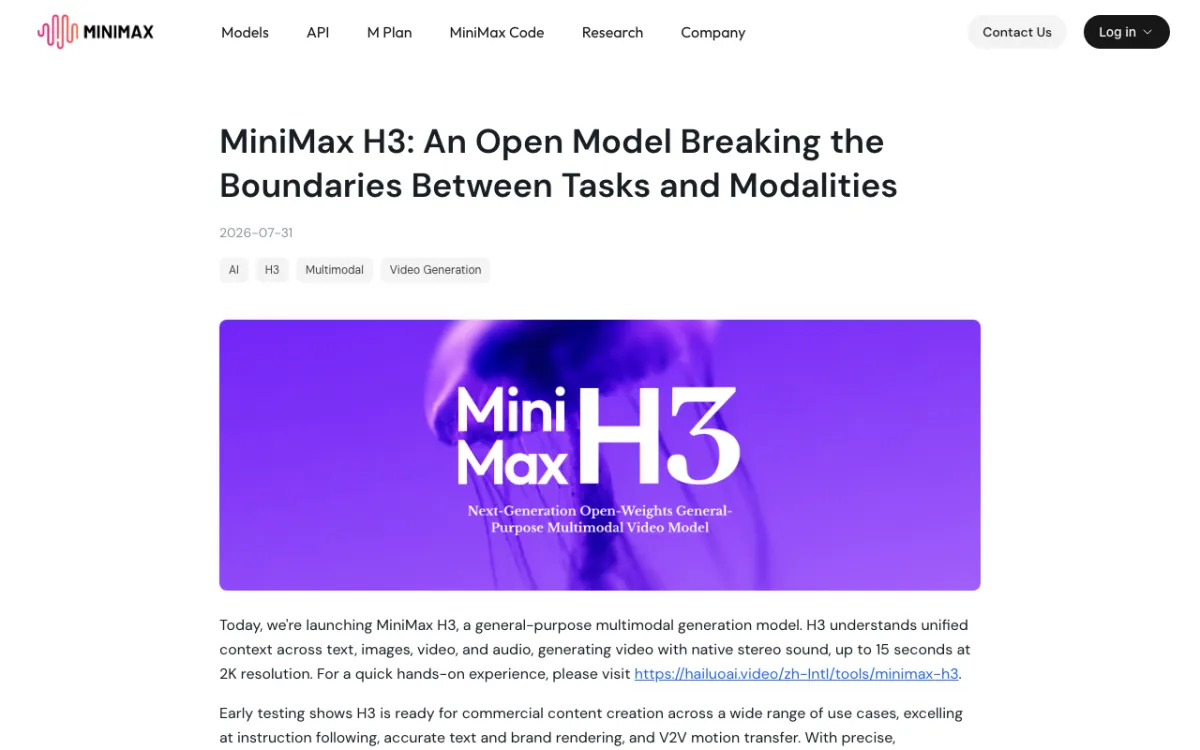 MiniMax’s H3 announcement, July 31, 2026
Hailuo 3 is MiniMax’s third-generation AI video model, sold as MiniMax H3 on the API and Hailuo 3.0 in the Hailuo app. MiniMax announced it on July 31, 2026 as “a general-purpose multimodal generation model” that reads text, images, video and audio together.
It follows Hailuo 01 and Hailuo 02. Instead of one tool per task, MiniMax pretrained H3 on generation, reference and editing tasks across image, video and audio, so one model covers all three.
MiniMax aims it at advertising, branding, e-commerce, product design, UI/UX and gaming. It says early testing shows strength in instruction following, accurate text and brand rendering, and video-to-video motion transfer.
H3 now comes in tiers. MiniMax’s API lists three flagship versions (H3, H3-Highspeed and H3-Lite) plus an extended model, H3 Max.
Hailuo 3 specs at a glance
These are H3’s limits on MiniMax’s own pages, checked November 2, 2026. Third-party platforms can set narrower ones.
| Spec | MiniMax H3 | Source |
|---|---|---|
| Clip length | 4 to 15 seconds, whole seconds only | MiniMax API docs |
| Resolution | 768p or 2K | MiniMax API docs |
| Frame rate | 24 fps | Hugging Face model card |
| Audio | Native stereo, 32 kHz | Model card |
| Aspect ratios | 21:9, 16:9, 4:3, 1:1, 3:4, 9:16 | Model card |
| Modes | Text to video, first and/or last frame, references | MiniMax API docs |
| References | Up to 9 images, 3 videos, 3 audio clips; 12 files max | MiniMax API docs |
| Reference clips | 2 to 15 seconds each, 15 seconds total per type | MiniMax API docs |
| File limits | Video 50 MB, image 30 MB, audio 15 MB | MiniMax API docs |
| Dialogue | Stable in 11 languages | Model card |
| Size | 33B parameters | Model card |
The 11 languages are Arabic, Chinese, English, French, German, Italian, Japanese, Korean, Portuguese, Russian and Spanish. Support for other languages varies, according to the model card.
Hailuo 3 pricing: what a second of 2K costs
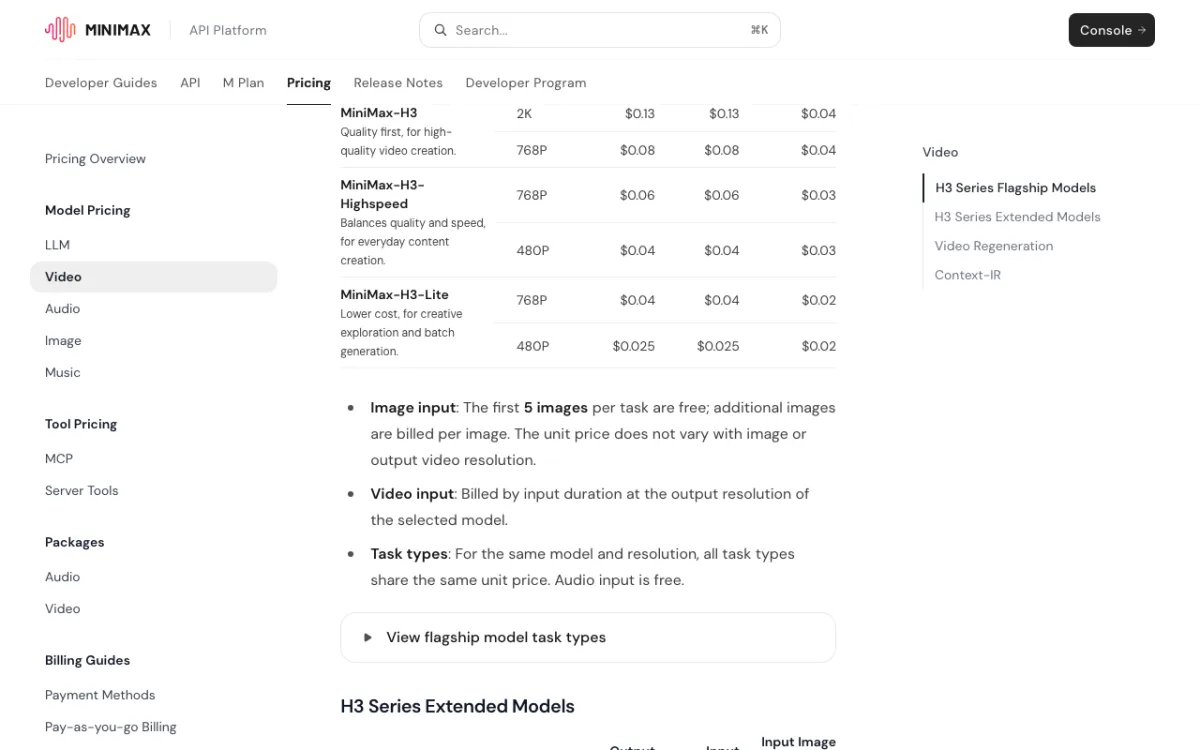 MiniMax’s API price list for the H3 series, checked November 2, 2026
Hailuo 3 is billed per second of output video. Here’s every H3 tier on MiniMax’s API pricing page, checked November 2, 2026:
| Model | Resolution | Per second | 10-second clip |
|---|---|---|---|
| MiniMax-H3 | 2K | $0.13 | $1.30 |
| MiniMax-H3 | 768p | $0.08 | $0.80 |
| MiniMax-H3-Highspeed | 768p | $0.06 | $0.60 |
| MiniMax-H3-Highspeed | 480p | $0.04 | $0.40 |
| MiniMax-H3-Lite | 768p | $0.04 | $0.40 |
| MiniMax-H3-Lite | 480p | $0.025 | $0.25 |
| MiniMax-H3-Max | 768p | $0.08 | $0.80 |
| MiniMax-H3-Max | 480p | $0.05 | $0.50 |
Reference inputs can cost extra. On H3 the first 5 images per task are free, then $0.04 each, and reference video bills per second at the output rate.
Audio references are free on every tier.
A maximum-length 15-second 2K clip costs $1.95. MiniMax claims its 2K price per second is “less than a third” of mainstream models, but doesn’t name the models.
The cheaper route to 2K
MiniMax also sells MiniMax-H3-Regeneration, which turns a 768p H3 video into 2K for $0.05 a second. Drafting at 768p and regenerating the keeper costs $0.13 a second, the same as rendering 2K directly.
The saving is in the takes you throw away. With a text-only prompt, three 10-second drafts at 768p ($2.40) plus one regeneration ($0.50) come to $2.90, against $3.90 for three straight 2K takes.
The Hailuo app nudges you the same way: “Generate in 768P first, then upscale the result to 2K.”
Hailuo app plans
In the Hailuo app, H3 runs on monthly credit plans. Hailuo’s subscribe page advertises 2K “from $0.081/sec” and 768p “from $0.047/sec”, which are its larger yearly plans.
The full plan prices didn’t load for us signed out, so confirm yours at checkout. MiniMax also lists its prompt-rewriting module, H3-Context-IR, as its own API line at $0.90 per million input tokens and $3.60 per million output tokens.
Hailuo 3 key features
Native stereo sound
H3 makes the sound in the same pass as the picture. MiniMax calls it “native stereo sound”, and fal’s H3 page lists score, dialogue, foley and ambience.
It can also take a voice from a reference recording and give it to a character, according to fal. Stable dialogue covers the 11 languages above.
References: images, video and audio together
This is H3’s headline feature. One request can carry up to 9 images, 3 video clips and 3 audio clips, capped at 12 files, plus a prompt of up to 7,000 characters.
MiniMax’s own example mixes all three. It asks for the camera move from a reference video, the character from a reference image, and singing that matches a reference audio clip.
Audio can’t go in alone; it needs at least one image or video beside it. On the API, first-and-last-frame mode takes 0, 1 or 2 images instead of references.
Editing, motion transfer and extend
H3 edits video you already have. fal lists swapping products, rewriting signage, replacing a line of dialogue, relighting a scene, and adding or removing objects.
Motion transfer maps the movement in one clip onto new subjects, which MiniMax names among H3’s early strengths. The Hailuo app adds an Extend tool that continues an uploaded video or audio clip.
2K by regeneration, not upscaling
H3 doesn’t bolt a super-resolution network onto the end. MiniMax says the model regenerates its own low-resolution output in context to reach 2K.
On fal, 2K means 1440 pixels on the short edge from 16:9 to 9:16, and 2976 × 1248 at 21:9. MiniMax’s stated limit is honest: “Visual detail can still be improved in certain scenarios.”
Hailuo 3 vs Hailuo 3 Max
Hailuo 3 Max is a speed-tuned version of H3 that fal, not MiniMax, post-trained. fal says it built H3 Max “on top of the open-weight base MiniMax H3 model”, and MiniMax now sells it in the Hailuo app and on its API.
| Hailuo 3 (H3) | Hailuo 3 Max (H3 Max) | |
|---|---|---|
| Built by | MiniMax | fal, on H3’s open weights |
| Resolution | 768p or 2K | 480p or 768p (1080p on fal) |
| Clip length | 4 to 15 s on the API | 5 to 15 s on fal and in the Hailuo app |
| Sound | Native stereo | Native audio, per fal |
| References | 9 images, 3 videos, 3 audio clips | Image, video and audio on MiniMax’s API; text and start/end frames only in the Hailuo app |
| Speed | Not published | 5-second 768p clip in 2.46 s on fal |
| API price | $0.13/s at 2K, $0.08/s at 768p | $0.08/s at 768p, $0.05/s at 480p |
| Artificial Analysis, text to video | 3rd (Elo 1161) | 7th (Elo 1149) |
| In Vidwip | 2K with sound | 768p, silent |
At 768p the two cost the same on MiniMax’s API, so H3 Max earns its place on speed alone. If you want cheap 768p drafts rather than fast ones, H3-Highspeed ($0.06) and H3-Lite ($0.04) undercut it.
Open weights: what you can actually download
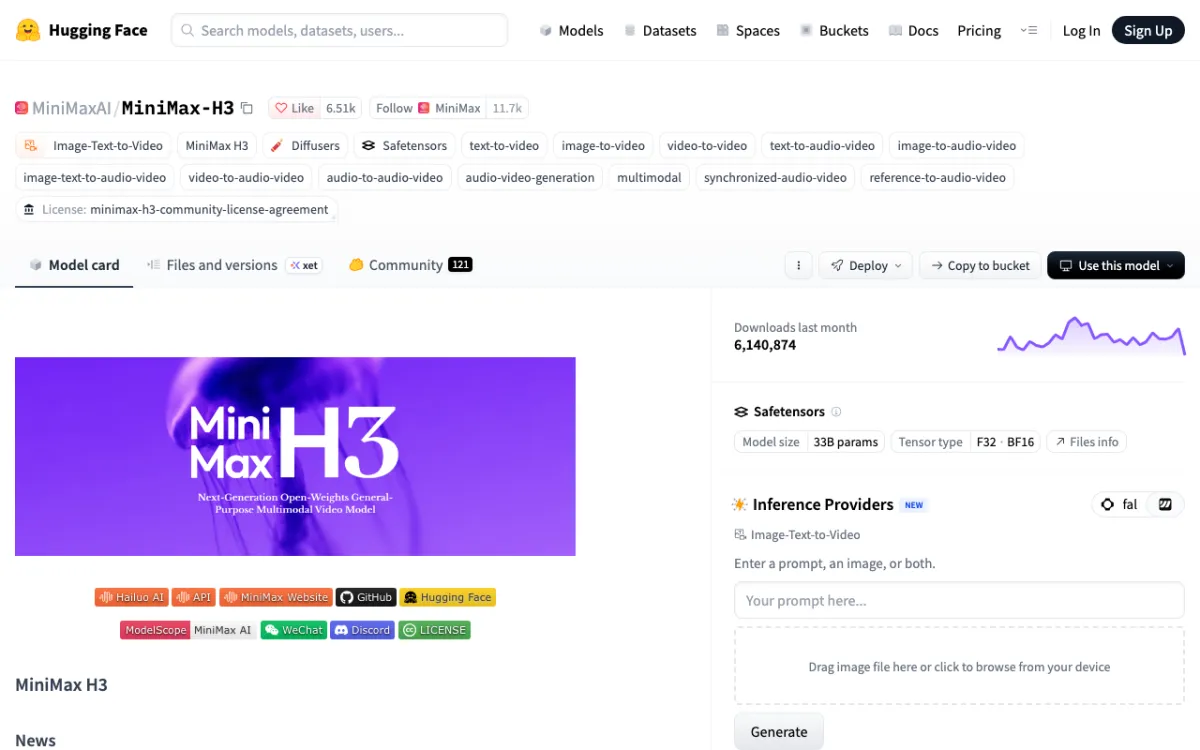 The MiniMax-H3 model card on Hugging Face, checked November 2, 2026
MiniMax promised the weights “in the coming days, subject to applicable laws and regulations.” They reached Hugging Face as MiniMaxAI/MiniMax-H3 on August 3, 2026, RITS reported.
What’s open is the base model. The model card ships two H3-Base checkpoints: FL2VA for text and first/last-frame video, and Ref2VA for references.
What isn’t open matters more:
- H3-Regenerate-2K: “not yet open-sourced”, so self-hosted H3 renders at 768p
- H3-Context-IR: the module that interprets your inputs and rewrites the prompt is API only
- Sparse attention: promised in a future update
The card listed 6,140,874 downloads in the past month when we checked on November 2.
The license fine print
The weights ship under the MiniMax H3 Community License, not an open-source license. Four clauses stand out:
- Excluded territories: the European Union, the United Kingdom, the Republic of Korea and the United States. Users there must apply to MiniMax.
- Revenue cap: products earning more than $20 million a year need separate written authorization.
- Attribution: commercial products must “prominently display” MiniMax H3 in their interface.
- No training on outputs: you may not use H3 or its outputs “to improve any other artificial intelligence model.”
MiniMax “claims no rights over the Outputs you generate.” The Batch called H3 a top video model that is “only minimally open.”
The license governs the weights. Hosted services such as MiniMax’s API, fal, Luma and Vidwip run under their own terms.
How Hailuo 3 ranks against other video models
Artificial Analysis ranks video models from blind human votes. Here’s where H3 stood on November 2, 2026; its main entry is H3 at 768p.
| Model | Text to video | Image to video | Video editing |
|---|---|---|---|
| MiniMax H3 (768p) | 3rd (1161) | 4th (1128) | 5th (1123) |
| MiniMax H3 Max | 7th (1149) | 8th (1117) | Not in top 10 |
| Wan 3.0 | 1st (1175) | 9th (1111) | 1st (1196) |
| Dreamina Seedance 2.5 | 4th (1157) | 1st (1153) | 2nd to 4th (1152) |
| Gemini Omni Flash 1.1 | 10th (1128) | Not in top 10 | 2nd to 4th (1149) |
Elo scores in parentheses, from the text to video, image to video and video editing leaderboards. Artificial Analysis treats models with overlapping confidence intervals as tied.
The trend is the story. In mid-August The Batch reported H3 first on Artificial Analysis’ video editing leaderboard; by November 2 it was fifth, 73 points behind Wan 3.0.
Hailuo 3 pros
- 2K with sound in one pass. Stereo dialogue, music and effects come with the picture, at $0.13 a second.
- Mixed references in one request. 9 images, 3 videos and 3 audio clips, so a product, a camera move and a voice can all be pinned at once.
- Generation, editing and motion transfer in one model. No switching tools to fix a take.
- Four H3 models on one API. From $0.025 a second on H3-Lite at 480p to $0.13 on H3 at 2K.
- Open base weights. Fine-tune or self-host the 768p model, with Diffusers listed on the model card and day-0 ComfyUI support.
- Easy to reach. MiniMax’s API, the Hailuo app, fal, Luma and Vidwip all carry it.
Hailuo 3 cons
- 15 seconds is the ceiling. Seedance 2.5 and Wan 3.0 run single takes up to 30 seconds.
- The open part stops at 768p. The 2K stage and prompt module stay closed.
- A restrictive license. Four major markets excluded, a $20 million revenue cap and mandatory attribution.
- Slipping on leaderboards. From first in editing in August to fifth by November.
- Confusing line-up. H3, Hailuo 3.0, H3-Highspeed, H3-Lite and H3 Max, and the Max version was post-trained by fal, not MiniMax.
- H3 Max is limited in the Hailuo app. It takes text or start and end frames there, not reference video.
Hailuo 3 vs alternatives
Hailuo 3 sits in a tight top group, so the deciding factor is your shot, not the leaderboard. Pick by job:
- Long takes: Seedance 2.5 or Wan 3.0, both up to 30 seconds
- Image to video: Seedance 2.5, first on Artificial Analysis
- Editing existing footage: Wan 3.0, first on the editing board
- 2K with sound and heavy references: Hailuo 3
For a ranked list with prices, see our Hailuo AI alternatives. Our Seedance alternatives and best text-to-video AI guides cover the same field from other angles.
Where to run Hailuo 3
You don’t need the Hailuo app to use H3. Here’s what it costs on five platforms, all checked November 2, 2026:
| Where | Hailuo 3 (H3) | Hailuo 3 Max | Notes |
|---|---|---|---|
| MiniMax API | $0.13/s at 2K, $0.08/s at 768p | $0.08/s at 768p, $0.05/s at 480p | Pay as you go, every tier |
| Hailuo app | From $0.081/s at 2K, $0.047/s at 768p | 480p to 768p | Credit plans; advertised “from” rates |
| Luma | 28 credits/s at 768p, 46 at 2K | 18, 28 or 56 credits/s at 480p, 768p, 1080p | Plus is $30/month for 10,000 credits, so H3 is ~$0.08 and ~$0.14 a second |
| fal | Pay per use | $0.05, $0.08 or $0.16/s at 480p, 768p, 1080p | 5 free H3 Max generations a day signed in |
| Vidwip | 35 credits/s, 2K with sound | 23 credits/s, 768p silent | 1 credit = $0.01; 16 models on one balance |
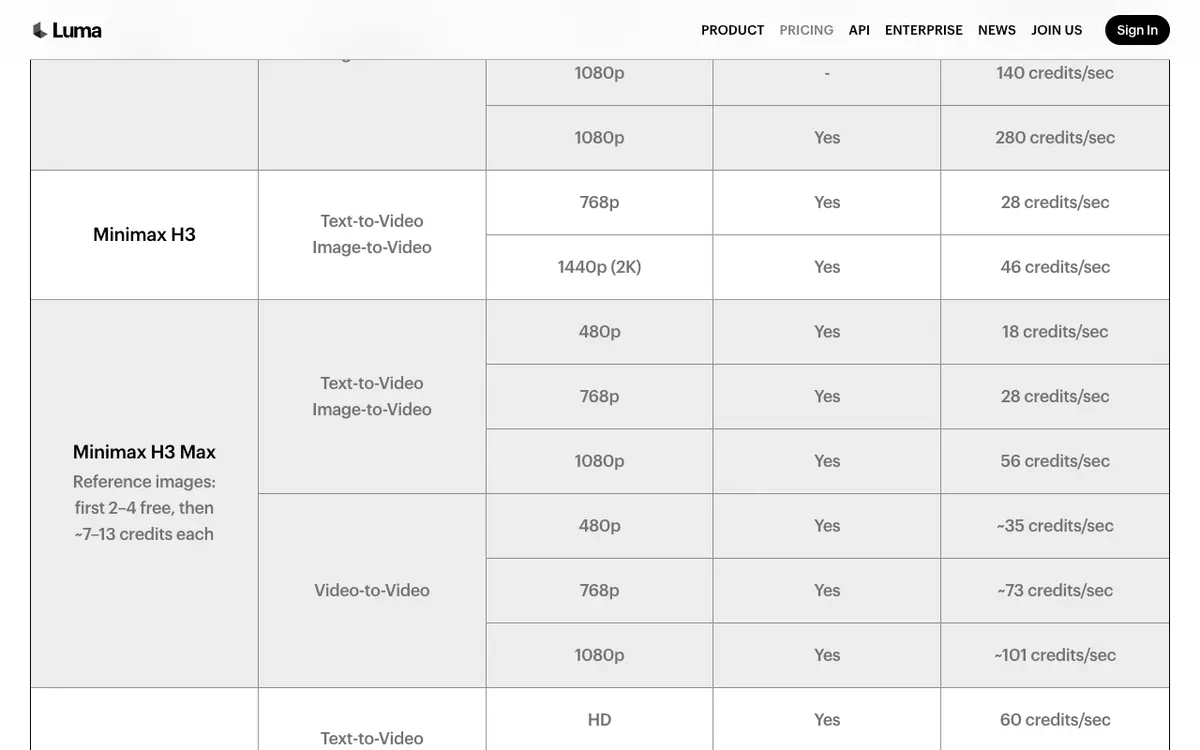 Luma’s per-second price list for MiniMax H3 and H3 Max, rates rechecked November 2, 2026
Hailuo 3 in Vidwip
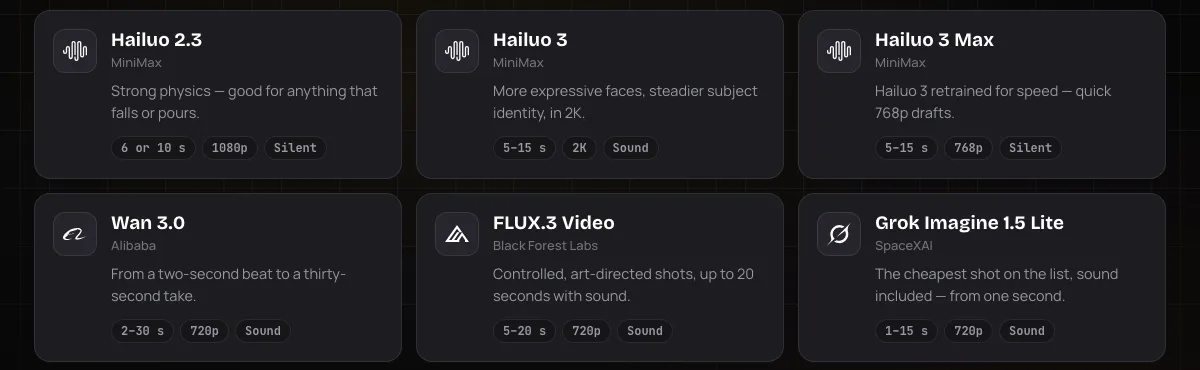 Hailuo 3 and Hailuo 3 Max on Vidwip’s models page
Vidwip AI Video Generator runs Hailuo 3 and Hailuo 3 Max in one picker with 14 other models, including Veo 3.1, Kling 3.0 Pro and Seedance 2.5. Hailuo 3 makes 5- to 15-second shots in 2K with sound, and Hailuo 3 Max makes silent 768p drafts.
It costs more per second than MiniMax’s API: about $0.35 a second for Hailuo 3. What you get for that is one balance across 16 models, so you can run the same prompt on Hailuo 3 and Seedance 2.5 and keep the better take.
Every shot lands on the AI Studio timeline, where you add voices, music and captions. Edits export at up to 1080p with no watermark, so a 2K shot is scaled down in a finished edit.
Vidwip’s character swap uses MiniMax H3 too, building a character from up to nine photos. AI video and character swaps need a paid plan, and plans start at $25 a month on the pricing page.
Who should use Hailuo 3?
- Ad and e-commerce teams: yes. MiniMax’s claimed text and brand rendering, plus 9 reference images, help keep a product consistent from shot to shot.
- Developers: yes. Four H3 models on one API let you draft on H3-Lite and finish on H3.
- Researchers outside the excluded territories: yes. The 768p base weights are yours to fine-tune.
- US, EU, UK and Korean teams who want to self-host: not without applying to MiniMax first.
- Anyone needing 30-second takes: no. Look at Seedance 2.5 or Wan 3.0.
- Fast drafting: use H3 Max for speed or H3-Lite for price, then finish on H3.
Conclusion: is Hailuo 3 worth it?
Yes, if your shots fit in 15 seconds. Hailuo 3 gives you 2K, stereo sound, deep references and editing for $0.13 a second, which is hard to beat in November 2026.
Just know what you’re buying. The open weights stop at 768p, the license shuts out four big markets, and Wan 3.0 and Seedance 2.5 have caught up on the leaderboards.
The cheapest way to judge it is to run your hardest shot on Hailuo 3 and a rival with the same prompt. Start at app.vidwip.com, on a plan from $25 a month, and compare Hailuo 3 against Seedance 2.5, Veo 3.1 or Kling 3.0 Pro on one timeline.