
Kling 4.0 and Wan 3.0 match Seedance 2.5's 30-second single take; Kling 4.0 adds 10 keyframes and 4K, Wan 3.0 costs about $0.05 a second. Veo 3.1 wins on dialogue but stops at 8 seconds. Vidwip AI Video Generator runs Seedance 2.5, 2.0 and 2.0 Fast beside Veo 3.1, Kling 3.0 Pro and Wan 3.0 on one credit balance.
Seedance 2.5 changed what one prompt can hold: a 30-second take with sound, steered by image, video and audio references. The Seedance alternatives below match it on take length, beat it on keyframes or resolution, or cost less per second.
Only two models here match that 30-second ceiling. Kling 4.0 and Wan 3.0 both reach it, and the rest stop between 8 and 15 seconds.
So the question isn’t which model is best. It’s which one your shot needs: a long take, a cut-together sequence, or a subject that has to look the same in every shot.
This post compares seven Seedance alternatives on shot length, reference inputs and cost per second. Every price was checked on the vendor’s own page on October 18, 2026.
Sora isn’t on the list. OpenAI closed the Sora app on April 26, 2026 and ended its API on September 24, 2026 (Engadget).
Quick picks: the best Seedance alternatives at a glance
- Vidwip AI Video Generator: Seedance 2.5, 2.0 and 2.0 Fast beside Veo 3.1, Kling 3.0 Pro and Wan 3.0 on one credit balance, with every shot on a timeline.
- Kling 4.0: 30-second takes, up to 10 keyframes and up to 4K, from $10 a month at list price.
- Google Veo 3.1: the dialogue pick, free to try with 50 daily Google Flow credits.
- Hailuo 3: 2K close-ups with up to 12 reference images, about $0.14 a second on Luma.
- Wan 3.0: 30-second takes for about $0.05 a second on Wan’s yearly Pro plan.
- Luma Ray3.2: cheap silent 10-second drafts with an Extend tool, about $0.06 a second.
- Runway Gen-4.5: short, polished 2- to 10-second shots, with Seedance 2.5 on the Pro plan too.
What Seedance 2.5 sets as the bar
Seedance 2.5 is ByteDance’s newest video model. ByteDance says it makes videos “up to 30 seconds in a single generation, with the option to extend twice.”
Through its API it accepts up to 30 reference images, 10 reference videos and 10 reference audio clips. That’s how you hold a character, product or voice steady across a sequence.
It isn’t cheap at full resolution. Luma charges 78 credits a second at 720p, about $0.23 on the $30 Plus plan, and 191 at 1080p, about $0.57.
Four questions separate the alternatives:
How long is one take? Seedance 2.5 runs 4 to 30 seconds. Anything shorter means more cuts, or an extend step.
How do you build a sequence? Some tools extend one clip, some pin keyframes along it, and some put shots on a timeline you cut yourself.
What can you reference? Images, videos, a voice, or only a first and last frame. This decides whether your subject survives the cut.
What does a second cost? Every rate below is converted to dollars per second at the plan’s own monthly price.
1. Vidwip AI Video Generator
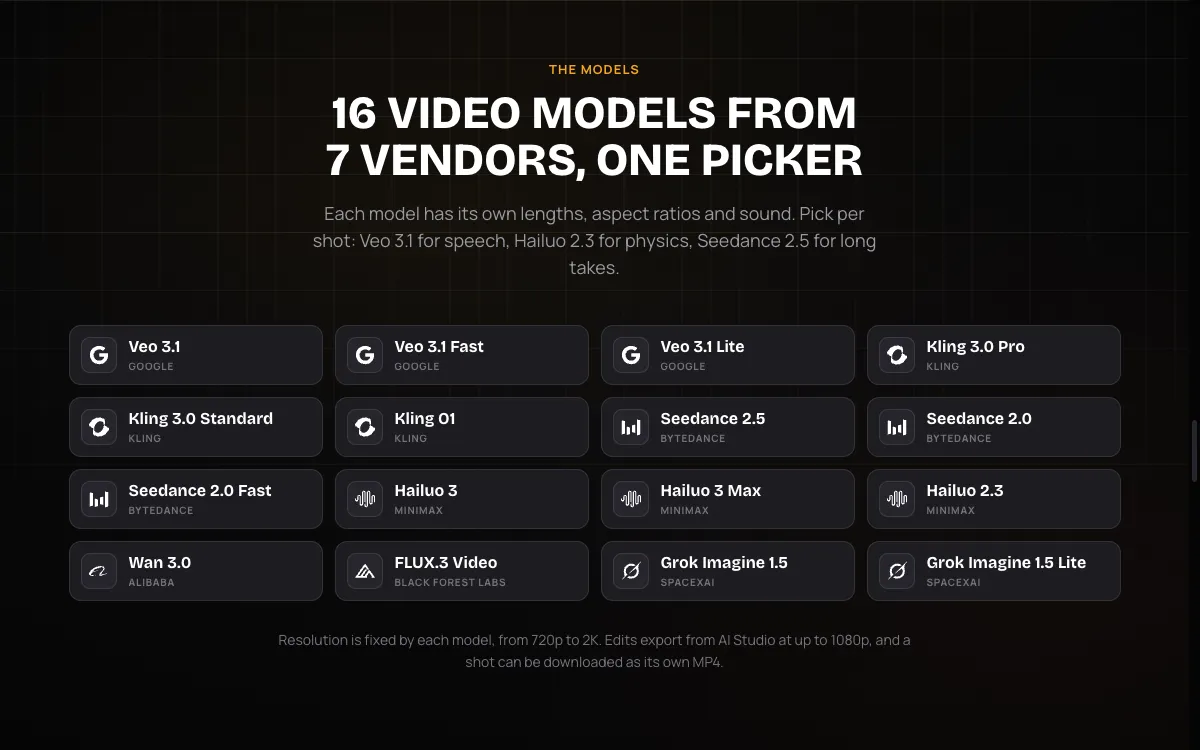 Vidwip AI Video Generator: 16 video models from 7 vendors, three Seedance tiers among them.
Vidwip AI Video Generator is a multi-model AI video generator that keeps Seedance and puts its rivals in the same picker. It runs Seedance 2.5, Seedance 2.0 and Seedance 2.0 Fast beside Veo 3.1, Kling 3.0 Pro, Hailuo 3 and Wan 3.0.
All 16 models draw on one credit balance. When Seedance gets a shot wrong, you switch the model and run the same prompt on Kling or Veo.
The picker shows each shot’s credit cost before you generate.
The Seedance tiers do different jobs. Seedance 2.5 makes takes of 4 to 30 seconds and takes up to 30 image, 10 video and 10 audio references; Seedance 2.0 and 2.0 Fast run 4 to 15 seconds with up to 9 image, 3 video and 3 audio references.
Multi-shot sequences happen on the AI Studio timeline. Each shot drops in after your last clip with its sound, and you can select one and generate a new take in its place without moving the rest of the cut.
Projects save, so a sequence you start today is there tomorrow. Edits export at up to 1080p.
Pros
- Seedance 2.5, 2.0 and 2.0 Fast beside Veo 3.1, Kling 3.0 Pro, Hailuo 3 and Wan 3.0, 16 models in all
- Seedance 2.5 and Wan 3.0 both reach 30-second takes
- Up to 30 image, 10 video and 10 audio references on Seedance 2.5
- Every shot lands on a timeline, and one shot can be regenerated in place
- AI voiceover and captions on the same timeline
Cons
- All three Seedance tiers run at 720p here; Luma offers Seedance 2.5 at 1080p
- Kling 4.0 isn’t in the picker yet; the Kling models are 3.0 Pro, 3.0 Standard and O1
- A shot uses frames or references, not both, and there’s no extend step
- Export tops out at 1080p, with no 4K
Best for: Building a multi-shot sequence where each shot may need a different model, without leaving the edit.
Pricing: AI video needs a paid plan. Starter: $25/month for 2,500 credits. Pro: $99/month for 10,000 credits. Enterprise: custom (vidwip.com/pricing).
2. Kling 4.0
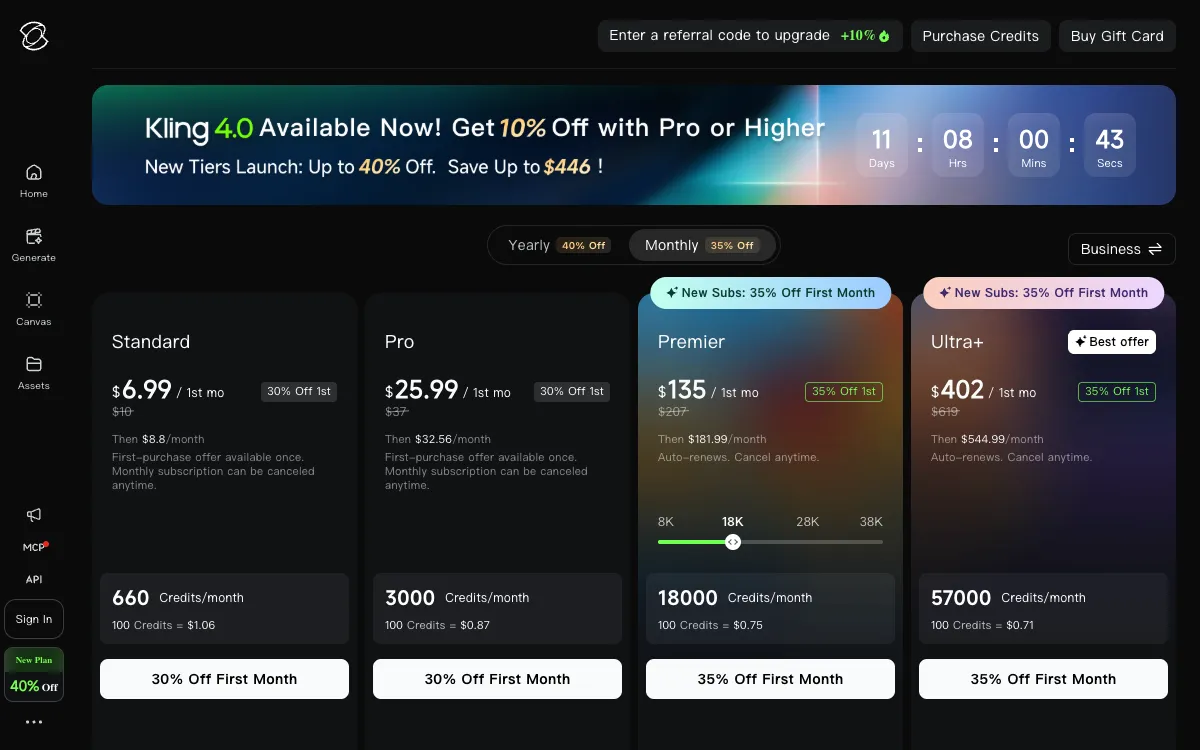 Kling AI: Kling 4.0 is live, with a launch discount from the Pro plan up.
Kling 4.0 is the closest like-for-like Seedance alternative. Kuaishou’s newest model makes 3 to 30 seconds per generation, double Kling 3.0’s 15, and matches Seedance 2.5’s ceiling.
It goes further on control. You can pin up to 10 keyframe images along a take, against a first and last frame on most models here.
References are deep too. Kling lists up to 10 images, 5 videos with 30 seconds combined, 7 subjects and a voice reference, up to 15 items per generation.
Output runs at 720p, 1080p or 4K, with two-channel stereo sound and lip sync. Kling says 10-bit HDR at 1080p and 4K is coming soon.
Pros
- 3 to 30 seconds per generation, tied for the longest here
- Up to 10 keyframes along one take
- Up to 15 reference items, including video and voice
- 720p, 1080p or 4K, with stereo sound
Cons
- No per-second Kling 4.0 rate on the public plans page
- The launch discount on Kling 4.0 starts at Pro, not Standard
- First-month prices are promotional; check the renewal rate before you subscribe
Best for: Long takes that need several fixed moments, or 4K delivery.
Pricing: Standard: $10/month list for 660 credits ($6.99 first month, then $8.80). Pro: $37/month list for 3,000 credits ($25.99 first month, then $32.56). Premier and Ultra+ above that (kling.ai, checked October 2026). For more on Kling itself, see our Kling AI alternatives comparison.
3. Google Veo 3.1
 Google Flow: Google’s studio for Veo 3.1, free to try with 50 daily credits.
Google Veo 3.1 is the Seedance alternative for dialogue. Google says it “excels in physics, realism and prompt adherence,” and it makes lip-synced speech with the picture.
The catch is length. Veo 3.1 makes 4, 6 or 8 seconds per generation, the shortest take on this list.
Flow is built to work around that. Video Extension continues a clip, Scenebuilder strings shots into a scene, and Ingredients to Video steers a shot with your own references.
On Luma, Veo 3.1 costs 280 credits a second with audio, about $0.84. That’s the highest rate here.
Pros
- Lip-synced speech generated with the picture
- Video Extension and Scenebuilder in Google Flow for multi-shot scenes
- Ingredients to Video for reference-driven shots
- Free to try with 50 daily Flow credits
Cons
- 8 seconds is the longest single generation
- About $0.84 a second with audio on Luma Plus
- Flow’s features vary by Google AI plan, platform and region
Best for: Scenes where people talk on camera and the lips have to match.
Pricing: Google Flow: free with 50 daily credits. Google AI Plus: $4.99/month adds 200 monthly Flow credits. Google AI Pro: $19.99/month adds 1,000. Google AI Ultra: from $99.99/month adds 10,000 (flow.google, checked October 2026). Our Google Veo alternatives post covers its rivals.
4. Hailuo 3 (MiniMax H3)
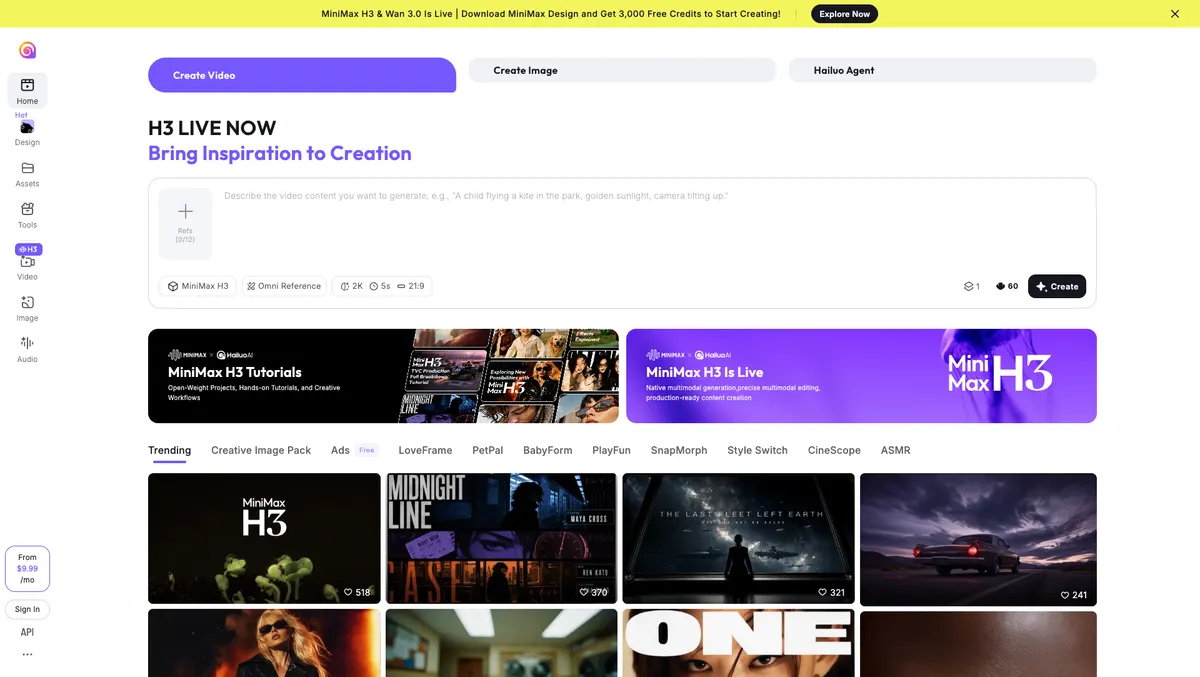 Hailuo AI: MiniMax’s studio, where Hailuo 3 runs as MiniMax H3 at up to 2K.
MiniMax’s Hailuo 3, sold on Hailuo AI as MiniMax H3, is the Seedance alternative for close-ups. It renders at up to 2K with sound.
One generation runs 5 to 15 seconds, half of Seedance 2.5’s ceiling. The create page takes up to 12 reference images and quotes 60 credits for a 5-second 2K shot.
It’s cheaper than Seedance at high resolution. Luma charges 46 credits a second for MiniMax H3 at 2K, about $0.14, against $0.57 for Seedance 2.5 at 1080p.
Pros
- Up to 2K output with sound
- Up to 12 reference images on Hailuo’s own create page
- About $0.14 a second at 2K on Luma Plus
Cons
- 15-second ceiling, half that of Seedance 2.5
- Only the starting price is public to a signed-out visitor
Best for: Faces and product close-ups in a sequence, where resolution decides whether the shot holds.
Pricing: Direct from $9.99/month (hailuoai.video, checked October 2026). On Luma Plus, MiniMax H3 is 28 credits a second at 768p and 46 at 2K.
5. Wan 3.0
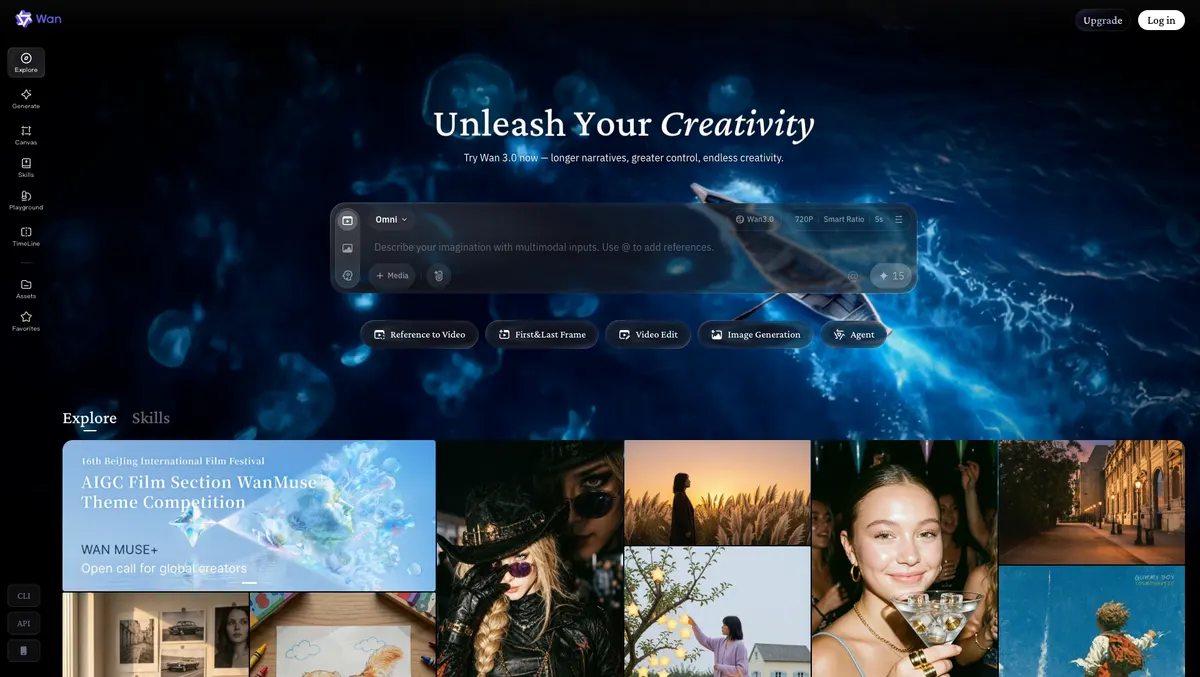 Wan: Alibaba’s studio for Wan 3.0, quoting 15 credits for a 5-second 720p shot.
Alibaba’s Wan 3.0 is the cheapest way to get a Seedance-length take. It runs 2 to 30 seconds per generation.
Wan’s create page quotes 15 credits for a 5-second 720p shot. On the Pro plan billed yearly, $5 a month for 300 credits, that’s about $0.05 a second, under a quarter of Seedance 2.5’s 720p rate on Luma.
Pro is where long takes open up. It adds 10- to 30-second videos, 1080p, watermark-free downloads and three videos in parallel.
The studio has Reference to Video, First & Last Frame and Video Edit modes, plus a TimeLine for putting shots in order.
Pros
- 2 to 30 seconds per generation
- About $0.05 a second at 720p on yearly Pro
- Reference to Video, First & Last Frame and Video Edit modes
- A TimeLine in the same studio
Cons
- 10- to 30-second videos and 1080p start on Pro, not Free
- The free plan runs one video at a time
- A Wan subscription covers create.wan.video only; API use is a separate purchase
Best for: Long takes and high-volume drafts where cost per second beats resolution.
Pricing: Free: $0 with daily check-in credits. Pro: $10/month, or $5/month billed yearly, for 300 credits. Premium: $40/month, or $20/month billed yearly, for 1,200 credits (create.wan.video/pricing, checked October 2026).
6. Luma Ray3.2
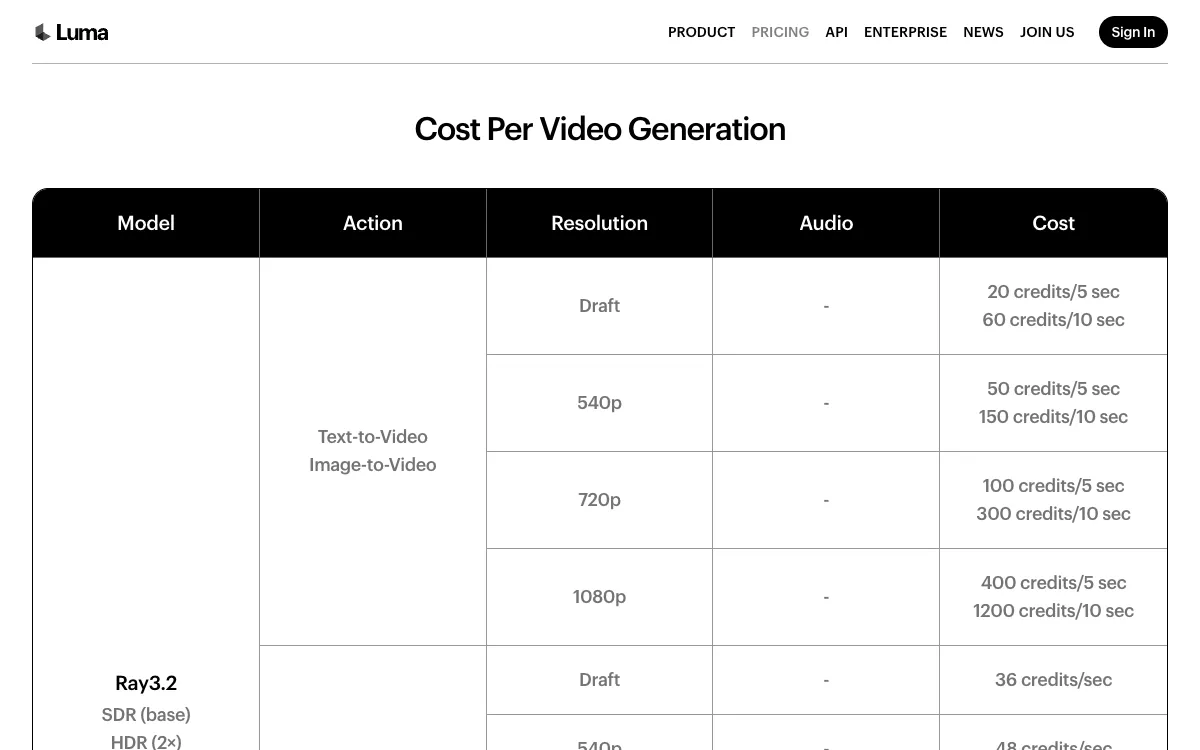 Luma’s price list: Ray3.2 priced per 5- and 10-second clip, from Draft to 1080p.
Luma Ray3.2 is Luma’s own video model and the draft pick among Seedance alternatives. It makes 5- or 10-second clips from Draft up to 1080p, with HDR and EXR options.
It’s cheap to iterate on. A 5-second 720p clip is 100 credits, about $0.06 a second on Plus, and a 10-second clip is 300, about $0.09.
Luma’s price list also carries an Extend Video tool, listed under Ray3.14 and priced per 5 seconds. That’s the route past a 10-second clip.
Luma also sells Seedance 2.5, Kling 3.0, Veo 3.1 and MiniMax H3 on the same credits. You can draft on Ray3.2 and render the final take on Seedance from one account.
Pros
- About $0.06 a second for a 5-second 720p clip
- HDR and EXR output options
- Extend Video (on Ray3.14) for scenes longer than one clip
- Seedance 2.5 and other models on the same credits
Cons
- 10 seconds is the longest single generation
- Ray3.2’s price list shows no audio option
- The cheapest plan is $30 a month, and unused credits expire each billing cycle
Best for: Drafting a sequence cheaply before you commit the final takes to a pricier model.
Pricing: Plus: $30/month for 10,000 credits. Pro: $90/month for 40,000 credits. Ultra: $300/month for 150,000 credits. Yearly billing saves up to 20% (lumalabs.ai/pricing, checked October 2026).
7. Runway Gen-4.5
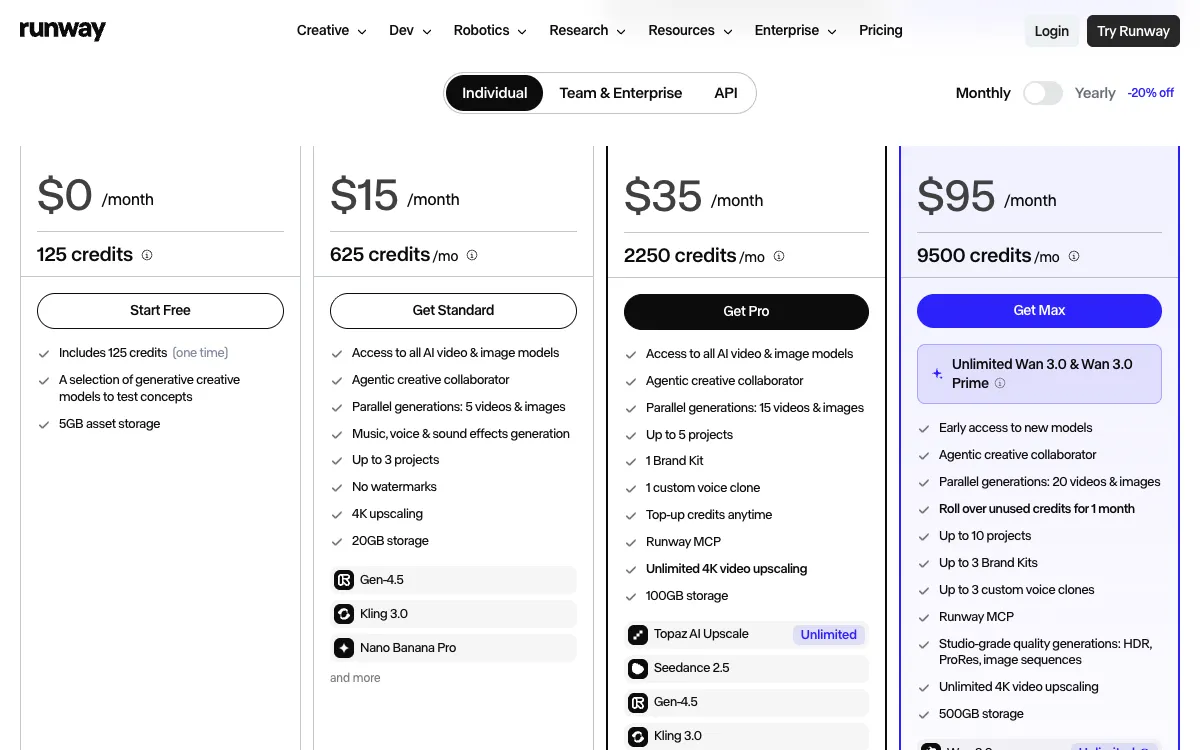 Runway: Gen-4.5 on every paid plan, with Seedance 2.5 from Pro up.
Runway Gen-4.5 is the Seedance alternative for short, polished shots. Runway’s help center lists 2 to 10 seconds per generation at 720p, from text or an image.
Runway prices it in seconds: 12 credits a second. Standard’s 625 credits buy 52 seconds, about $0.29 a second, and Pro’s 2,250 buy 187 seconds, about $0.19.
It isn’t a long-take model. Its strength is the account around it, with music, voice and sound effects generation on paid plans and 5 to 20 parallel generations.
Pro and Max also carry Seedance 2.5. So you can keep Seedance for the long takes and use Gen-4.5 for the short ones on one bill.
Pros
- Credits stated as seconds of Gen-4.5, so the cost is clear
- Music, voice and sound effects generation on paid plans
- Seedance 2.5 on Pro and Max
- 5 to 20 parallel generations, by plan
Cons
- 10 seconds is the longest generation, at 720p
- Text and image to video only for now; Runway says more inputs are coming
- The free tier is 125 one-time credits, not a monthly grant
Best for: Short hero shots inside a sequence, with Seedance on the same plan for the long ones.
Pricing: Free: 125 one-time credits. Standard: $15/month ($12 billed yearly) for 625 credits. Pro: $35/month ($28 yearly) for 2,250 credits. Max: $95/month ($76 yearly) for 9,500 credits (runwayml.com/pricing, checked October 2026). See our Runway alternatives for more.
Seedance alternatives compared
| Tool | Longest take | Sequence tools | References | Cost per second | Entry price |
|---|---|---|---|---|---|
| Seedance 2.5 (baseline) | 30 s | Extend twice | 30 images, 10 videos, 10 audio (API) | ~$0.23 at 720p, ~$0.57 at 1080p (Luma Plus) | Via a platform |
| Vidwip AI Video Generator | 30 s (Seedance 2.5, Wan 3.0) | Timeline, regenerate one shot in place | Up to 30 images, 10 videos, 10 audio (Seedance 2.5) | Shown per shot before you generate | Starter $25/mo |
| Kling 4.0 | 30 s | Up to 10 keyframes | 10 images, 5 videos, 7 subjects, voice | Not on public plans page | $10/mo list |
| Google Veo 3.1 | 8 s | Video Extension, Scenebuilder | Ingredients to Video | ~$0.84 with audio (Luma Plus) | Free in Flow |
| Hailuo 3 (MiniMax H3) | 15 s | None listed | Up to 12 images | ~$0.14 at 2K (Luma Plus) | $9.99/mo |
| Wan 3.0 | 30 s | TimeLine | Reference to Video | ~$0.05 at 720p (yearly Pro) | $5/mo yearly |
| Luma Ray3.2 | 10 s | Extend Video (Ray3.14) | Not listed | ~$0.06 at 720p, silent (Luma Plus) | $30/mo |
| Runway Gen-4.5 | 10 s | None listed | Start image only | ~$0.29 Standard, ~$0.19 Pro | $15/mo |
Cost per second is the plan’s monthly price divided by its credits, times the model’s published rate. Take lengths are per generation, before any extend step.
How to choose the right Seedance alternative
You want Seedance and its rivals in one place. Vidwip AI Video Generator runs three Seedance tiers beside Veo 3.1, Kling 3.0 Pro and Wan 3.0, and every shot lands on a timeline. Luma and Runway also carry Seedance 2.5 next to their own models.
You need one long take with fixed moments. Kling 4.0 matches Seedance’s 30 seconds and lets you pin up to 10 keyframes along it. It’s also the only alternative here that generates 4K natively.
You need dialogue. Use Veo 3.1, and try it free in Google Flow first. Build the scene from 8-second shots with Scenebuilder.
You need long takes on a budget. Wan 3.0 reaches 30 seconds for about $0.05 a second on yearly Pro. Luma Ray3.2 is the cheap draft option, if you can live without sound.
You need sharp close-ups. Hailuo 3 renders at 2K for about $0.14 a second on Luma, well under Seedance 2.5’s 1080p rate.
You want a finished video, not a folder of clips. In Vidwip, shots from any model go on the AI Studio timeline, where you cut them and add an AI voiceover. For the wider field after Sora’s shutdown, see our Sora alternatives guide.
Seedance 2.5 is still one of the strongest long-take models you can use. The case for an alternative is specific: keyframes, 4K, dialogue, sharper close-ups or a lower cost per second, and a different model wins each one.
If you’d rather not pick just one, run them side by side. Start at app.vidwip.com, on plans from $25 a month, with Seedance 2.5, Veo 3.1 and Kling 3.0 Pro in the same picker.