
GPT Image 2.5 wins editing and ranks first on Arena and Artificial Analysis. Nano Banana wins on price and, in the one test that scored both, photorealism: Nano Banana 2.1 costs $0.0336 for a 1K image, against about $0.21 for GPT Image 2.5 at max quality. Google's current model is Nano Banana 2.1, which replaced Nano Banana 2 on October 6, 2026.
GPT Image 2.5 vs Nano Banana 2: the short answer
GPT Image 2.5 vs Nano Banana 2 is an editing-and-ranking contest against a price-and-photography contest. OpenAI’s model leads both major leaderboards and editing. Google’s Nano Banana costs a fraction as much per image and looks more natural in photos.
One naming note first. “Nano Banana 2” is no longer Google’s newest model: Nano Banana 2.1 was published on October 6, 2026, and Google’s docs name it the replacement. We cover Nano Banana 2.1, the older Nano Banana 2 and Nano Banana Pro, checked in November 2026.
We can’t generate images for this post, so there are no invented side-by-sides. Every claim below comes from the vendors, the leaderboards or a named tester, with links.
| Area | Winner | Why |
|---|---|---|
| Image editing | GPT Image 2.5 | #1 on Arena Image Edit (1517) and Artificial Analysis editing (1199) |
| Overall ranking | GPT Image 2.5 | Sunburst 1427 vs Nano Banana 2.1 1325 on Arena text-to-image |
| Photorealism | Nano Banana | Curious Refuge preferred Pro for natural skin and textures |
| Text rendering | Tie | Both are good; both still slip on small type |
| Reference images | GPT Image 2.5 in testing, Google on documented limits | Curious Refuge’s three-reference test favored OpenAI; Google documents 14 references |
| Price per image | Nano Banana 2.1 | $0.0336 for 1K vs about $0.21 for GPT Image 2.5 at max |
| Speed | Not benchmarked | No independent head-to-head latency test exists |
Pick GPT Image 2.5 if you edit existing images, composite from several references or need layouts to hold still. Pick Nano Banana if you generate natural-looking photos, run volume or pay by the image.
The models: GPT Image 2.5 and Nano Banana at a glance
GPT Image 2.5 came out on September 8, 2026 as two API models, gpt-image-2.5-flare and gpt-image-2.5-sunburst. Google’s Nano Banana line is built on Gemini models, and the current one is Nano Banana 2.1.
| GPT Image 2.5 | Nano Banana 2.1 | Nano Banana 2 | Nano Banana Pro | |
|---|---|---|---|---|
| Maker | OpenAI | |||
| API model ID | gpt-image-2.5-flare, gpt-image-2.5-sunburst | gemini-nano-banana-2.1 | gemini-3.1-flash-image | gemini-3-pro-image |
| Released | September 8, 2026 | October 6, 2026 | February 26, 2026 | November 2025 |
| Built on | Not published | Gemini 3.6 Flash | Gemini 3.1 Flash Image | Gemini 3 Pro Image |
| Max resolution | Edges to 3,840 px | 4K | 4K | 4K |
| Consumer access | ChatGPT Images 2.5, all tiers | Gemini app, AI Mode, Flow | Gemini app, AI Mode, Flow | Gemini app, Google AI Plan |
Sources: OpenAI’s launch post and docs, Google’s Nano Banana 2.1 model card, the Nano Banana 2 launch post and the Gemini API model docs. Our GPT Image 2.5 review covers OpenAI’s side in depth.
 OpenAI’s launch post for ChatGPT Images 2.5
 Google DeepMind’s Nano Banana page: “Pro-level image generation and editing. Flash-level speed.”
Which Nano Banana is which
- Nano Banana 2.1: the newest and Google’s efficient pick. Thinking levels minimal, medium (default) and high, and 1K, 2K and 4K output
- Nano Banana 2: the February 2026 model, still sold at $0.067 for 1K. Google’s deprecations page lists no shutdown date and points users to 2.1
- Nano Banana Pro: the premium model. Google’s docs list it at $0.134 for 1K and 2K and $0.24 for 4K
An earlier, smaller Nano Banana (gemini-2.5-flash-image) is deprecated and shuts down on March 15, 2027, so ignore it.
Rankings: Arena and Artificial Analysis
GPT Image 2.5 beats every Nano Banana on both major boards, in generation and in editing. Arena’s snapshot is dated November 2, 2026, and Artificial Analysis was checked on November 6.
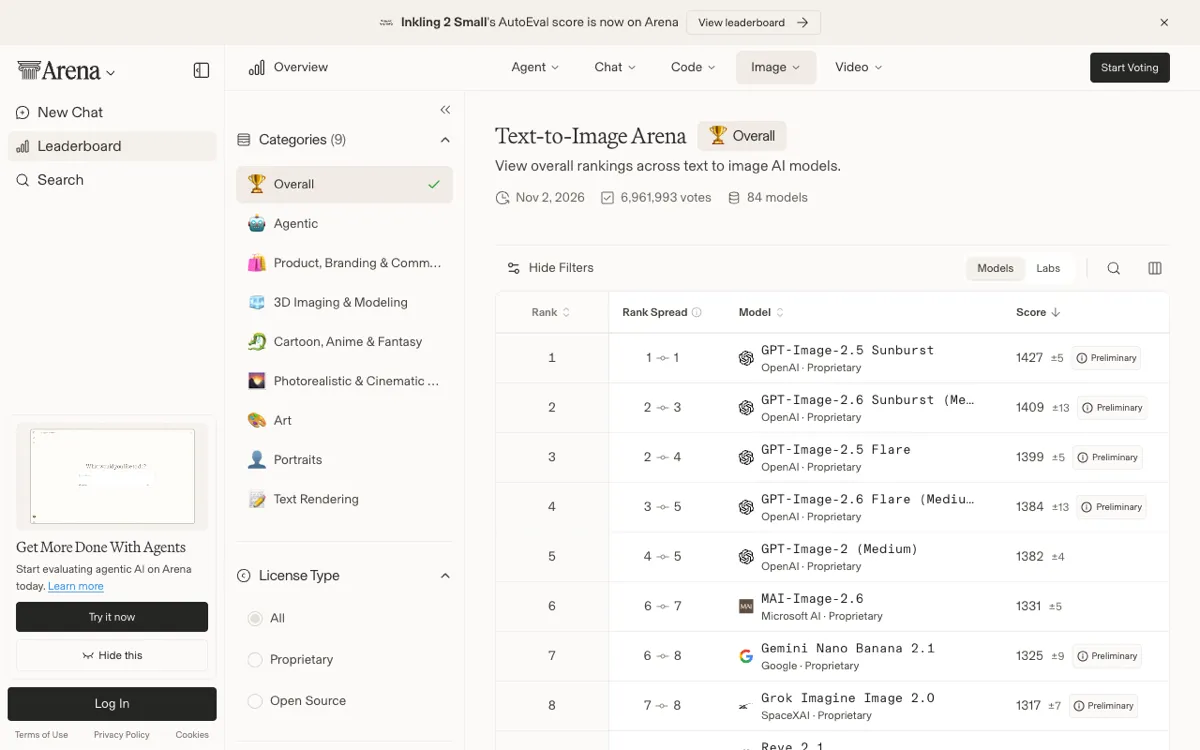 Arena’s Text-to-Image board, last updated November 2, 2026
| Board | GPT Image 2.5 Sunburst | GPT Image 2.5 Flare | Nano Banana 2.1 | Nano Banana 2 | Nano Banana Pro |
|---|---|---|---|---|---|
| Arena text-to-image | 1427 (#1) | 1399 (#3) | 1325 (#7) | 1257 (#13) | 1246 (#18) |
| Arena single image edit | 1517 (#1) | 1482 (#2) | 1427 (#8) | 1387 (#17) | 1390 (#16) |
| Artificial Analysis text-to-image | 1227 (#1) | 1208 (#2) | 1176 (#4) | 1142 (#7) | 1119 (#12) |
| Artificial Analysis editing | 1199 (#1) | 1182 (#3) | 1152 (#5) | 1125 (#11) | 1109 (#18) |
Arena marks the 2.5 and Nano Banana 2.1 scores as preliminary. Read the gaps as direction, not decimals.
The sources are Arena and Artificial Analysis. Note that Artificial Analysis scores GPT Image 2.5 at its max quality setting, which is its most expensive one.
Google’s own numbers disagree
Google’s model card puts Nano Banana 2.1 (with thinking) first in its own side-by-side tests: 1050 overall preference against 990 for Nano Banana 2 and 935 for Nano Banana Pro. Those tests do not include GPT Image 2.5, and they are Google grading Google, so use them only to rank the Nano Banana models against each other.
Text rendering
Both models render readable text, and neither is reliable on small or dense lettering. Treat any generated sign, menu or poster as a draft to proofread.
- OpenAI: its image guide says the model is “significantly improved” at text but “can still struggle with precise text placement and clarity”
- Google: the DeepMind model card lists small text and long text among known weaknesses of Nano Banana 2.1, while the docs promise “legible, stylized text for infographics, menus, diagrams, and marketing assets”
- Curious Refuge: in its November 2 ranking, GPT Image 2.5 scored 9.86 on prompt adherence and Nano Banana 2.1 scored 9.79. In its GPT Image 2.5 review it still saw “distinctly AI-looking typography choices” on posters
Multilingual work is a possible Google edge: its launch post says Nano Banana 2 can translate and localize text inside an image. Picsart, which sells both models, claims near-99% English accuracy for GPT Image 2.5, but that is a vendor page with no cited test.
If text and layout are the whole job, Canva built its Craft model around them. Ideogram is the other text-first option, covered in our Ideogram 4.5 review.
Photorealism
Nano Banana has the edge on natural-looking photos. This is the one area where the leaderboards and the hands-on tests disagree.
Curious Refuge’s GPT Image 2.5 review says “Nano Banana Pro consistently produced more natural skin, cleaner textures, and more convincing photography.” It also saw GPT Image 2.5 faces develop “an artificial fractal-like texture” when zoomed in.
The newer ranking agrees on style. Curious Refuge scored Nano Banana 2.1 8.69 on style and realism and GPT Image 2.5 8.29, though GPT Image 2.5 scored higher on visual fidelity, 8.86 to 8.59. Overall it was a near tie: 9.02 for Nano Banana 2.1 and 9.00 for GPT Image 2.5, with Nano Banana Pro at 8.8.
Their advice for photographers and compositors is to generate the base with Nano Banana Pro and refine it with GPT Image 2.5. That is the most useful workflow tip in either review.
Image editing
GPT Image 2.5 is the better editor, on every ranking and in hands-on tests. Sunburst leads Arena’s single-image edit board by 90 points over Nano Banana 2.1.
- Targeted edits: Curious Refuge called GPT Image 2.5 “one of the most intelligent models we’ve tested” for edits and compositing
- Edit memory: it kept earlier context across multi-step edits, which Picsart also describes as protecting “what is already in the frame”
- Drift: “with every edit, the image became slightly sharper, more saturated, and more artificial,” so limit yourself to one or two edits per generation
- Google’s strength: Nano Banana 2.1 supports mask-based editing and Google Search and Image Search grounding, which helps when an edit has to be factually right, such as a diagram or a landmark
Google’s model card claims 2.1 beats earlier Nano Banana models on general editing and multi-reference editing. It does not compare against GPT Image 2.5, so the leaderboard is the fairer judge here. Microsoft’s challenger is covered in our MAI Image 2.7 review.
Reference images
Both models take many references, and the limits are not like for like. Google documents exact caps, and OpenAI’s docs we read do not.
| Documented reference limit | |
|---|---|
| Nano Banana 2.1 and 2 | Up to 14 total: up to 10 objects and 4 characters |
| Nano Banana Pro | Up to 14 total: up to 6 objects, 5 characters and 3 style references |
| GPT Image 2.5 | OpenAI’s API docs show multi-image edits but state no cap in the sections we read; Picsart claims 16 |
Google’s launch post phrases the Nano Banana 2 limit as “up to five characters” and “up to 14 objects,” which differs from the API docs’ 10 and 4. Trust the API docs when you build.
In testing, OpenAI’s model did better. Curious Refuge’s three-reference test found GPT Image 2.5 “the clear winner for complex multi-reference generation,” while Nano Banana Pro “didn’t follow the requested composition nearly as closely.” The same testers found Nano Banana Pro made the more realistic character in a character-sheet test.
Speed
Nobody has published an independent head-to-head latency test, so treat speed as a vendor claim. OpenAI says GPT Image 2.5 generates up to 50% faster than Images 2.0, and sells Flare as the fast tier and Sunburst as the slower, more precise one.
Google’s tagline is “Pro-level image generation and editing. Flash-level speed.” Its page quotes HubX reporting a 74-76% latency cut, but the quote refers to Gemini 3.1 Flash Image, not 2.1. Google’s model card also warns of “occasional slowness or timeout issues.”
Both vendors also add thinking or complexity settings that raise latency. Test your own prompts on your own tier before you commit.
Price per image
Nano Banana costs far less per image at high quality. Google publishes a per-image price. OpenAI publishes token prices only, so GPT Image 2.5 figures are estimates.
| Model | Cost per image |
|---|---|
| Nano Banana 2.1 | $0.0336 (1K), $0.0504 (2K), $0.113 (4K); batch is half |
| Nano Banana 2 | $0.045 (0.5K), $0.067 (1K), $0.101 (2K), $0.151 (4K) |
| Nano Banana Pro | $0.134 (1K and 2K), $0.24 (4K) |
| GPT Image 2.5, 1024x1024 estimate | about $0.006 low, $0.013 medium, $0.053 high, $0.094 xhigh, $0.211 max |
Google prices are from the Gemini Developer API pricing page, checked November 2026, US dollars, standard tier. OpenAI charges $30 per million image output tokens, per its API pricing page. The per-image figures are the third-party reconstruction used in our GPT Image 2.5 review, and input images add cost.
Artificial Analysis lists both on one scale: $210.72 per 1,000 images for GPT Image 2.5 at max against $33.60 for Nano Banana 2.1. The leaderboard scores GPT Image 2.5 at max, so its top rank is the expensive result. Run GPT Image 2.5 on low or medium and the cost falls below Nano Banana 2.1, but you give up the quality the ranking measured.
Google’s batch tier halves 2.1 prices, and no model in Google’s table has a free API tier.
Availability and consumer apps
You can use both in a chat app without code. OpenAI says ChatGPT Images 2.5 is rolling out to ChatGPT, ChatGPT Work and Codex users on all tiers.
Google’s model card lists the Gemini app, Google AI Studio, the Gemini API, AI Mode in Search, Google Ads, Flow and Stitch for Nano Banana 2.1. Google’s help page, checked November 2026, still describes Nano Banana 2 for the Gemini app and Nano Banana Pro for Google AI Plan subscribers, with downloads at 2K on a plan and 1K without one. It did not name 2.1, so the app label may lag the API.
Google marks all generated images with SynthID.
Which one should you pick?
- Photo editors and marketers who revise images: GPT Image 2.5. Use Sunburst for tight edit control
- Photographers and realism-first creators: Nano Banana, with Pro for the best base photo
- Developers shipping at volume: Nano Banana 2.1 at $0.0336 per 1K image, or GPT Image 2.5 Flare on medium at about 1.3 cents
- Infographics and fact-based visuals: Nano Banana 2.1, since Google grounds it in Search and Image Search
- Designers who need locked layouts: GPT Image 2.5, then check type by hand
- Anyone chasing a particular style: try Midjourney. Our Midjourney V8 review covers plan costs
- Animating stills afterwards: see the best text-to-video AI ranking
Conclusion: GPT Image 2.5 or Nano Banana?
GPT Image 2.5 wins the scoreboard and Nano Banana wins the invoice. OpenAI’s model leads Arena and Artificial Analysis and is the better editor. Google’s is about a sixth of the price at the top setting and looks more natural in photos.
Most teams should use both. Generate the base image with Nano Banana, then bring in GPT Image 2.5 for the edits that have to be exact.