
Kimi K3.1 Pro is Moonshot's flagship open-weight model, released October 23, 2026: 2.8 trillion parameters (104B active), a 1M-token context and $2 in / $10 out per million tokens. It scores 46 on the Artificial Analysis Intelligence Index, first among open-weight models in its class but about 14 points behind the leader, and it is slow and costly per task. The weights are on Hugging Face under a custom license.
This Kimi K3.1 Pro review covers what Moonshot AI’s newest model does, what it costs and where it falls short. We read Moonshot’s API docs, its Hugging Face model card and the Artificial Analysis page, and every number below was checked on November 6, 2026.
We did not run our own benchmarks. Where a figure comes from Moonshot, we say so. If you searched “kimi 3.1 pro”, this is the same model: the official name is Kimi K3.1 Pro, and the API ID is kimi-k3.1-pro.
TL;DR: Kimi K3.1 Pro review verdict
Kimi K3.1 Pro is the strongest open-weight LLM on Artificial Analysis today, but it does not catch the top closed models. It has a 1M-token context, costs $2 per million input tokens and $10 per million output tokens, and its weights are public.
| Category | Verdict | Why |
|---|---|---|
| Intelligence | Strong, not the best | 46 on the Artificial Analysis index; the leader scores 60 |
| Coding and agents | Strong | 65.7 on Terminal-Bench 4.0, 75.5 on DeepSWE (Moonshot’s figures) |
| Hard reasoning | Weaker | 39.4 on HLE-Diamond against 60.9 for Claude Opus 5.5 |
| API price | Mid to high | $2 in / $10 out, expensive next to other open models |
| Speed | Slow | About 33 tokens per second on the standard tier |
| Openness | Good | Weights on Hugging Face, custom license with revenue limits |
Use it for long-horizon coding agents, huge-context document work and cases where you want weights you can host. Skip it if latency matters and you can’t pay double for Highspeed, or if you need the top score on hard reasoning.
What is Kimi K3.1 Pro?
 Moonshot’s Kimi API Platform pricing page, checked November 6, 2026
Kimi K3.1 Pro is a flagship model from Moonshot AI, released on October 23, 2026. Moonshot calls it “an open-weight, natively multimodal agentic model” and “our most capable 3T-class model to date.”
It is post-trained from Kimi K3 with large-scale reinforcement learning across hundreds of domains. It is the first model in the K3.1 series.
Moonshot says the gains are in coding, 3D creation, financial research and factual accuracy. It takes text and images as input and returns text.
Kimi K3.1 Pro specs at a glance
These specs come from the Hugging Face model card and Moonshot’s API docs.
| Spec | Kimi K3.1 Pro |
|---|---|
| Architecture | Mixture-of-experts, 93 layers |
| Parameters | 2.8T total, 104B active per token |
| Experts | 896, with 16 selected per token plus 2 shared |
| Context window | 1,048,576 tokens |
| Max output | 131,072 default, up to 1,048,576 |
| Input | Text, images and video files |
| Reasoning | Always on; low, high or max effort (max is default) |
| Precision | MXFP4 weights, trained with quantization-aware training |
| Vision encoder | MoonViT-V2, 401M parameters |
The API also supports streaming, strict JSON Schema output, partial mode, tool choice, dynamic tool loading and automatic context caching. Public image URLs are not supported; you send base64 or an uploaded file ID.
One change from K3: Moonshot swapped the full-attention layers for Gated DeepSeek Sparse Attention to make long contexts cheaper.
Kimi K3.1 Pro pricing
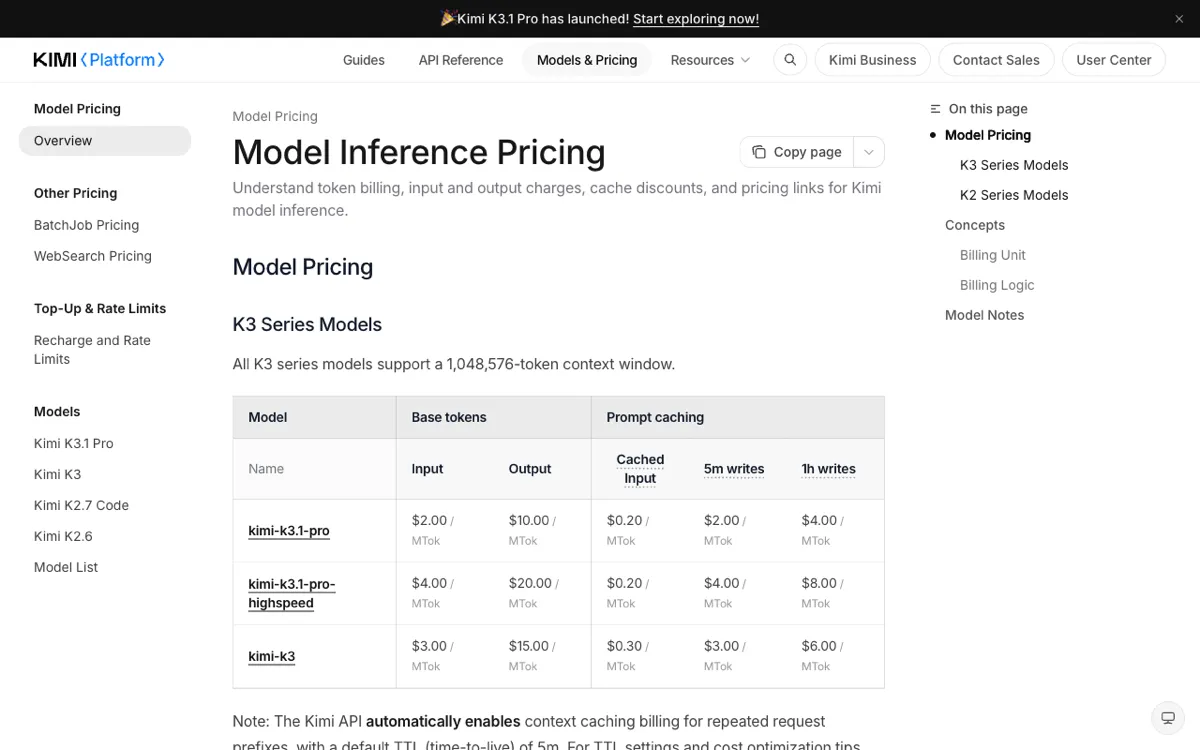
Kimi K3.1 Pro costs $2.00 per million input tokens and $10.00 per million output tokens on Moonshot’s API pricing page, checked November 6, 2026. Billing is pay-as-you-go, with no subscription.
| Model | Input | Output | Cached input | 5-min cache write | 1-hour cache write |
|---|---|---|---|---|---|
| kimi-k3.1-pro | $2.00 | $10.00 | $0.20 | $2.00 | $4.00 |
| kimi-k3.1-pro-highspeed | $4.00 | $20.00 | $0.20 | $4.00 | $8.00 |
| kimi-k3 (previous) | $3.00 | $15.00 | $0.30 | $3.00 | $6.00 |
All prices are per million tokens. K3.1 Pro is cheaper than the K3 it replaces.
Context caching is automatic for repeated prefixes, with a 5-minute default lifetime. Cache hits cost $0.20, a 90% discount. Batch jobs bill at 60% of the standard price.
Flagship models unlock after a top-up of at least $1. Your cumulative top-ups set your rate-limit tier.
What a real task costs
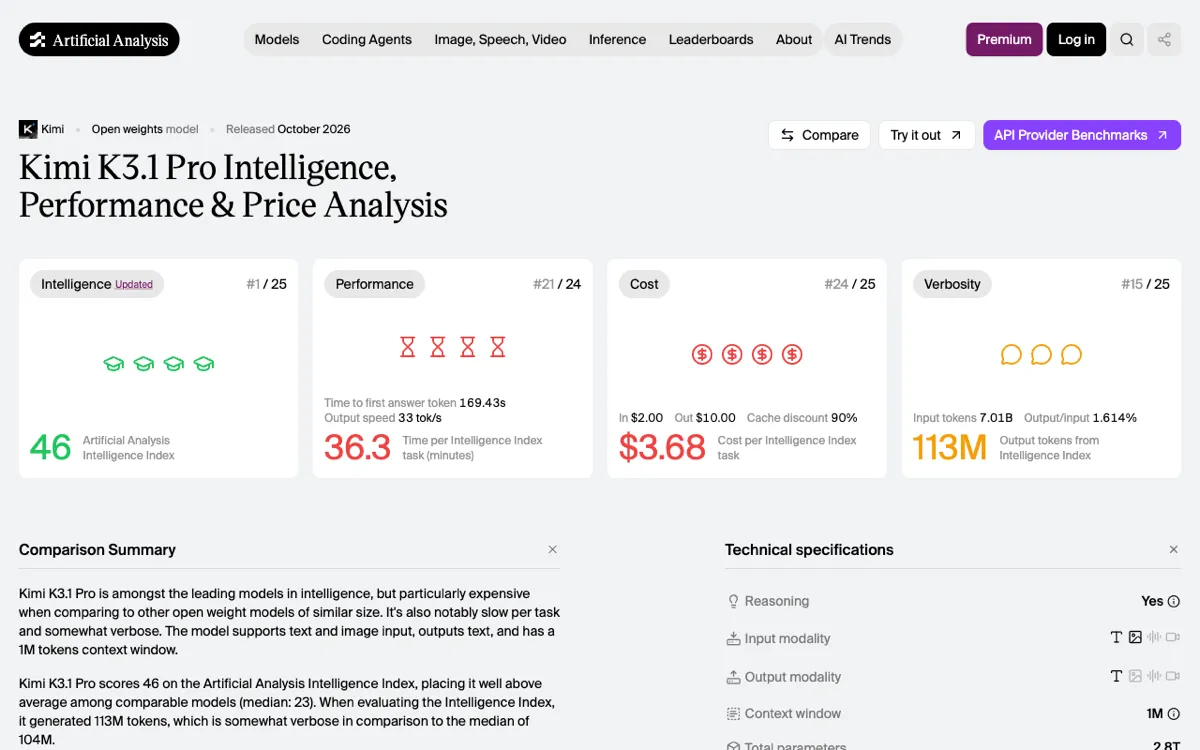
Artificial Analysis ran its full index on K3.1 Pro and put the cost at $3.68 per task. That ranks 24th of 25 on cost in its comparison set.
The reason is verbosity plus price. The model generated 113 million output tokens across the index, and Artificial Analysis calls its pricing “expensive” against a $0.47 median for similar models.
Kimi K3.1 Pro Highspeed: is it worth double?
 Artificial Analysis’s Kimi K3.1 Pro page, checked November 6, 2026
Kimi K3.1 Pro Highspeed is the same model served faster. Moonshot’s quickstart says kimi-k3.1-pro-highspeed “delivers 2-3× the speed of K3.1 Pro.”
It costs exactly twice as much: $4 in and $20 out per million tokens. It launched with the standard model on October 23.
The speed claim is Moonshot’s. We found no independent measurement of the Highspeed tier alone, and gateway listings show a range of numbers.
The baseline is slow. Artificial Analysis measured the standard model at about 33 output tokens per second, with 169 seconds before the first answer token, because thinking is always on. A full index task took 36.3 minutes, against a 13.6-minute median.
If you run interactive coding agents, Highspeed is the version you will feel. For overnight batch work, the standard tier at 60% batch pricing is the better deal.
How Kimi K3.1 Pro ranks on Artificial Analysis
Artificial Analysis scores Kimi K3.1 Pro at 46 on its Intelligence Index v5.0.1, which averages nine evaluations including Terminal-Bench 4.0, FrontierCode 2.0, HLE-Diamond and GDP.pdf. That is first among the 25 open-weight models in its size class and well above the 23 median for comparable models.
On the full leaderboard it sits lower. The top entries when we checked were:
| Model | Index score |
|---|---|
| Gemini 4 Carbon (high) | 60 |
| Claude Opus 5.5 (max) | 59 |
| GPT-6 Astra (max) | 57 |
| Claude Sonnet 5.5 (max) | 55 |
| Kimi K3.1 Pro | 46 |
By our count from the leaderboard table, K3.1 Pro lands around 23rd overall, level with GPT-6.1 Sol (medium). The practical reading: best open weights available, a clear step behind the closed frontier. Our Kimi K3.1 Pro vs Claude Opus 5.5 comparison goes through that gap in detail.
Kimi K3.1 Pro benchmarks
Moonshot’s model card compares K3.1 Pro with Claude Fable 5.1, GPT-6 Astra, Claude Opus 5.5, DeepSeek-V4.1-Flash and GLM-5.3, all at maximum effort. These are Moonshot’s own numbers, and several benchmarks are internal.
| Benchmark | Kimi K3.1 Pro | Claude Opus 5.5 | GPT-6 Astra |
|---|---|---|---|
| Terminal-Bench 4.0 | 65.7 | 66.4 | 58.2 |
| SWE Marathon v1.1 | 51.7 | 46.3 | 42.5 |
| DeepSWE v1.1 | 75.5 | 74.2 | 74.1 |
| BrowseComp | 92.1 | 90.8 | 91.5 |
| GPQA-Diamond | 94.2 | 93.9 | 96.1 |
| Program Bench | 31.5 | 65.0 | 50.0 |
| HLE-Diamond | 39.4 | 60.9 | 65.8 |
| Terminal-Bench-Science 0.1 | 38.1 | 63.3 | 68.1 |
| ExploitBench | 74.7 | 91.0 | 100 |
The pattern is clear. K3.1 Pro matches or beats the closed models on long-horizon coding and browsing agents. It trails badly on whole-program generation, expert-level science and security exploitation.
Moonshot also reports a hallucination rate of 5.4 on its internal Kimi Hallu Bench without tools, where lower is better, against 6.8 for Claude Opus 5.5 and 4.2 for GPT-6 Astra.
Kimi K3.1 Pro open weights
 The moonshotai/Kimi-K3.1-Pro model card on Hugging Face, checked November 6, 2026
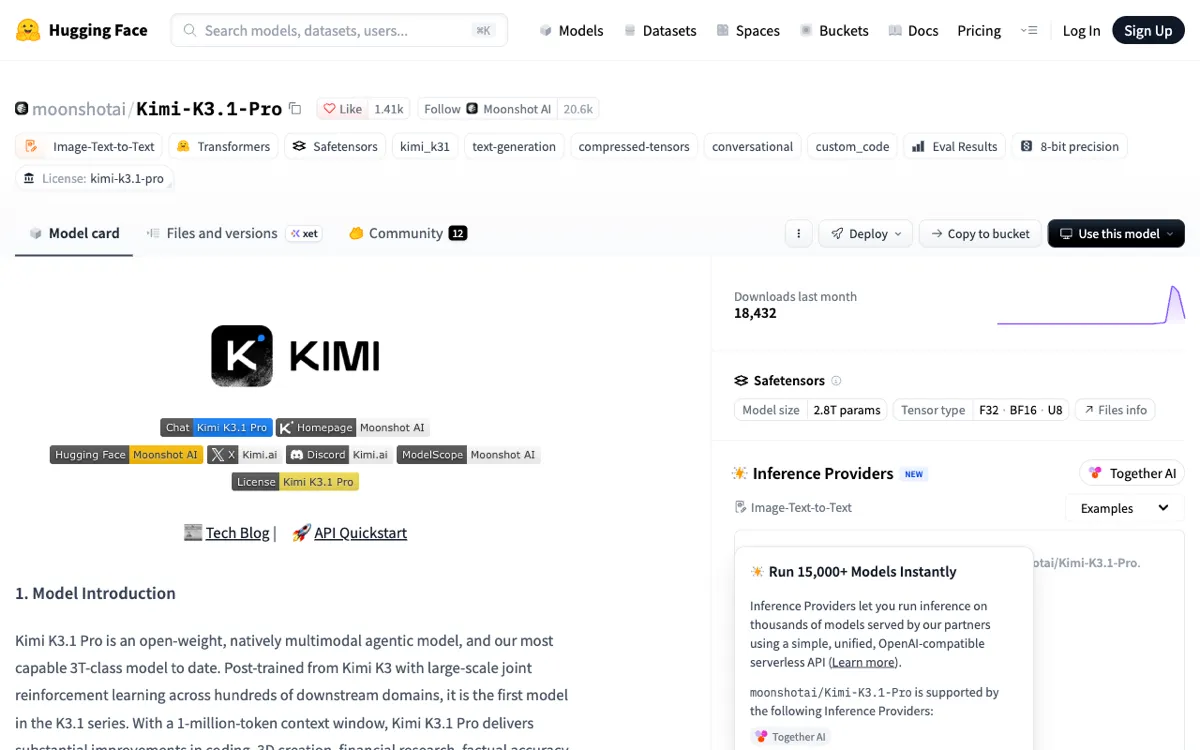
Kimi K3.1 Pro’s weights are public. Moonshot promised a November 4 release, and moonshotai/Kimi-K3.1-Pro is on Hugging Face now, with 18,432 downloads in the past month and inference through providers such as Together AI.
The files are 2.8T parameters in a compressed-tensors format. At 4-bit weights that is roughly 1.4 TB before the KV cache, by our arithmetic, so this is a multi-node deployment, not a workstation job. The model card lists vLLM and SGLang as the serving routes.
The license
The Kimi K3.1-Pro License is a modified permissive license, so it is not open source in the strict sense. It grants broad rights to use, modify, fine-tune and sell, with three conditions:
- Model-as-a-service: if you run a paid inference or fine-tuning business and earn more than $20 million over 12 months, you need a separate agreement with Moonshot.
- Attribution: products with over 100 million monthly users, or over $20 million in monthly revenue, must display “Kimi K3.1-Pro” in the interface.
- Exemptions: internal use, and use through Moonshot’s official products or certified inference partners, skip the first two rules.
For most teams hosting it themselves, those limits never bite. Unlike the video model release in our Hailuo 3 review, there is no territory exclusion.
Kimi K3.1 Pro pros and cons
Pros
- Best open-weight score: 46 on Artificial Analysis, first among 25 open models in its class
- 1M-token context: with output up to the same ceiling
- Strong agentic coding: 65.7 on Terminal-Bench 4.0 and 75.5 on DeepSWE, per Moonshot
- Cheaper than K3: $2 / $10 against $3 / $15, with a 90% cache discount
- Public weights: a permissive license with a $20 million revenue trigger for service providers
Cons
- Slow: about 33 tokens per second and 36 minutes per index task
- Costly per task: $3.68 per task, 24th of 25 on cost
- Thinking can’t be turned off: every call pays for reasoning, with 169 seconds to the first answer token
- Weak on hard science and whole programs: 39.4 on HLE-Diamond, 31.5 on Program Bench
- Text out only: no image or audio generation
- Hosting is heavy: 2.8T parameters need a serious cluster
Who should use Kimi K3.1 Pro?
Agent builders get the most. Long-horizon coding agents, browsing and office-task automation are where the benchmark results are strongest.
Teams that need control over their model should look at the weights. You can self-host, fine-tune and keep data in-house, provided you have the hardware.
Cost-sensitive teams should look elsewhere or use caching hard. At $10 per million output tokens and long reasoning traces, it is not a cheap open model.
People who want the highest raw score should stay with Gemini 4 Carbon or Claude Opus 5.5.
If you are here because you build with video models rather than LLMs, our roundup of the best open-source AI video models covers that side, and the Grok Imagine 1.5 review covers another recent release.
Kimi K3.1 Pro vs the alternatives
| Kimi K3.1 Pro | Kimi K3.1 Pro Highspeed | Kimi K3 (previous) | |
|---|---|---|---|
| API price (in / out per M) | $2 / $10 | $4 / $20 | $3 / $15 |
| Cached input per M | $0.20 | $0.20 | $0.30 |
| Context | 1M | 1M | 1M |
| Speed | About 33 tokens/s (Artificial Analysis) | 2-3x faster (Moonshot’s claim) | Not checked here |
This table covers Moonshot’s own lineup, priced on its platform. For a full matchup with the strongest closed rival, see Kimi K3.1 Pro vs Claude Opus 5.5.
Conclusion
Kimi K3.1 Pro is the best open-weight model you can download today, and a credible agentic coding engine at $2 / $10 per million tokens. It is also slow, wordy and well short of the closed frontier on hard reasoning.
Pick it when you want weights, a 1M context and strong agent results. Pick Highspeed when speed matters more than the bill, and pick a closed model when you need the highest score.
Sources
- Moonshot Kimi API pricing
- Kimi K3.1 Pro quickstart
- Hugging Face model card
- Artificial Analysis leaderboard