
Claude Opus 5.5 is the stronger model: 59 on the Artificial Analysis Intelligence Index against 46 for Kimi K3.1 Pro, about 3x the output speed, and far ahead on hard science and whole-program tasks. Kimi K3.1 Pro charges half as much per token ($2 / $10 against $4 / $20), ships public weights, and matches Opus on several agentic coding benchmarks in Moonshot's own tests. Both have a 1M-token context.
Kimi K3.1 Pro vs Claude Opus 5.5 is a contest between the best open-weight model and one of the best closed ones. We read Anthropic’s announcement and docs, Moonshot’s model card and the Artificial Analysis pages, and every number below was checked on November 6, 2026.
We did not run either model ourselves. Where a score comes from a vendor, we say whose it is, and vendor numbers are not run under identical settings.
TL;DR: Kimi K3.1 Pro vs Claude Opus 5.5
Claude Opus 5.5 wins on raw capability and speed. Kimi K3.1 Pro wins on token price and openness, and it is competitive on long-horizon coding agents.
| Dimension | Kimi K3.1 Pro | Claude Opus 5.5 | Edge |
|---|---|---|---|
| Artificial Analysis index | 46 | 59 | Opus |
| Agentic coding (Terminal-Bench 4.0) | 65.7 (Moonshot) | 66.4 (Anthropic) | Roughly even |
| Hard reasoning (HLE) | 39.4 (Moonshot) | 60.9 (Moonshot) / 67.7 with tools (Anthropic) | Opus |
| Context window | 1M | 1M | Tie |
| API price in / out per M | $2 / $10 | $4 / $20 | Kimi |
| Output speed | About 33 tokens/s | About 108 tokens/s | Opus |
| Weights | Public (custom license) | Closed | Kimi |
Pick Opus 5.5 when quality and latency matter most. Pick Kimi K3.1 Pro when you want weights you control, or when token price is the constraint and your task suits an agent.
Kimi K3.1 Pro at a glance
Moonshot AI released Kimi K3.1 Pro on October 23, 2026. It is a mixture-of-experts model with 2.8T total parameters and 104B active per token, a 1,048,576-token context, and always-on thinking.
The weights are on Hugging Face as moonshotai/Kimi-K3.1-Pro under a custom license that asks for a separate agreement from large paid inference services. The API costs $2.00 per million input tokens and $10.00 per million output tokens, with a Highspeed tier at $4 / $20.
Our Kimi K3.1 Pro review covers the specs, license and pricing in full.
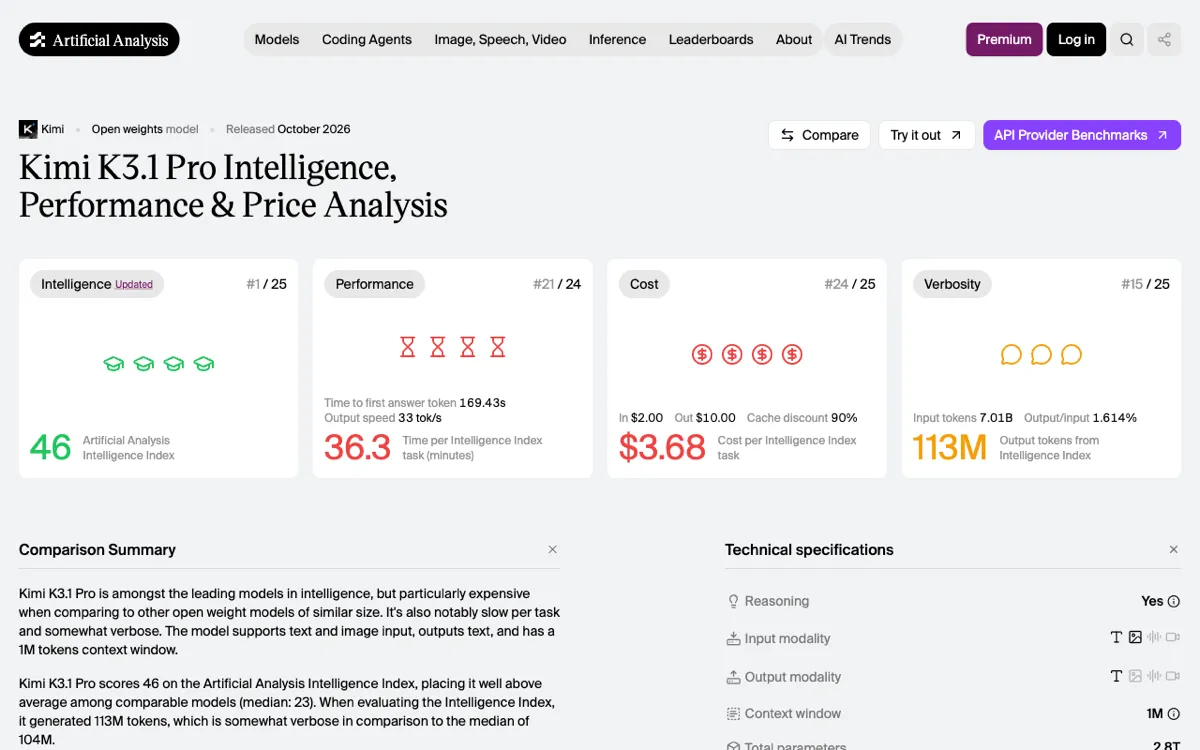 Artificial Analysis’s Kimi K3.1 Pro page, checked November 6, 2026
Claude Opus 5.5 at a glance
Anthropic released Claude Opus 5.5 on September 22, 2026. Its docs describe it as built for long-running agentic coding and knowledge work, and its API ID is claude-opus-5-5.
It has a 1M-token context window and 128K tokens of synchronous output. Thinking is adaptive and always on, and the default effort is medium. Anthropic lists it as available through its API, Amazon Bedrock, Google Cloud and Microsoft Foundry, and says it will not retire before September 22, 2027.
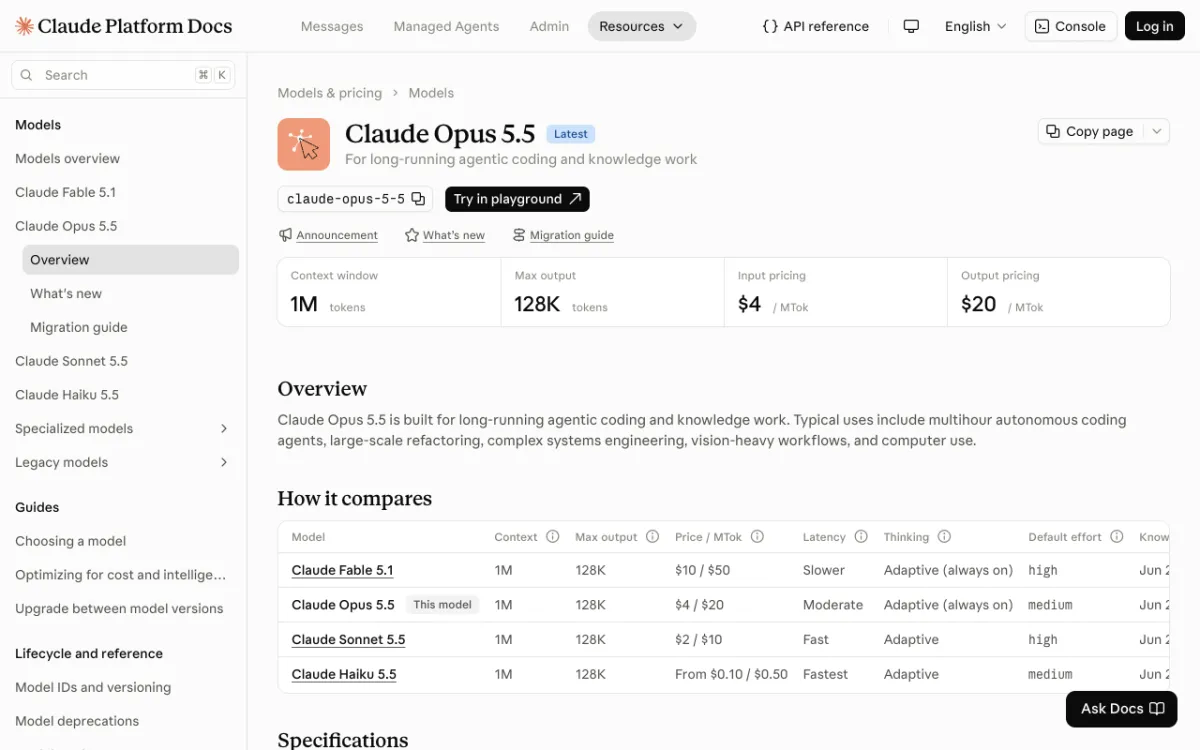 Anthropic’s Claude Opus 5.5 model page, checked November 6, 2026
Artificial Analysis index: 59 vs 46
Artificial Analysis scores Claude Opus 5.5 (max) at 59 on its Intelligence Index, second of 69 models. Kimi K3.1 Pro scores 46, first among the 25 open-weight models in its size class.
That 13-point gap is the clearest independent signal in this comparison. The same board shows how each model gets there:
| Artificial Analysis measure | Kimi K3.1 Pro | Claude Opus 5.5 |
|---|---|---|
| Intelligence Index | 46 | 59 |
| Output speed | 33 tokens/s | 108 tokens/s |
| Cost per index task | $3.68 | $10.04 |
| Output tokens across the index | 113M | About 218M |
| Time per index task | About 36 minutes | 26.7 minutes |
Opus is faster per token and finishes tasks sooner, even though it writes more tokens in total. Kimi is cheaper per task, but you wait longer for it.
Coding and agentic benchmarks
Both vendors publish Terminal-Bench 4.0 results, and they agree: Anthropic reports 66.4% for Claude Opus 5.5 (at xhigh effort), and Moonshot reports 65.7 for Kimi K3.1 Pro and 66.4 for Opus. That is a near tie on a hard terminal-agent benchmark.
Moonshot’s model card compares the two across more tests. These are Moonshot’s own runs, several on internal benchmarks, with both models at maximum effort.
| Benchmark (Moonshot’s model card) | Kimi K3.1 Pro | Claude Opus 5.5 |
|---|---|---|
| Terminal-Bench 4.0 | 65.7 | 66.4 |
| SWE Marathon v1.1 | 51.7 | 46.3 |
| DeepSWE v1.1 | 75.5 | 74.2 |
| BrowseComp | 92.1 | 90.8 |
| GPQA-Diamond | 94.2 | 93.9 |
| Program Bench | 31.5 | 65.0 |
| HLE-Diamond | 39.4 | 60.9 |
| Terminal-Bench-Science 0.1 | 38.1 | 63.3 |
| ExploitBench | 74.7 | 91.0 |
The pattern: Kimi matches or edges Opus on long-horizon coding and browsing, and falls far behind on whole-program generation, expert science and security tasks. A vendor choosing which benchmarks to show will favor its own model, so treat the first five rows with care.
Anthropic’s own table adds numbers Moonshot did not report. Opus 5.5 scores 54.4% on FrontierCode v1.1, 57.8% on CursorBench 4.0, 81.8% on OSWorld 2.1 (partial) and 67.7% on Humanity’s Last Exam with tools. Its figures for Terminal-Bench-Science (58.7%) and HLE differ from Moonshot’s, which shows how much settings and tools move the results.
We found no SWE-bench Verified score for either model in the vendor sources, so we do not quote one.
Context window and output limits
Both models have a 1M-token context window. The difference is in how it is billed and capped.
Anthropic includes the full 1M window at standard per-token pricing, so a 900K-token request costs the same per token as a 9K one. Opus 5.5 returns up to 128K tokens per call, or up to 300K on the Batches API with a beta header.
Kimi K3.1 Pro defaults to 131,072 output tokens and can be raised to 1,048,576. It also caches repeated prefixes automatically, at $0.20 per million cached input tokens.
Price per million tokens
Claude Opus 5.5 costs $4 per million input tokens and $20 per million output tokens on Anthropic’s pricing page, checked November 6, 2026. Kimi K3.1 Pro costs $2 and $10 on Moonshot’s pricing page.
| Price per million tokens | Kimi K3.1 Pro | Claude Opus 5.5 |
|---|---|---|
| Input | $2.00 | $4.00 |
| Output | $10.00 | $20.00 |
| Cached input | $0.20 | $0.20 |
| Batch | 60% of standard | 50% off |
| Faster tier | Highspeed: $4 / $20 | Fast mode: $8 / $40 |
Anthropic says fast mode runs up to 2.5x faster, and Moonshot says Highspeed is 2 to 3 times faster than standard. Both are vendor claims.
As a worked example, a job with 10M input tokens and 2M output tokens, uncached, costs $40 on Kimi ($20 plus $20) and $80 on Opus ($40 plus $40). That is the headline gap. Artificial Analysis shows the real-world gap is even bigger on its index, where Opus cost $10.04 per task against $3.68 for Kimi.
Opus 5.5 is cheaper than its predecessor, Claude Opus 5, which Anthropic priced at $5 and $25.
Open weights vs a closed API
Kimi K3.1 Pro’s weights are public, so you can self-host, fine-tune and keep data in your own environment. The catch is size: at 2.8T parameters and 4-bit weights, you need roughly 1.4 TB for weights alone by our arithmetic, before the KV cache.
Claude Opus 5.5 is closed. You reach it through Anthropic or a cloud partner, and you get no weights, but you also run no infrastructure. For most teams the API route is the practical one for either model.
If open weights are what you care about in video models rather than language models, see our guide to the best open-source AI video models. The Hailuo 3 review shows how another recent open release handles licensing, and the Grok Imagine 1.5 review covers a closed one.
Which should you pick?
Pick Claude Opus 5.5 if:
- You need the highest score on hard reasoning, science or whole-program generation
- Latency matters: it runs about 3x faster per token on Artificial Analysis
- You want a managed model on Bedrock, Google Cloud or Foundry with a published retirement date
Pick Kimi K3.1 Pro if:
- You need weights you can host, audit or fine-tune
- Your workload is long-horizon coding or browsing agents, where Moonshot’s results are closest to Opus
- Token price matters and you can use caching and batch pricing
Use both if you route by task: Kimi for high-volume agent runs, Opus for the hard cases. The cost gap makes that split worth testing on your own prompts.
Conclusion
Claude Opus 5.5 is the better model: 59 against 46 on Artificial Analysis, faster, and far stronger on hard reasoning. Kimi K3.1 Pro is the better deal and the only one you can download, and it holds up on agentic coding.
Run your own evals before committing. Vendor benchmarks, ours included, cannot tell you how either model behaves on your codebase.
Sources
- Anthropic: Claude Opus 5.5 announcement
- Claude Opus 5.5 model page
- Anthropic API pricing
- Moonshot Kimi API pricing
- Kimi K3.1 Pro model card
- Artificial Analysis leaderboard