
Kling 4.0 is Kuaishou's biggest Kling release yet: native clips up to 30 seconds, up to 15 Omni references, up to 10 keyframes and two-channel stereo audio. Kling says it rolled out fully on October 15, 2026. 10-bit HDR and 2-minute extension are still marked coming soon, and its API pricing page lists 4K as unavailable. We didn't run it ourselves, so this review reports Kling's own pages and outside tests, with each source named.
This Kling 4.0 review covers what Kuaishou’s newest video model does, what it costs and what is still marked “coming soon”. We didn’t run Kling 4.0 ourselves, so every claim below comes from Kling’s own pages or a named outside test.
It’s for creators and ad teams deciding whether a 30-second model is worth a plan. If you’re still shopping, our Kling AI alternatives list ranks seven rivals.
TL;DR: Kling 4.0 review verdict
Kling 4.0 is Kuaishou’s fourth-generation video model, and its headline change is length. It generates up to 30 seconds in one pass, doubling Kling 3.0’s 15, with stereo audio, up to 15 reference assets and up to 10 keyframes.
| Category | Verdict | Why |
|---|---|---|
| Clip length | Strong | 3 to 30 seconds native, per Kling |
| Control | Strong | 10 keyframes, 15 Omni references, 21:9 to 9:16 |
| Audio | Good, unproven | Stereo and nine named languages; no accuracy score published |
| Resolution | Mixed | 720p and 1080p now; 4K shown with no API price; HDR coming soon |
| Price clarity | Weak | API is public; app credit cost per second is not |
| Independent evidence | Thin | Mostly short tests and invited demos |
Use it for 20- to 30-second product shots, story beats and ads where one take beats stitching clips. Wait if you need HDR, 4K through the API or a published per-second app price.
What is Kling 4.0?
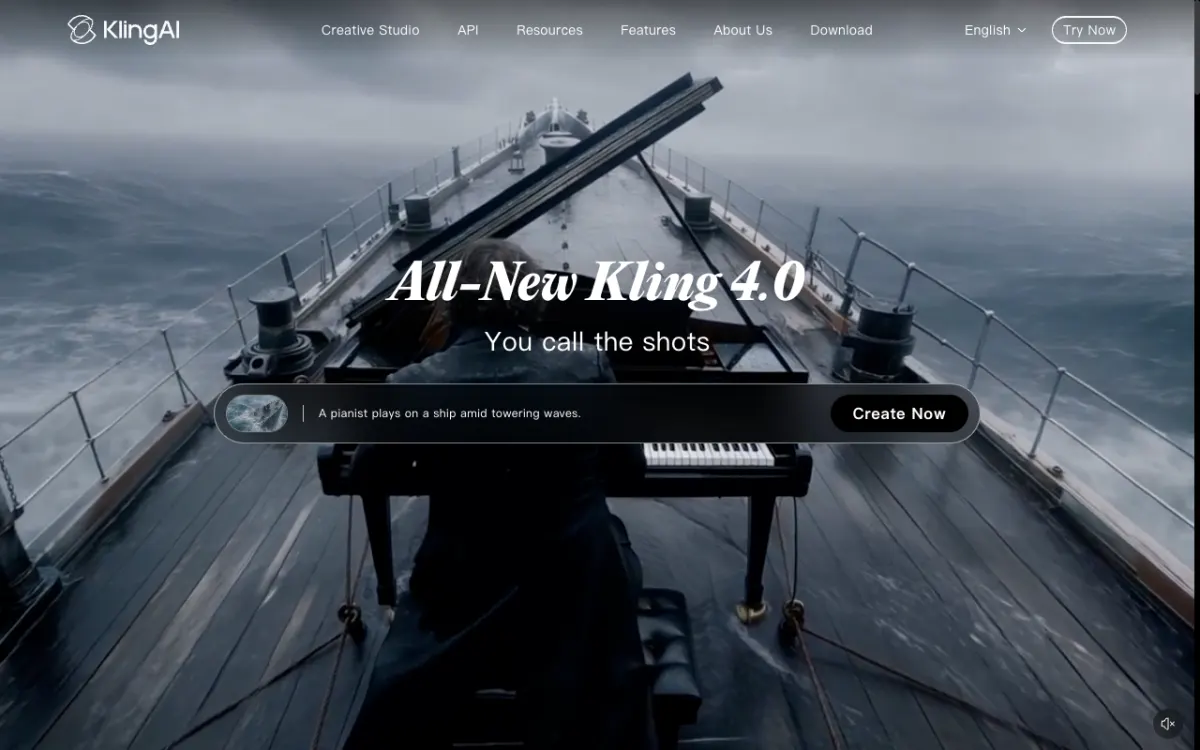 The Kling 4.0 page on kling.ai
Kling 4.0 is a text-to-video and image-to-video model from Kuaishou’s Kling AI. Kling announced it on September 30, 2026 with “native 30-second generation, 10-bit HDR, omni reference, multiple keyframes.”
The rollout came in steps. Kling 4.0 Flash opened on September 28 to Ultra Yearly subscribers, and Kling’s October 15 post said Kling 4.0 was fully available, per Kingy’s check of the release note. Kling’s API took the model on October 28, according to CometAPI’s guide, which cites Kling’s update notice.
Kling 4.0 specs at a glance
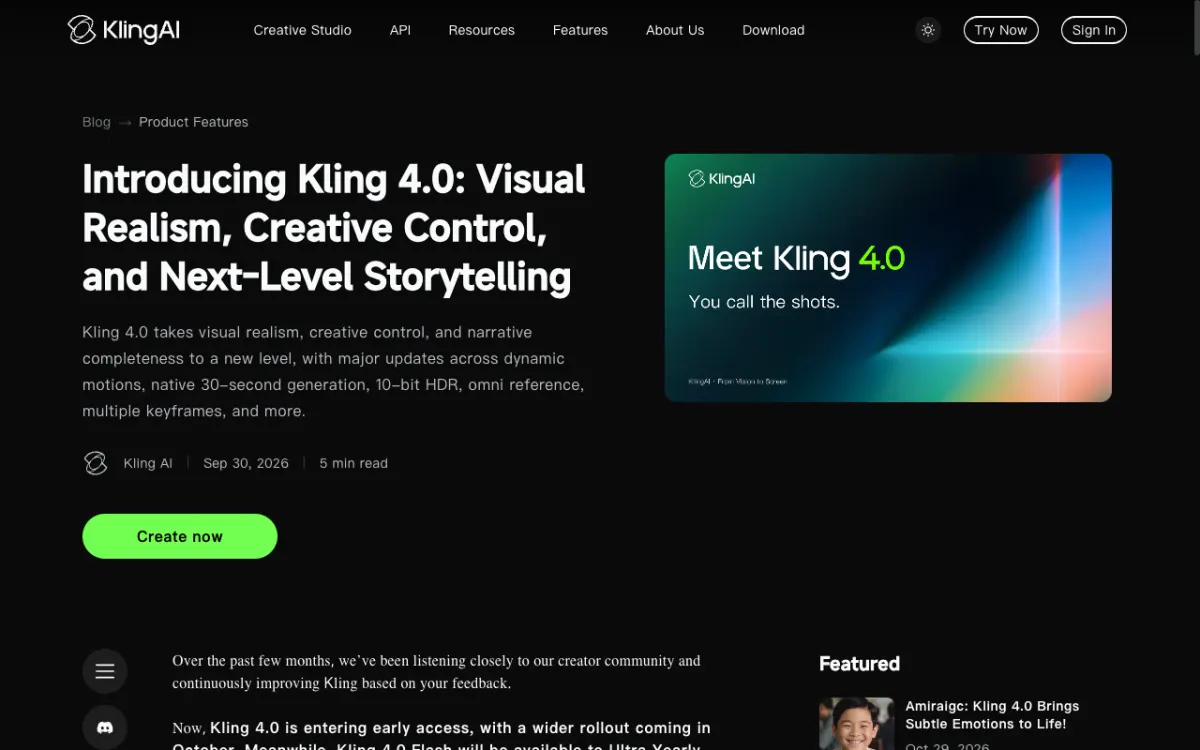 Kling’s announcement post, September 30, 2026
Every row below is from Kling’s announcement unless marked.
| Spec | Kling 4.0 |
|---|---|
| Length | Up to 30 seconds per generation (3 s minimum) |
| Keyframes | Up to 10 images |
| Omni references | Up to 15 assets: 10 images, 5 videos (30 s combined), 7 subjects |
| Audio | Two-channel stereo |
| Aspect ratios | 21:9, 16:9, 1:1, 9:16 and auto (per CometAPI) |
| Resolution | 720p and 1080p; 4K listed, see below |
| HDR | 10-bit at 1080p and 4K: coming soon |
| Prompt length | Up to 8,000 tokens |
| Extension to 2 minutes | Coming soon |
Kling 4.0 key features
30-second native clips
Kling 4.0 generates up to 30 seconds in one go, so a full ad spot or a story beat no longer needs stitching. Kling’s post says the clip stays coherent through “dynamic motions,” and one vendor-hosted demo shows a 30-second product sequence holding together across shots.
That is an invited demo, not a measured success rate. Kingy’s review states it ran no new generations and has no independent success rate for 30-second clips.
Omni references and keyframes
Omni lets you mix up to 15 reference assets per generation: 10 images, 5 videos (30 seconds in total) and 7 subjects. You can also bind a voice reference to a saved subject, per CometAPI.
Keyframes work the other way round: you drop up to 10 images on the timeline to pin key moments, and the model fills the movement between them. For product shots and character continuity, this is the feature that matters most. Compare the Omni idea with Hailuo 3’s reference system, which takes 9 images, 3 videos and 3 audio clips.
Stereo audio and lip sync
Kling 4.0 generates two-channel stereo audio in the same pass as the picture. Kling’s post lists Chinese, English, Japanese, Korean, Spanish, Portuguese, German, French and Hindi “and more”, plus Chinese dialects and English accents.
One outside reading, from CellCog, says that language list describes text rendered in frame rather than lip sync. Kling publishes no per-language lip-sync score, so confirm your language in your own account before committing.
4K and HDR: what is actually live
Kling lists 720p, 1080p and 4K, and says 10-bit HDR at 4K and 1080p is “coming soon.” On Kling’s API pricing page, the 4K column shows a dash for every Kling 4.0 row.
CellCog also reports 4K as not yet available in the API. The practical read: plan around 1080p, and treat 4K and HDR as a roadmap.
What testers found
Hands-on evidence is thin so far, and all of it is early. Here is what named outside sources reported.
- Lip sync. MindStudio’s early-access test of Kling 4.0 Flash kept sync through a dialogue-heavy diner scene and said the 3.0 drift problem “appears to be largely fixed,” from a small number of tests.
- Consistency. The same test saw a sink stay put when a character returned and eyelines match across cuts in a noir scene.
- Added details. Text-to-video added unprompted actions, Omni mode added a gray jacket that wasn’t in the reference, and a candle that should have melted didn’t.
- Emotion. Some testers found performances flat, even when sync was right.
- Ranking. Kingy noted Kling 4.0 did not appear on the Artificial Analysis audio leaderboards it checked on October 15.
MindStudio’s verdict, per its own write-up: a meaningful upgrade over 3.0, not a dramatic leap over leading rivals. Read Kling 4.0 vs Kling 3.0 for the side-by-side and Kling 4.0 vs Seedance 2.5 for the rival that testers call steadier.
Kling 4.0 pricing
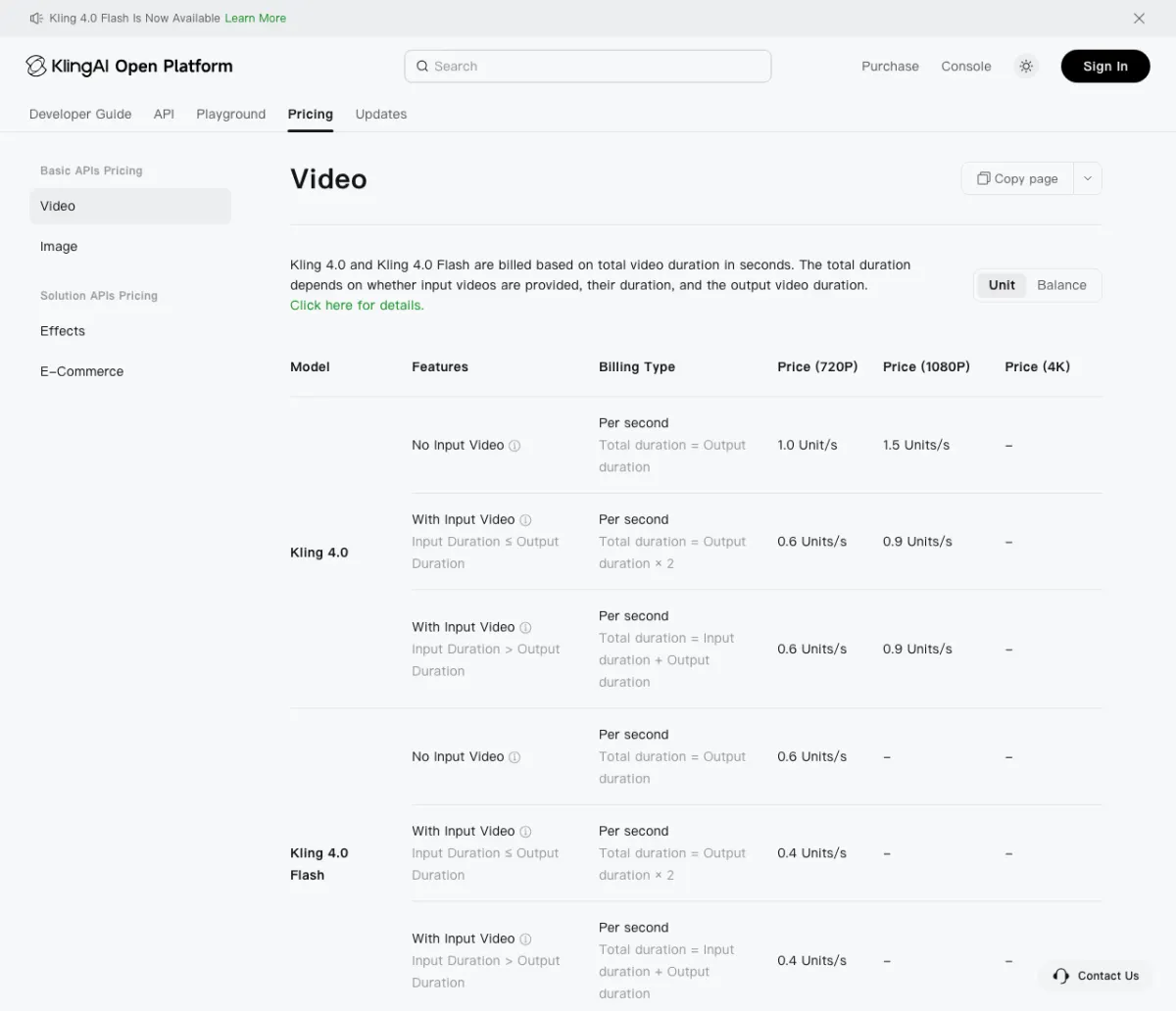 Kling’s API pricing page, checked November 6, 2026
Kling 4.0 has two public price points: the API’s per-second units and the app’s monthly plans. Both are below, with the one gap that matters flagged.
API price per second
Kling’s API bills by total video seconds. Checked November 6, 2026:
| Model | 720p | 1080p | 4K |
|---|---|---|---|
| Kling 4.0, no input video | 1.0 unit/s | 1.5 units/s | not listed |
| Kling 4.0, with input video | 0.6 unit/s | 0.9 unit/s | not listed |
| Kling 4.0 Flash, no input video | 0.6 unit/s | not listed | not listed |
Billing with an input video counts the output twice, or input plus output, which Kling spells out on the page. CellCog’s guide converts the units to $0.157 a second at 720p and $0.235 at 1080p, which makes a 30-second 1080p clip about $7.05. That conversion is theirs, not Kling’s.
App plans
These figures are from Kling’s own membership page, monthly view, checked November 6, 2026. Yearly billing is 34% off and Premier has a credit slider from 8K to 38K.
| Plan | First month | Then per month | Credits per month |
|---|---|---|---|
| Standard | $6.99 | $8.80 | 660 |
| Pro | $25.99 | $32.56 | 3,000 |
| Premier (8K slider) | $64.99 | $80.96 | 8,000 |
| Premier (18K slider) | $144.99 | $181.99 | 18,000 |
| Ultra+ | $432.99 | $544.99 | 57,000 |
Kling hasn’t published a flat credit cost per second for 4.0. Kingy recorded quotes of 270 credits for a 15-second product shot and 468 or 540 for 30-second setups, and says those are not billing receipts. On a 3,000-credit Pro plan, that is roughly five or six 30-second clips a month.
Kling 4.0 pros
- 30-second takes. Double Kling 3.0’s 15, and level with Seedance 2.5 and Wan 3.0 on length.
- Strong control. 10 keyframes and 15 mixed references in one prompt.
- Stereo audio in one pass. No separate sound step.
- Flash tier. At 0.6 units a second, a cheaper draft model sits in the same API.
- Public API pricing. You can budget it before you generate.
Kling 4.0 cons
- HDR is not live. Kling still marks it coming soon.
- 4K has no API price. It is listed on the spec sheet and missing from the price table.
- App cost is opaque. No published credits per second.
- Added details. Testers saw invented actions and clothing.
- Little independent data. No success rate or lip-sync score exists yet.
Where to run it, and a Kling 3.0 alternative
Kling 4.0 runs on kling.ai and through Kling’s API, and third-party API hosts are adding it. Our cheapest Kling 4.0 provider guide tracks who charges least.
If you’d rather run Kling next to other models on one balance, Vidwip’s AI video generator runs Kling 3.0 Standard, Kling 3.0 Pro and Kling O1, not Kling 4.0. It also carries Veo 3.1, Seedance 2.5, Hailuo 3 and Wan 3.0, so you can compare shots without switching tools.
| Vidwip model | Credits per second | Cost per second | Length |
|---|---|---|---|
| Kling O1 | 18 | $0.142 to $0.18 | 5 or 10 s |
| Kling 3.0 Standard | 20 | $0.158 to $0.20 | 3 to 15 s |
| Kling 3.0 Pro | 26 | $0.205 to $0.26 | 3 to 15 s |
A credit costs $0.01 on Starter ($25 a month for 2,500) and $0.0079 on Pro billed yearly ($79 a month for 10,000), so the lower figure is the Pro rate. See all 16 models on the models page and plan details on pricing. AI video needs a paid plan, from $25 a month.
If open weights matter more than length, read best open-source AI video models.
Who should use Kling 4.0?
Kling 4.0 suits you if you:
- make 20- to 30-second ads or story beats and hate stitching
- need keyframes and references to keep a product or character consistent
- can live at 1080p today and wait for HDR
Skip it if you need a published per-second app price, guaranteed 4K, or proven multilingual lip sync. Test one dialogue clip in your language first.
Conclusion: is Kling 4.0 worth it?
Kling 4.0 earns its hype on length and control. A 30-second native clip with 10 keyframes and 15 references is a real step up from Kling 3.0, and the API pricing is public.
The caveats are just as real. HDR and 2-minute extension are still roadmap, 4K has no API price, the app’s credit cost is unpublished, and independent testing is thin. Start with one 30-second clip on a Standard or Pro plan, and budget from the 468 to 540 credit quotes rather than the sticker credit count.