
PlayHT is gone: Meta bought the team in July 2025 and the service shut down on December 31, 2025. If your scripts end up under a video, Vidwip AI Voiceover voices them in 74 languages on the same timeline. ElevenLabs is the closest all-round replacement, Cartesia the fastest API, Fish Audio the cheapest paid voice cloning, and Chatterbox the free, self-hosted option.
PlayHT was a favorite for developers and creators who wanted realistic voices, an API and voice cloning in one place. Then it disappeared, and its users have needed PlayHT alternatives ever since.
Meta bought the team in July 2025, and the service closed on December 31, 2025.
If you landed here looking for PlayHT alternatives, you need two things: a tool that’s still running next year, and one that fits how you used PlayHT. That might be a voice agent API, a narration studio or a cloned brand voice.
This guide ranks eight replacements on voice realism, API latency, cloning and price per character. Every price was checked on the vendor’s own page in October 2026.
TL;DR — PlayHT alternatives at a glance
| Tool | Best for | Starting price | Voice cloning |
|---|---|---|---|
| Vidwip AI Voiceover | Script to speech inside a video editor | Free to start, no card | No |
| ElevenLabs | Closest all-round PlayHT replacement | $6/mo Starter | Instant and professional |
| Cartesia | Real-time voice agents | $5/mo Pro | Instant from 10 seconds |
| Fish Audio | Cheap cloning and pay-as-you-go API | $11/mo Plus | Every plan |
| Murf AI | Narration studio and cheap API | $0.01/1K chars (Falcon API) | Enterprise only |
| Chatterbox | Free, self-hosted TTS | Free (MIT) | Yes, from a reference clip |
| Deepgram Aura | Pay-as-you-go API, no subscription | $0.030/1K chars | No |
| OpenAI TTS | Teams already on the OpenAI API | $15/M chars (tts-1) | Sales-approved customers only |
What happened to PlayHT
PlayHT, which also traded as PlayAI, built text-to-speech and voice cloning for creators and developers. Its PlayDialog model was built for multi-turn, conversational speech.
In July 2025, Meta confirmed it had acquired PlayAI, and the team moved to Meta. Here is the timeline that matters to a former customer:
- July 2025: Meta acquires PlayAI. The whole team joins Meta.
- August 2025: PlayHT stops taking new sign-ups.
- December 31, 2025: The service shuts down for good. Accounts, saved audio and cloned voices are deleted.
- October 2026: The play.ht domain no longer resolves (checked October 19, 2026).
So there’s nothing to wait for. Your old voice clones are gone, and any PlayHT API key in your codebase is dead weight.
What to look for in a PlayHT alternative
Voice realism. Listen for breath, pacing and emotion on a long paragraph, not a one-line demo. Flat delivery shows up fast in a 10-minute narration.
API latency. Voice agents need the first audio chunk back in under about 100ms, or the pause feels awkward. If you only render narration files, latency barely matters.
Voice cloning and rights. Check which plan includes cloning, how much audio it needs, and whether a commercial license comes with it. Clone only voices you have permission to use.
Price per character. PlayHT users mostly paid per character or per word. Compare tools on the same unit: cost per million characters, or per hour of finished speech (about 54,000 characters).
1. Vidwip AI Voiceover
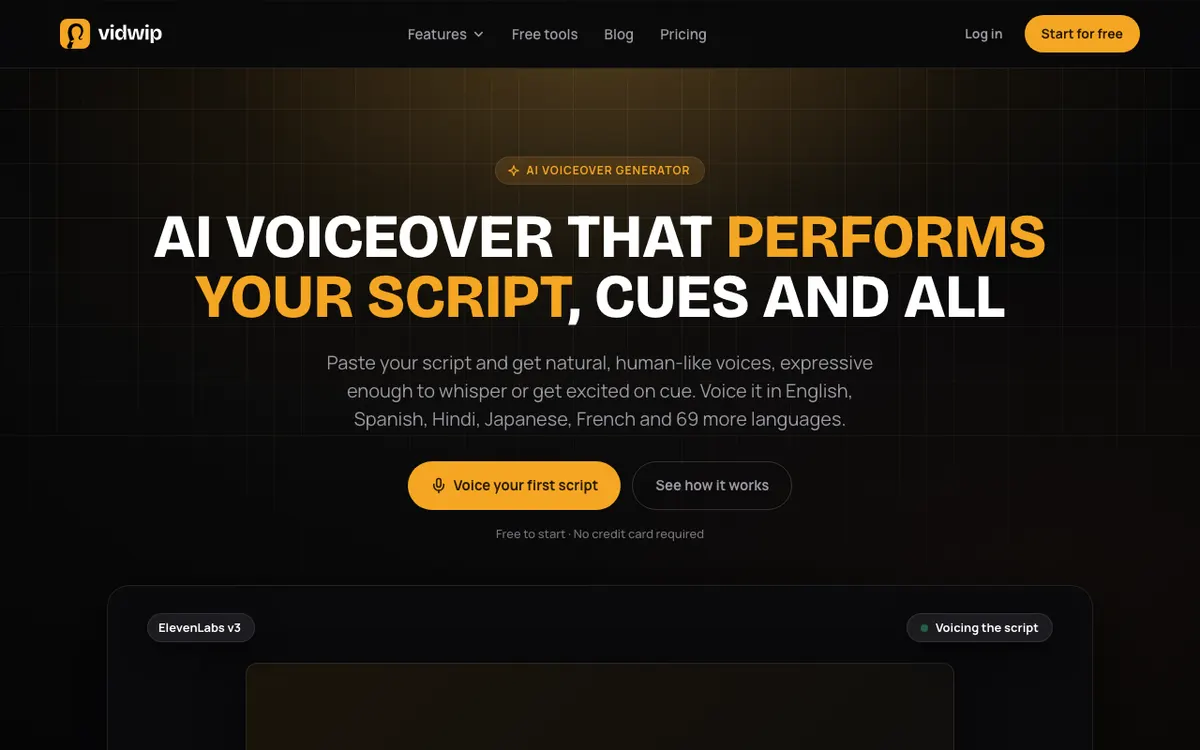 Vidwip AI Voiceover — script to speech in 74 languages, placed straight on your video timeline
Vidwip AI Voiceover is a script-to-speech tool inside the Vidwip AI Studio, for creators whose voiceover ends up under a video. You paste a script, pick a voice and a language, and get a mastered track on your timeline.
That’s the gap PlayHT never filled. PlayHT gave you an audio file, and you still had to import it, level it and line it up in an editor.
You paste up to 5,000 characters, about 5.5 minutes of speech. Pick one of 190+ voices, native to 23 languages, and keep the script’s language or choose any of 74.
When you pick a new language, the AI translates the script paragraph by paragraph before it’s spoken. Your names, brand spellings and cues stay intact.
Cues in square brackets, like [whispers] or [warmly], are performed rather than read aloud. A blank line between paragraphs adds a pause.
Every track comes out as one MP3, mastered to -14 LUFS and placed after the audio already on your timeline. Your voice and language stay selected for the next script, so a course or a series keeps one consistent voice.
Need narration written for you? AI Video Voiceover watches your video, writes the script from what’s on screen and voices it, at $0.60 per finished minute.
Pros
- The voiceover lands on a video timeline, with no export, import or leveling step
- 190+ voices, each able to speak all 74 languages
- Bracketed cues direct the read: [whispers], [warmly], [excited]
- Built-in script translation keeps tags, names and brand spellings
- Free to start, with no credit card
Cons
- No voice cloning or custom voices, so it can’t replace a PlayHT clone
- No public API, so it won’t power a voice agent or an app
- One voice per track: a dialogue means one track per line
- You can’t regenerate a single sentence; you fix the script and generate the track again
Best for: YouTubers, course creators and marketers who used PlayHT to narrate videos and want the voice and the edit in one place.
Pricing: Free to start, no credit card. Starter is $25/month for 2,500 credits and Pro is $99/month for 10,000 credits. See Vidwip pricing.
2. ElevenLabs
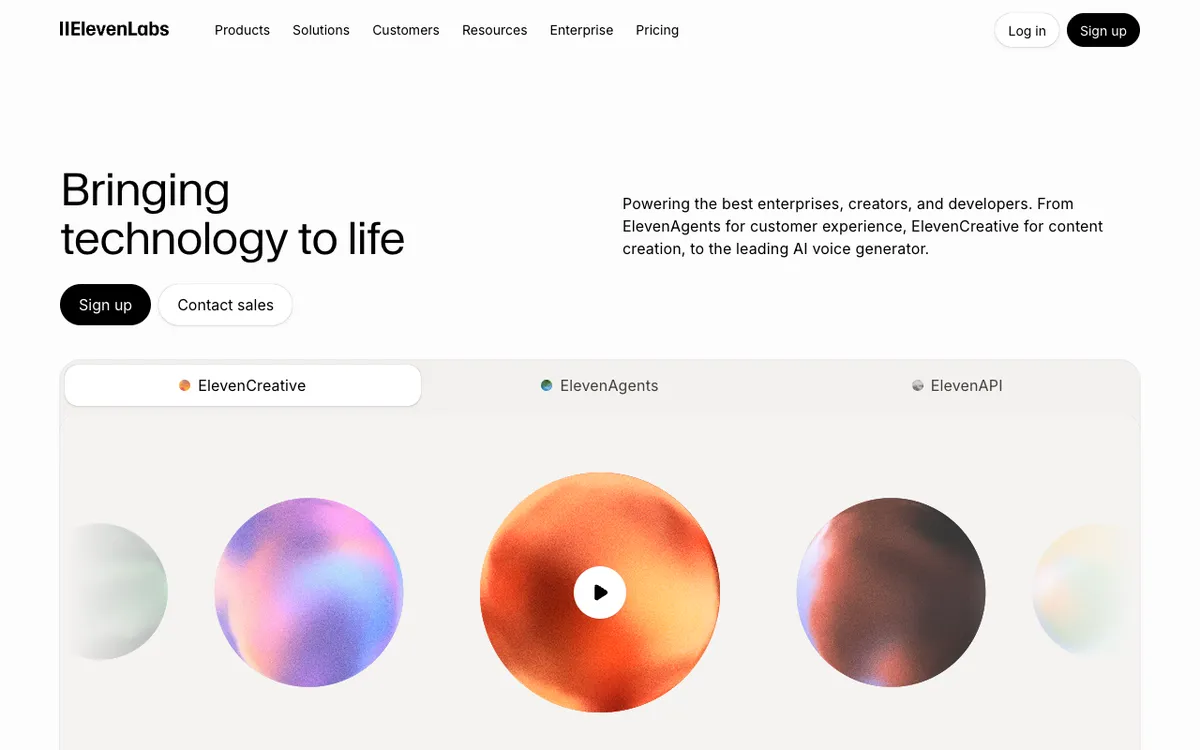 ElevenLabs — studio, API and voice cloning in one account
ElevenLabs is the closest like-for-like PlayHT alternative: a browser studio, a developer API and voice cloning in one account, from $6/month. If you used PlayHT for everything, start here.
Eleven v3 handles expressive narration in 70+ languages and takes audio tags for direction. Eleven v4 extends that to 90+ languages, per the ElevenLabs model docs.
For agents, Flash v2.5 lists about 75ms of model latency in 32 languages. That’s the model to test if you ran a PlayHT voice bot.
Cloning comes in two tiers. Instant cloning starts on the $6 Starter plan, and professional voice clones start on the $22 Creator plan.
Pros
- One account covers studio, API, cloning, dubbing and agents
- Expressive Eleven v3 delivery with audio tags
- Flash v2.5 at about 75ms for real-time use
- Commercial license from the $6/month Starter plan
Cons
- Costs more per hour of speech than Cartesia, Deepgram or OpenAI
- Credits run out fast on long-form narration at the lower tiers
- The free plan carries no commercial license
Best for: Former PlayHT users who want one vendor for narration, cloning and an API, and care about realism more than cost.
Pricing: Free (about 10 minutes a month, no commercial license). Starter $6/month (about 30 minutes), Creator $22/month (about 121 minutes, one professional clone), Pro $99/month (about 600 minutes). Checked October 2026 on elevenlabs.io/pricing.
3. Cartesia
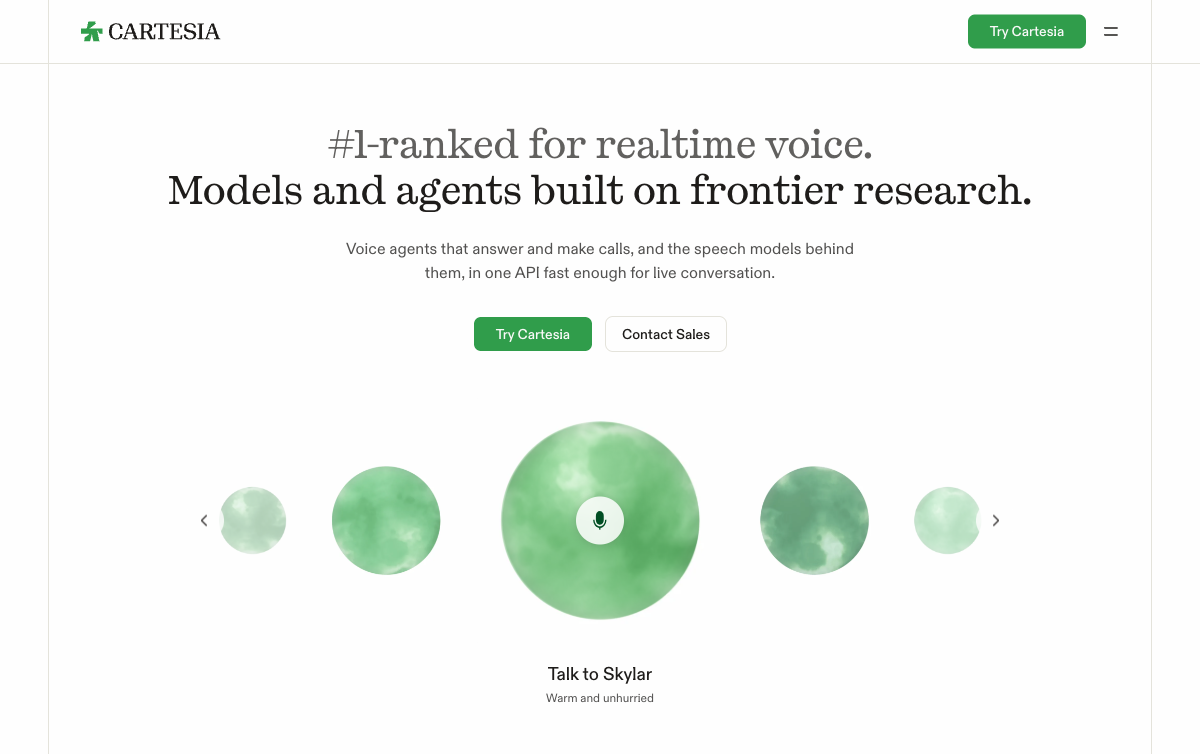 Cartesia — the Sonic voice API, built for real-time agents
Cartesia is a TTS API for developers building voice agents, with first audio in under 90ms on Sonic-3.6. If PlayHT powered your phone bot or assistant, this is the most direct swap.
Sonic-3.6 covers 44 languages and clones a voice from 10 seconds of audio, per the Sonic product page. Instant cloning starts on the $5 Pro plan.
Billing is simple: one credit equals one character, and a minute of speech uses about 750 to 800 credits. The $49 Startup plan works out to roughly $1.76 per hour of audio.
Pros
- Under 90ms to first audio on Sonic-3.6
- Instant voice cloning from about 10 seconds of audio, from $5/month
- 44 languages
- Clear credit-per-character billing with published overage rates
Cons
- Built for developers: no long-form narration studio
- Long, emotional narration is not its focus
- The free plan has no voice cloning
Best for: Developers who ran PlayHT behind a voice agent, IVR or assistant and need low latency at a low price.
Pricing: Free (20K credits, about 27 minutes). Pro $5/month (100K credits, instant cloning). Startup $49/month (1.25M credits, about 1,667 minutes, 2 professional clone slots). Scale $299/month (8M credits). Checked October 2026 on cartesia.ai/pricing.
4. Fish Audio
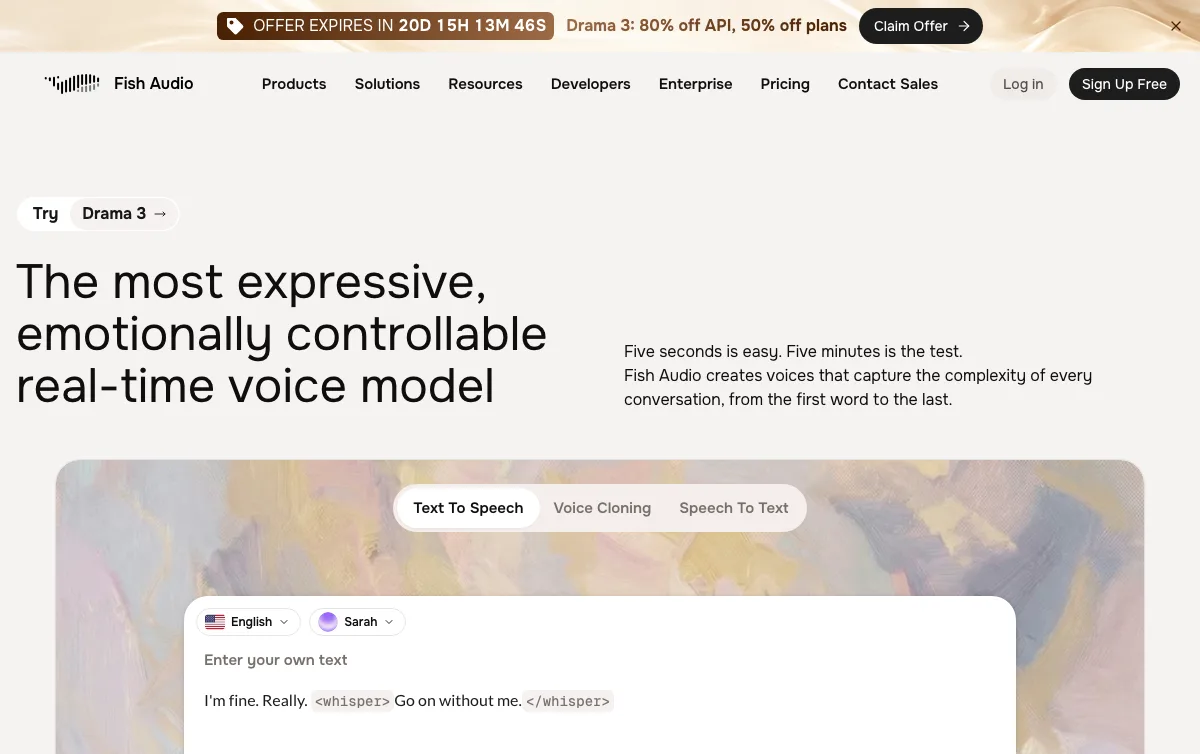 Fish Audio — voice cloning on every plan, plus a pay-as-you-go API
Fish Audio is the cheapest paid route to a cloned voice, with cloning on every plan and an $11/month Plus tier. It’s the closest match for PlayHT users who mainly cloned voices.
The Plus plan gives 250,000 credits, up to about 200 minutes a month, and 15,000 characters per generation. Commercial use is allowed from Plus up.
The API is pay-as-you-go at $15 per million UTF-8 bytes for the S2 models, with no subscription. Fish Audio’s own docs put a million bytes at about 12 hours of English speech.
Pros
- Voice cloning on every plan, including free
- $15 per million UTF-8 bytes on the API, with no monthly minimum
- Large community voice library
- Up to 30,000 characters per generation on Pro
Cons
- Community voices vary a lot in quality
- The free plan is for personal, non-commercial projects only
- The older S1 model retires on December 31, 2026, so build on S2
Best for: Creators and small teams who need a cloned voice for commercial work on a tight budget.
Pricing: Free (8,000 credits, about 7 minutes, non-commercial). Plus $11/month (250K credits). Pro $75/month (2M credits, 5 professional voice slots). API $15 per million UTF-8 bytes. Checked October 2026 on fish.audio and its API pricing docs.
5. Murf AI
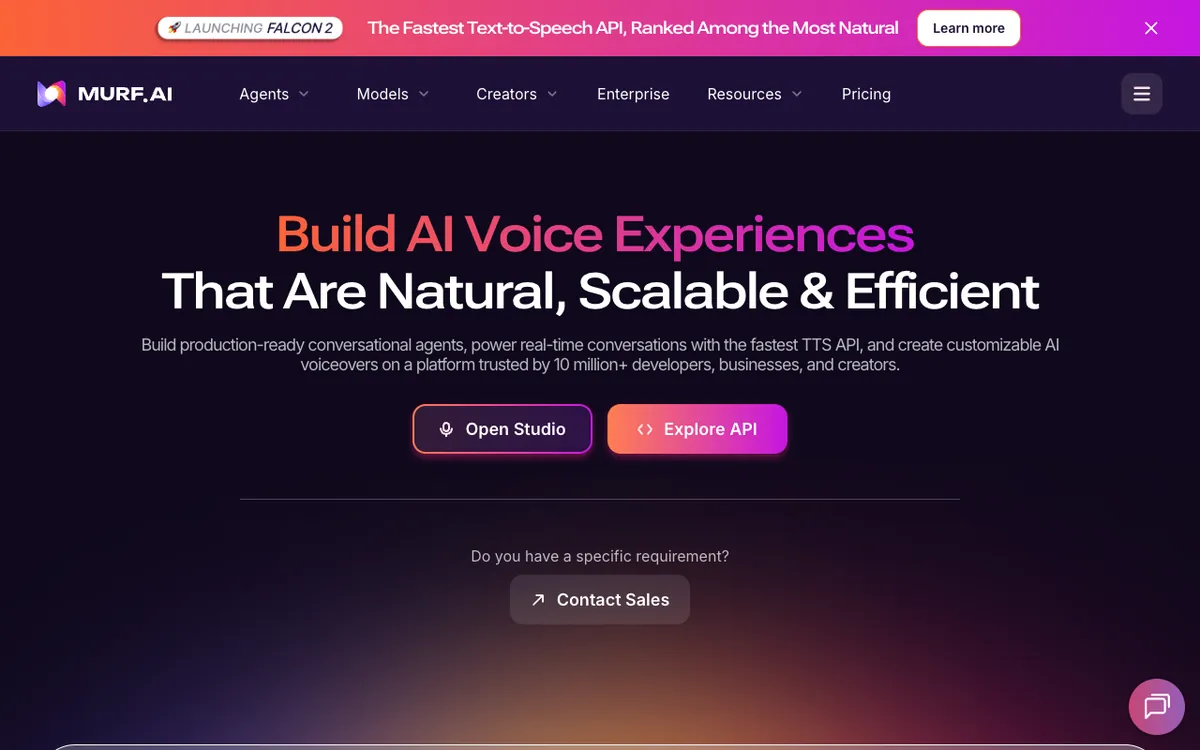 Murf AI — a narration studio with 200+ voices, plus the Falcon API
Murf AI covers both halves of what PlayHT did: a voiceover studio with 200+ voices, and an API whose Falcon model costs $0.01 per 1,000 characters. That’s about $0.54 per hour of speech.
Falcon is built for voice agents and lists time-to-first-audio under 100ms. The Gen2 model, for richer narration, costs $0.03 per 1,000 characters.
The Studio is where Murf earns its keep for narrators. You get pitch, pace and pronunciation controls, plus emphasis and “Say It My Way” on the Business plan.
Pros
- Falcon API at $0.01 per 1,000 characters, with $10 of free API credit
- Studio with 200+ voices across 30+ languages and accents
- Pronunciation controls and a personal pronunciation library
- Commercial rights on every paid Studio plan
Cons
- Voice cloning is an Enterprise add-on, not self-serve
- Studio plans include one editor seat, even on Business
- The free Studio plan has no downloads and no commercial rights
Best for: E-learning and marketing teams that want a narration studio, and developers who want a cheap, fast TTS API from the same vendor.
Pricing: API: Falcon $0.01/1K characters, Gen2 $0.03/1K characters, $10 free credit. Studio: Creator $19/month billed annually (24 hours a year), Business $66/month billed annually (96 hours a year). Checked October 2026 on murf.ai/pricing.
6. Chatterbox by Resemble AI
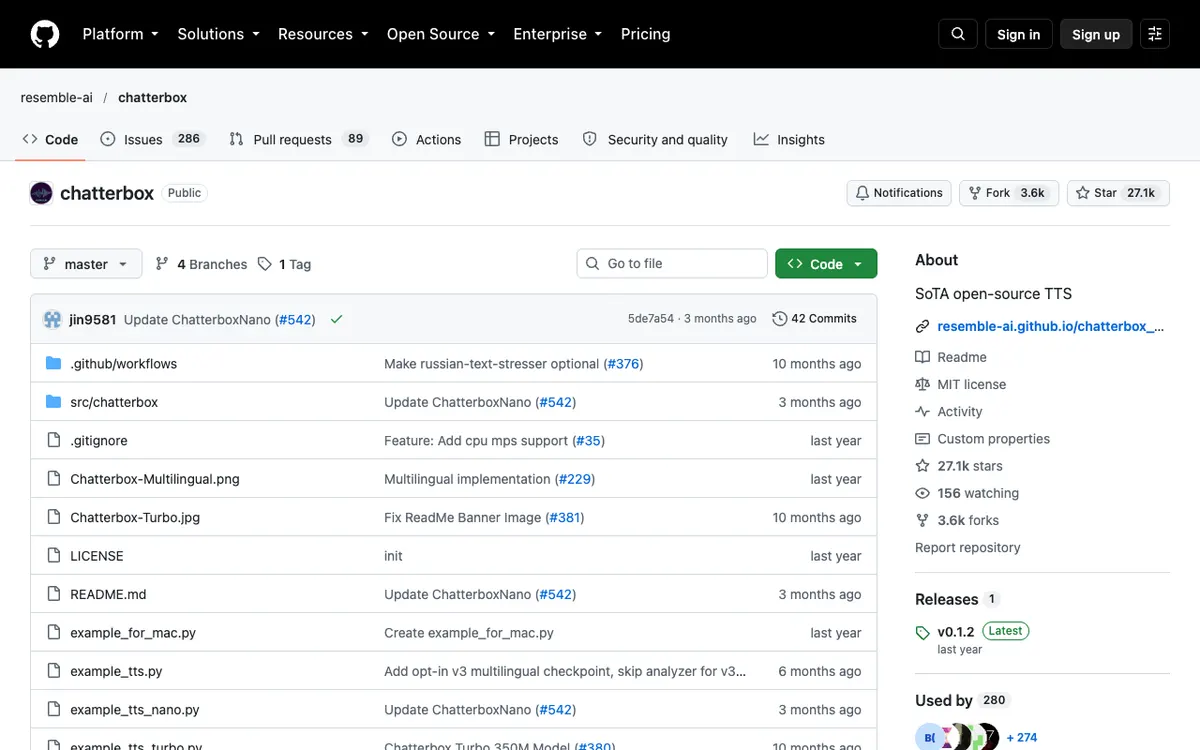 Chatterbox — Resemble AI’s MIT-licensed TTS models on GitHub
Chatterbox is Resemble AI’s open-source text-to-speech family, free under the MIT license and run on your own hardware. After PlayHT, plenty of teams decided they never want a vendor shutdown to take their voices again.
One note on Resemble AI itself: its pricing page now sells deepfake detection, watermarking and identity checks, with no hosted text to speech (checked October 2026). Chatterbox is the part of Resemble you can still use for speech.
The family has four main models. Chatterbox-Multilingual V3 (500M parameters) covers 23 languages, Turbo (350M) targets low-latency agents with tags like [laugh], and Nano (110M) runs on a CPU.
Each model clones a voice from a short reference clip. Every file it generates carries Resemble’s Perth watermark, which is built to survive MP3 compression.
Pros
- Free and MIT-licensed, with no per-character fees
- Self-hosted, so no vendor can shut down your voices
- Voice cloning from a short reference clip
- Multilingual V3 covers 23 languages; Nano runs on a CPU
Cons
- You run the servers, GPUs and scaling yourself
- No studio, no support and no SLA
- Turbo and Nano are English only
Best for: Engineering teams who want PlayHT-style cloning with no vendor lock-in and have the infrastructure to host it.
Pricing: Free (MIT license). You pay only for your own compute. Checked October 2026 on GitHub.
7. Deepgram Aura
 Deepgram Aura — pay-as-you-go TTS with no subscription
Deepgram Aura is a pay-as-you-go TTS API at $0.030 per 1,000 characters on Aura-2, about $1.62 per hour of speech. New accounts get $200 of free credit.
There’s no plan to pick and no credit balance to watch. You call the API and pay for the characters you send.
The trade-off is range. Aura-2 has 90 voices across 7 languages, per Deepgram’s model docs, and no voice cloning.
Pros
- Pay-as-you-go, with no subscription
- $200 free credit for new accounts
- About $1.62 per hour of speech on Aura-2, $0.81 on Aura-1
- Pairs with Deepgram’s speech-to-text for full voice agents
Cons
- No voice cloning
- Only 7 languages on Aura-2
- API only, with no studio for narrators
Best for: Developers building English-first voice agents who want simple billing and already use, or plan to use, Deepgram’s transcription.
Pricing: Aura-2 $0.030 per 1,000 characters ($0.027 on Growth). Aura-1 $0.015 per 1,000 characters. $200 free credit. Checked October 2026 on deepgram.com/pricing.
8. OpenAI TTS
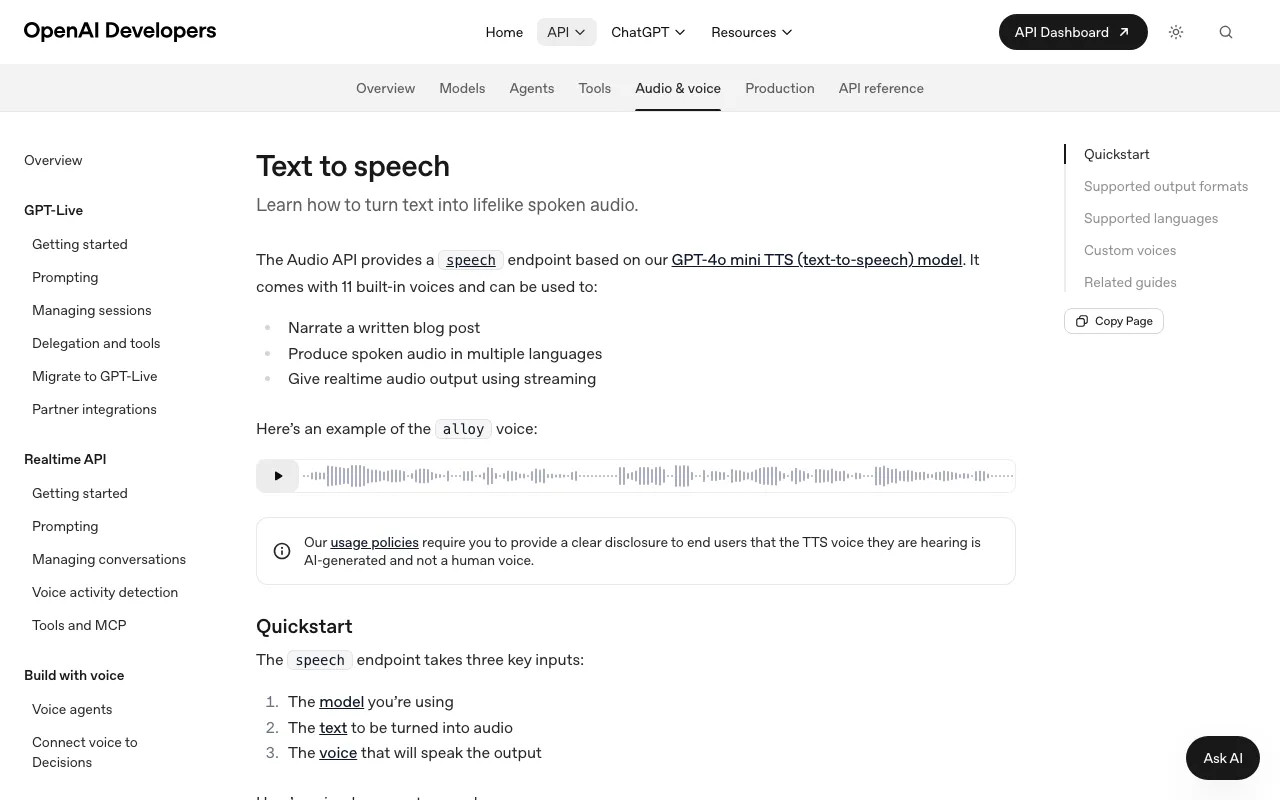 OpenAI TTS — speech from the API you may already call
OpenAI TTS is text to speech inside the OpenAI API, at $15 per million characters on tts-1. If your app already calls OpenAI, it’s the fastest migration off a dead PlayHT key: same account, same SDK, same bill.
gpt-4o-mini-tts takes plain-language instructions on tone and delivery, such as “calm and reassuring”. It’s billed at $0.60 per million text input tokens and $12 per million audio output tokens.
The limits are real. You get 13 built-in voices, and custom voices are open only to eligible customers through sales, with a consent recording from the speaker, per OpenAI’s custom voices guide.
Pros
- No new vendor if you already use the OpenAI API
- tts-1 at about $0.81 per hour of speech
- gpt-4o-mini-tts follows tone instructions
- Simple, documented pricing
Cons
- Custom voices need sales approval and a speaker consent recording
- 13 built-in voices, a small set next to ElevenLabs or Fish Audio
- API only, with no narration studio
Best for: Developers already on OpenAI who need serviceable speech in an app, not a signature voice.
Pricing: tts-1 $15 per million characters, tts-1-hd $30 per million characters, gpt-4o-mini-tts $0.60 per million text input tokens and $12 per million audio output tokens. Checked October 2026 on OpenAI’s pricing page.
PlayHT alternatives compared side by side
| Tool | Type | Voice cloning | Latency (vendor-listed) | Languages | Approx. cost per hour of speech |
|---|---|---|---|---|---|
| Vidwip AI Voiceover | Studio, video timeline | No | Not built for real time | 74 | Plan credits (from $25/mo) |
| ElevenLabs | Studio + API | Instant and professional | ~75ms (Flash v2.5) | 70+ (v3), 90+ (v4) | ~$11 (Creator) |
| Cartesia | API | Instant, 10 seconds | Under 90ms (Sonic-3.6) | 44 | ~$1.76 (Startup) |
| Fish Audio | Studio + API | Every plan | Not listed | Not listed | ~$1.25 (API) |
| Murf AI | Studio + API | Enterprise add-on | Under 100ms (Falcon) | 30+ | ~$0.54 (Falcon API) |
| Chatterbox | Open source | Yes, reference clip | Depends on your hardware | 23 (Multilingual V3) | Your compute only |
| Deepgram Aura | API | No | Not listed | 7 | ~$1.62 (Aura-2) |
| OpenAI TTS | API | Eligible customers via sales | Not listed | Not listed | ~$0.81 (tts-1) |
Cost per hour assumes about 54,000 characters per hour of speech. Fish Audio’s figure uses its own estimate of about 12 hours per million UTF-8 bytes. All prices checked October 2026.
How to choose the right PlayHT replacement
- You narrated videos with PlayHT: pick Vidwip AI Voiceover. The voice lands on the timeline, in 74 languages, without a round trip through an editor.
- You used PlayHT for everything: pick ElevenLabs. It’s the only option here with a mature studio, an API, two tiers of cloning and dubbing in one account.
- You ran a voice agent on the PlayHT API: test Cartesia and ElevenLabs Flash first, then Murf Falcon if cost decides it.
- You cloned voices on a budget: pick Fish Audio. Cloning is on every plan, and commercial rights start at $11/month.
- You never want another shutdown to take your voices: self-host Chatterbox.
- You want the simplest bill: Deepgram Aura or OpenAI TTS, both pay-as-you-go.
Migrating off PlayHT in four steps
- Find every PlayHT call in your code and content pipeline. Search for the PlayHT SDK, API keys and webhook URLs.
- Gather your source recordings. Your PlayHT clones are gone, so re-clone from the original audio, and only voices you have rights to.
- Run a blind listening test. Voice the same 500-word script in your top two tools and compare realism, pronunciation and latency.
- Budget on the right unit. Convert each vendor’s price into cost per hour of speech before you sign up for a yearly plan.
Final verdict
PlayHT isn’t coming back, so pick a replacement for how you actually used it.
ElevenLabs is the safest all-round swap, and Cartesia wins for voice agents. Fish Audio wins on cloning per dollar, and Chatterbox wins if you want to own the model outright.
If your scripts end up under a video, skip the export-and-import loop. Vidwip AI Voiceover voices your script in 74 languages and puts the mastered track on your timeline. It’s free to start, with no credit card.
Related guides
- 9 Best ElevenLabs Alternatives for AI Voice and TTS in 2026
- 8 Best Murf AI Alternatives for Studio-Quality Voiceover 2026
- Best AI Video Voiceover Generators for 2026: 4 Picks Ranked
- The 5 Best AI Video Dubbing Tools Compared and Ranked 2026