
Wan 3.0 is Alibaba's 30-second AI video model with generated sound. It sits at #1 on the Artificial Analysis text-to-video leaderboard (1,172 Elo, checked November 6, 2026), well above Kling 3.0 Pro (1,000), at $0.10 a second for 720p on Alibaba's API. Its weights are closed, so you can't run it locally; the last open Wan is 2.2. We didn't run our own tests.
Wan 3.0 is Alibaba’s AI video model, and on the Artificial Analysis leaderboard it is currently the best-rated one with sound. It makes clips up to 30 seconds long and costs $0.10 a second at 720p on Alibaba’s API.
The catch is access. Unlike earlier Wan versions, Wan 3.0 has no public weights, so this Wan 3.0 review covers a hosted model only.
We didn’t run our own generations. Every claim below comes from Alibaba’s pages or a named third party, all read on November 6, 2026.
TL;DR: Wan 3.0 review verdict
Wan 3.0 is a strong long-clip video model with generated sound. It tops the blind-vote leaderboard, takes text, images, video and audio as input, and costs $0.10 a second at 720p on the API.
| Category | Verdict | Why |
|---|---|---|
| Quality (leaderboard) | Strong | #1 on Artificial Analysis text to video with audio, 1,172 Elo |
| Clip length | Strong | 2 to 30 seconds in one pass |
| Price | Strong | $0.10/s at 720p, $0.20/s at 1080p on Alibaba’s list |
| Inputs | Strong | 10 images, 5 videos, 5 audio clips, plus a document or web link |
| Open weights | Weak | None; the open line ends at Wan 2.2 |
| Evidence | Mixed | Alibaba published no benchmark of its own |
Use it for long takes, drafts and cost-sensitive volume. Skip it if you need to self-host or want a model you can fine-tune.
What is Wan 3.0?
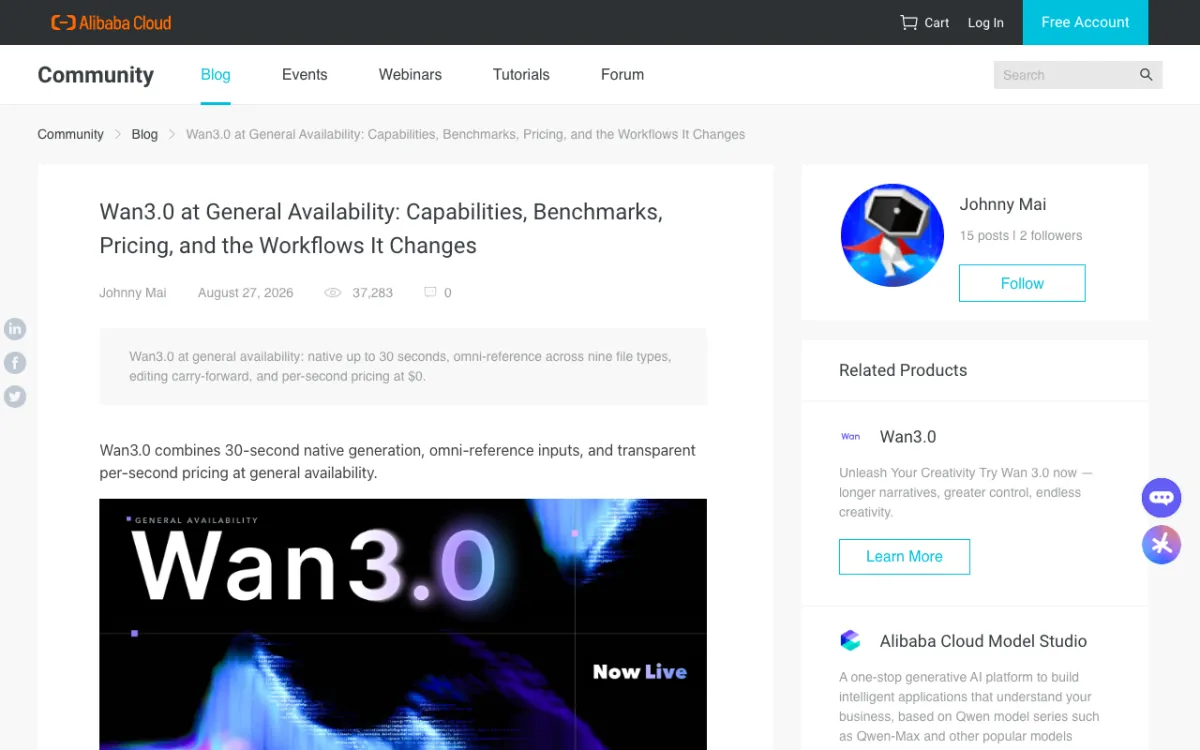 Alibaba Cloud’s general availability post for Wan3.0, August 27, 2026
Wan 3.0 is the third generation of Alibaba’s Wan video models, sold on Alibaba Cloud Model Studio as wan3.0-video. Alibaba Cloud announced general availability on August 24, 2026 across its international channels, after a public beta from early August.
Alibaba’s API reference page still labels the model “currently in preview”. Treat “generally available” as Alibaba’s wording, not a guarantee of final terms.
The headline change is length. Wan 2.7 made 2 to 15 second clips, and Wan 3.0 doubles that to 30 seconds in one generation.
You can reach it three ways: wan.video, Alibaba Cloud Model Studio’s API, and third-party platforms. Vidwip’s AI Video Generator is one of those.
Wan 3.0 specs
These are the limits on Alibaba’s Wan3.0 API reference, checked November 6, 2026. Other platforms can set narrower ones.
| Spec | Wan 3.0 (Alibaba API) |
|---|---|
| Clip length | 2 to 30 seconds, or let the model choose |
| Resolution | 480p, 720p, 1080p |
| Frame rate | 30 fps |
| Aspect ratios | Adaptive, 21:9, 16:9, 4:3, 1:1, 3:4, 9:16 |
| Audio | Generated by default; can be switched off at the same price |
| Reference inputs | 10 images, 5 videos (15 s total), 5 audio clips (15 s total) |
| Documents | One file or web link (PDF, Office, text; up to 50 pages) |
| Prompt | Up to 20,000 characters, Chinese or English |
| Output | MP4 (H.264); result links expire after 24 hours |
Two details matter in practice. First and last frame inputs can’t be combined with reference inputs in the same request, and a file can’t be combined with a web link.
The document and web-link input is the odd one out. You can hand the model a PDF or a page and ask for a video from it, which no other model in this comparison lists.
Wan 3.0 pricing: what a second costs
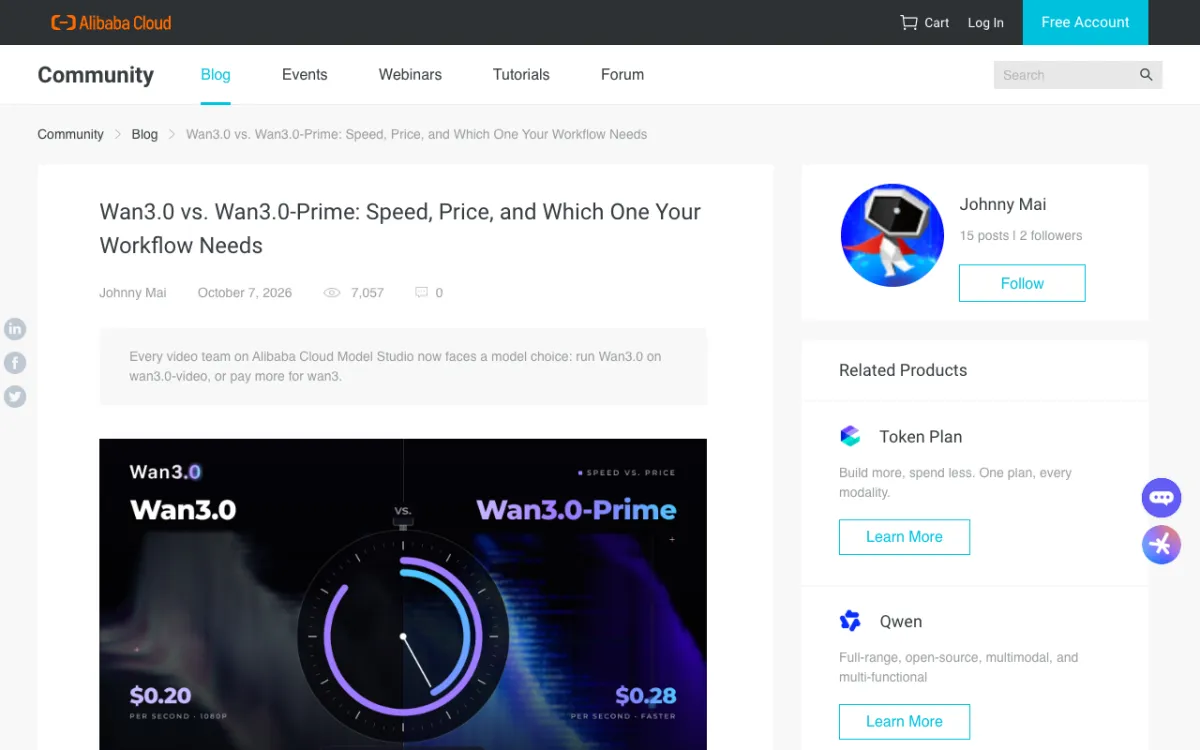 Alibaba’s Wan3.0 vs Wan3.0-Prime post, with the 1080p per-second prices
Alibaba bills Wan 3.0 per second of output video. Here’s the Singapore (international) list on its Model Studio pricing page, checked November 6, 2026:
| Model | 480p | 720p | 1080p | 10 s at 720p |
|---|---|---|---|---|
| wan3.0-video | $0.05 | $0.10 | $0.20 | $1.00 |
| wan3.0-video-prime | $0.068 | $0.14 | $0.28 | $1.40 |
Prime is the faster tier. Alibaba says it shares the standard model’s capabilities and is “significantly faster”, but publishes no speed figure.
The US (Virginia) section of the same page lists wan3.0-video at about $0.0825 a second for 720p and $0.165 for 1080p, flagged as a limited-time 30% discount. Prime is $0.127 and $0.254. The page tags the Singapore rows with the same 30% promotion, so it isn’t clear whether $0.10 is already discounted; fal.ai also charges $0.10 a second at 720p. Those are the rows for the global deployment scope, so check the page for yours.
Input video also bills by duration, and the 30-second free quota covers input and output combined. A 30-second 1080p clip at the Singapore rate is $6.00.
What it costs in Vidwip
Vidwip runs Wan 3.0 at 16 credits a second, 720p, with sound, in 16:9, 9:16, 1:1, 4:3 and 3:4. A credit costs $0.0079 on Pro annual and $0.01 on Starter monthly (pricing).
| Clip | Credits | Pro annual | Starter monthly |
|---|---|---|---|
| 5 seconds | 80 | $0.63 | $0.80 |
| 10 seconds | 160 | $1.26 | $1.60 |
| 30 seconds | 480 | $3.79 | $4.80 |
That is above Alibaba’s raw 720p list of $0.10 a second. What you buy is the same balance across 16 video models, no API keys, and a timeline to cut shots together. If raw price is your only filter, our sibling guide on the cheapest Wan 3.0 provider compares the resellers.
How good is Wan 3.0? Leaderboard and testers
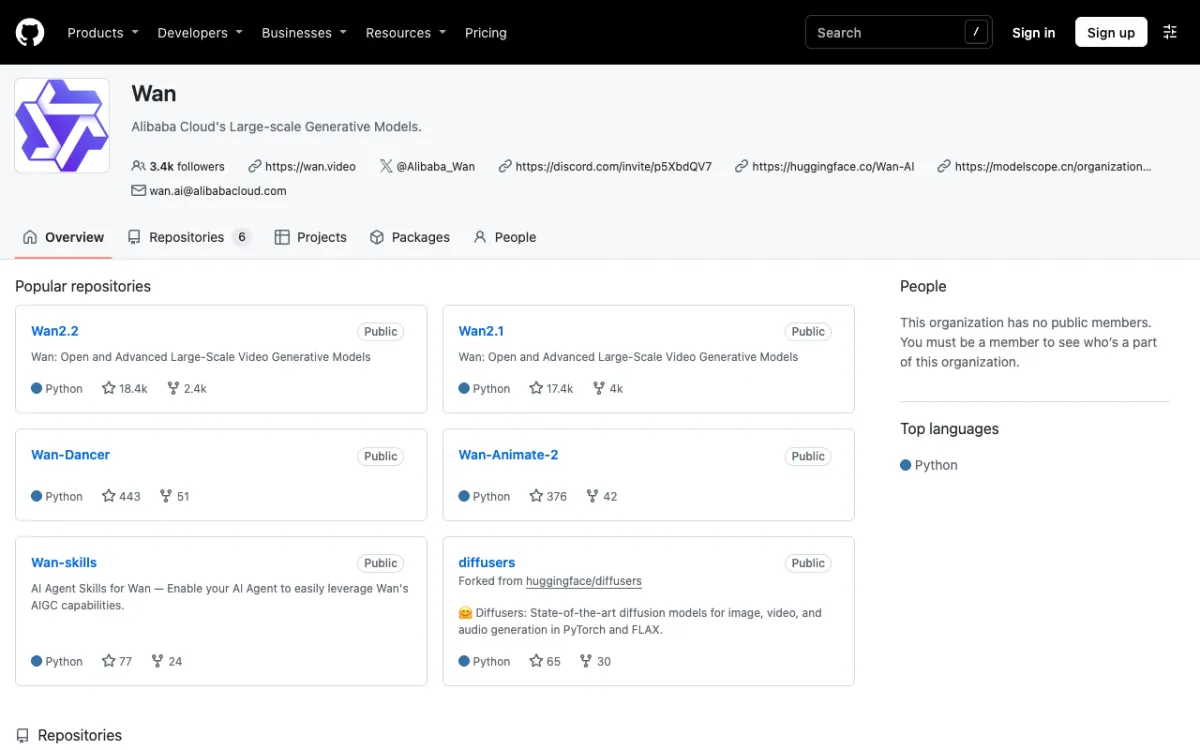 The Wan-Video GitHub organization on November 6, 2026: no Wan 3.0 repository
Alibaba’s own launch posts report no benchmark results, so quality claims rest on third parties. The Next Web noted at launch that Wan 3.0 “has not yet been independently benchmarked at all”.
The best evidence since is the Artificial Analysis text-to-video leaderboard, where voters pick between two clips without knowing the model. On its with-audio board on November 6, 2026:
| Rank | Model | Elo | Price per minute |
|---|---|---|---|
| 1 | Wan 3.0 | 1,172 | $12.00 |
| 3 | MiniMax H3 (768p) | 1,160 | $4.80 |
| 5 | Dreamina Seedance 2.5 | 1,155 | $34.12 |
| 9 | Dreamina Seedance 2.0 | 1,136 | $22.45 |
| 18 | Kling 3.0 Omni 1080p (Pro) | 1,022 | $8.40 |
| 19 | Kling 3.0 1080p (Pro) | 1,000 | $10.08 |
| 22 | Veo 3.1 | 961 | $24.00 |
Read that with care. Wan 3.0 leads by only 3 points over Utopai X (which has no API) and 12 over H3, and Elo scores carry confidence intervals, so the top five are close to a tie.
The gap to Kling 3.0 is not close: roughly 170 points. The board’s $12.00 a minute for Wan 3.0 is the 1080p rate, $0.20 a second.
Snapshots vary. Other sites captured Wan 3.0 at 1,175 in October and 1,229 in September, so treat any single number as a date-stamped reading.
Wan 3.0 vs Kling
Wan 3.0 beats Kling 3.0 Pro on blind votes and runs twice as long per clip. Kling 3.0 Pro stops at 15 seconds.
Kling 4.0 is the closer rival. Per our Kling 4.0 review, it makes 30-second clips with stereo audio at about $0.157 a second for 720p on one third-party API, and it hadn’t appeared on the Artificial Analysis audio boards when that review was written.
So on paper the two match on length and sound, and Wan 3.0 is the one with a published rank. For Kling’s own strengths, read that review before you decide.
Wan 3.0 vs Seedance and Hailuo
Seedance 2.5 also makes 30-second clips, and it ranks a few points behind Wan 3.0 at a far higher leaderboard price. Our Seedance 2.5 review covers its 50-reference input and 4K trial.
Hailuo 3 (MiniMax H3) reaches 2K and is cheaper, but caps at 15 seconds. See the Hailuo 3 review.
Wan 3.0 pros and cons
Pros
- Top-rated with sound: #1 on the Artificial Analysis with-audio text-to-video board, 1,172 Elo
- Long takes: 2 to 30 seconds in one generation, double Wan 2.7
- Low API price: $0.10 a second at 720p, $0.05 at 480p for drafts
- Rich inputs: 10 images, 5 videos and 5 audio clips, plus a PDF or web page
- Sound can be off at no price change
Cons
- Closed weights: no download, no fine-tunes, no local run
- No Alibaba benchmark: quality claims lean on third-party votes
- Preview label: Alibaba’s API docs still say “preview”
- Rough edges: Alibaba says audio texture and on-screen text are still maturing
- Short link life: API result URLs expire after 24 hours
Open weights: can you run Wan 3.0 locally?
No. The weights don’t exist publicly, and we checked where they would be.
The Wan-Video GitHub organization lists six repositories, newest open model Wan2.2. The Wan-AI Hugging Face page shows Wan2.2 variants, Wan-Dancer and Wan2.2-Animate-2, and no Wan 3.0. Both match what DataNorth reported at launch.
This is a change from the Wan 2.1 and 2.2 era, and it matches our open-source AI video models guide, which says Wan 2.5, 2.6, 2.7 and 3.0 have no public weights. Sites claiming “Apache 2.0 Wan 3.0” are wrong.
What you can run locally is Wan 2.2, released July 28, 2025 under Apache 2.0. Its official repo documents a 24 GB GPU for the 5B text-and-image model at 720p, and at least 80 GB for the A14B models. Those clips are about 5 seconds and silent.
So the local-versus-cloud choice is simple. Want sound and 30 seconds, you rent Wan 3.0. Want ownership, you run Wan 2.2 or one of the open models in that guide.
Who should use Wan 3.0?
- Use Wan 3.0 if you want long, sound-on clips at a low per-second price.
- Use Kling or Seedance if you need their specific references, editing tools or the 4K trial.
- Use Wan 2.2 if you must self-host.
Vidwip runs Wan 3.0 next to Kling 3.0 Pro and O1 (not 4.0), Seedance 2.5 and Veo 3.1, so you can run the same prompt through several. The models page lists every rate, and AI Studio cuts the shots together.
Conclusion
Wan 3.0 is the model to try first for long clips with sound. Its leaderboard rank, 30-second length and $0.10-a-second API price are hard to beat, and the closed weights are the only real strike against it.
Test it on your own prompt before you commit a project. Vidwip’s Starter plan gives you 2,500 credits for $25 a month, enough for 31 five-second Wan 3.0 shots (80 credits each).