
ElevenLabs gives the most accurate clones if you can pay $80 per million characters on its v3 and v4 models. MiniMax Speech 2.8 and Inworld TTS are the cheapest hosted swaps, Cartesia is the pick for sub-90 ms voice agents, and Chatterbox (MIT) and Qwen3-TTS (Apache 2.0) are the open-source models you can self-host commercially. F5-TTS is research-only, and Resemble AI no longer sells voice cloning.
Fish Audio made voice cloning cheap: clone a voice from about 10 seconds of audio, pay $15 per million bytes on the API, and pick from 2,000,000+ community voices. That’s still a strong deal, so most people looking for Fish Audio alternatives are chasing something specific: tighter clones, lower latency, cleaner licensing or open weights they can actually ship.
This guide ranks seven of them for developers and voice-heavy creators. Every price was checked on the vendor’s own pricing page or docs on October 18, 2026, and every open-source license was read at the source.
TL;DR — the 7 best Fish Audio alternatives at a glance
| Tool | Best for | Cloning | API price (per 1M chars) | License to self-host |
|---|---|---|---|---|
| ElevenLabs | Most accurate clones | Instant (1–2 min audio) and Professional (30+ min) | $80 (v3/v4), $40 (Flash) | No |
| MiniMax Speech 2.8 | Cheap pay-per-clone API | 10 s to 5 min audio, $1.50 per voice | $60 (Turbo), $100 (HD) | No |
| Cartesia | Sub-90 ms voice agents | Instant from 10 s, Pro clones from $49/mo | About $37–$65 by plan | No |
| Inworld TTS | Lowest-cost commercial API | Instant from 3–30 s | $15–$25 (On-Demand) | No |
| Chatterbox | Open source, commercial use | Zero-shot from about 5 s | Free (your GPU) | MIT |
| Qwen3-TTS | Open source with voice design | Zero-shot from 3 s | Free (your GPU) | Apache 2.0 |
| F5-TTS | Research and prototyping | Zero-shot, reference under 12 s | Free (your GPU) | Weights non-commercial |
Fish Audio itself sits at $15 per million UTF-8 bytes. The API rows above are list prices before volume discounts.
What Fish Audio offers in October 2026
Fish Audio is a text-to-speech and voice-cloning platform built on its own models. The homepage leads with S2.1 Pro and its Drama 3 model, and lists 22 bracketed tags such as [whispering], [sobbing] and [laughing].
Here’s what the plans look like on fish.audio/plan (checked October 18, 2026).
| Plan | Price | Credits per month | Generation time | Commercial use |
|---|---|---|---|---|
| Free | $0 | 8,000 | Up to 7 min | Personal only, per the FAQ |
| Plus | $15/mo, or $11/mo billed annually | 250,000 | Up to 200 min | Yes |
| Pro | $100/mo, or $75/mo billed annually | 2,000,000 | Up to 1,620 min | Yes |
| Max | $999/mo, or $749/mo billed annually | 25,000,000 | Up to 6,250 min | Yes |
The API is pay-as-you-go. The Fish Audio pricing docs list $15 per million UTF-8 bytes for s2.1-pro and s2-pro, and say the older S1 model retires on December 31, 2026.
Why people look for Fish Audio alternatives
- Byte billing. English costs 1 byte per character, but Chinese, Japanese and Korean cost 3, so a CJK script runs about $45 per million characters.
- Open-weight limits. The Fish Audio Community License caps commercial use at $500,000 in annual revenue, requires a “Built with Fish Audio” credit and bans running a hosted TTS service.
- Unclear numbers. The FAQ lists 8 languages while another section says 30+, and no latency figure is published.
- Community voices. Two million voices means wide variety and uneven quality, with licensing that depends on who uploaded them.
What to look for in a Fish Audio alternative
Clone accuracy. Short-clip zero-shot cloning is now everywhere. The real gap is how well the clone holds accent, breath and pacing over a 10-minute read, so test a long script, not a single line.
Latency. Voice agents need first audio in under about 200 ms. Narration and audiobooks don’t care, so don’t pay a latency premium you won’t use.
Price per million characters. Convert every plan to the same unit. One hour of narration is roughly 50,000–55,000 characters, so $15 per million works out to under $1 an hour.
License. Check whether the free tier is commercial, whether you can clone third-party voices, and, for open weights, whether the model or only the code is open.
1. ElevenLabs — best Fish Audio alternative for clone accuracy
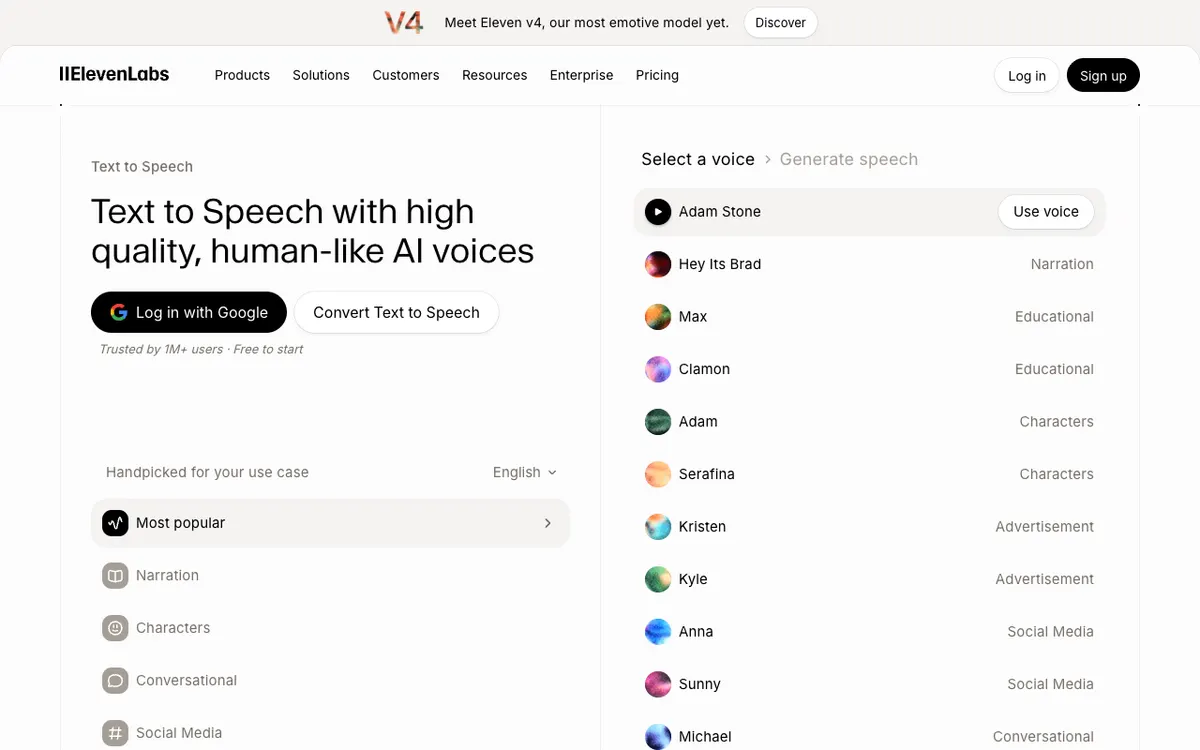 ElevenLabs — text to speech, voice cloning and a large shared voice library.
ElevenLabs is an AI voice platform for creators and developers, offering two tiers of voice cloning and an API from $0.04 per 1,000 characters. If Fish Audio’s clones drift on long reads, this is the upgrade.
Instant Voice Cloning works from 1–2 minutes of clean audio, per the ElevenLabs cloning docs. Professional Voice Cloning trains on 30–180 minutes and starts on the Creator plan.
Eleven v4 is billed as the company’s most emotive model, with 90+ languages and audio tags for direction. The Flash/Turbo models trade some expressiveness for about 75 ms latency.
Pros
- Professional clones hold a speaker’s identity better than any short-clip model here
- Commercial license from the $6 Starter plan
- Audio tags and 90+ languages on Eleven v4
- Mature API, SDKs and a shared voice library
Cons
- About 5x Fish Audio’s API price on v3 and v4 ($80 vs $15 per million)
- Free plan has no commercial license
- Instant cloning wants 1–2 minutes of audio, not 10 seconds
- No open weights or self-hosting
Best for: Audiobook, course and ad producers who need a clone that’s hard to tell from the original. Pricing: Free (10,000 credits). Starter $6/mo. Creator $22/mo ($11 first month). Pro $99/mo. API $0.08 per 1,000 characters on v4, v3 and Multilingual v2, $0.04 on Flash/Turbo (elevenlabs.io/pricing/api, checked October 18, 2026).
Our ElevenLabs alternatives guide covers the reverse move, if price is what pushed you to Fish Audio in the first place.
2. MiniMax Speech 2.8 — best pay-per-clone API
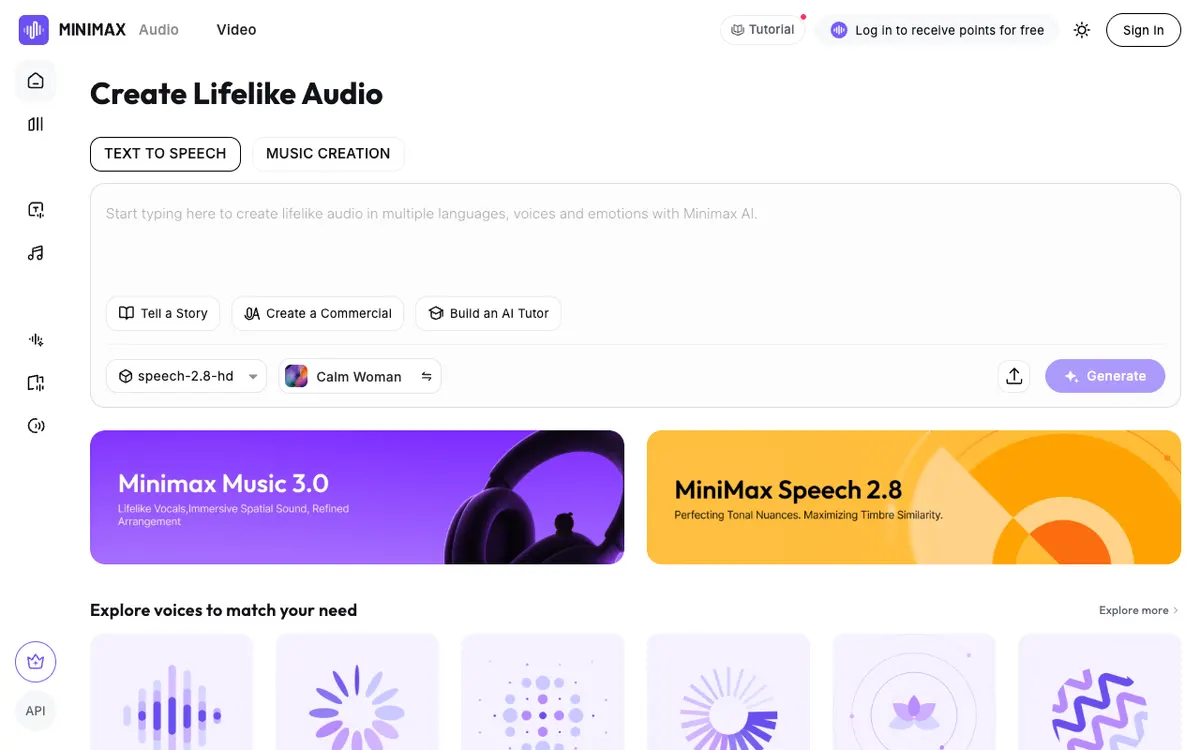 MiniMax Audio — the web studio for MiniMax Speech 2.8, with the same models on the API.
MiniMax Speech 2.8 is a text-to-speech API for developers, offering voice cloning for $1.50 per voice and synthesis from $60 per million characters. It’s the closest match to Fish Audio’s “clone fast, pay little” model.
Rapid cloning takes 10 seconds to 5 minutes of MP3, M4A or WAV audio, up to 20 MB. Both speech-2.8-hd and speech-2.8-turbo support 40 languages and 7 emotions, and HD adds sound tags.
Two details to plan around. The clone fee is charged on first use, not at cloning time, and a cloned voice you don’t use within 7 days is deleted.
Pros
- $1.50 one-time fee per cloned voice, with no plan required
- 40 languages from one model, plus 7 emotion settings
- Async endpoint handles up to 1 million characters per request
- Voice Design ($3 per voice) builds a voice from a text prompt
Cons
- 4x Fish Audio’s per-character price on Turbo, almost 7x on HD
- Unused clones are deleted after 7 days
- No first-party latency figure in the docs
- No open weights for the speech models
Best for: Apps that clone many user voices and want to pay per clone rather than per seat. Pricing: speech-2.8-turbo $60 per million characters, speech-2.8-hd $100 per million, Rapid Voice Cloning $1.50 per voice (MiniMax pay-as-you-go pricing, checked October 18, 2026).
3. Cartesia — best for real-time voice agents
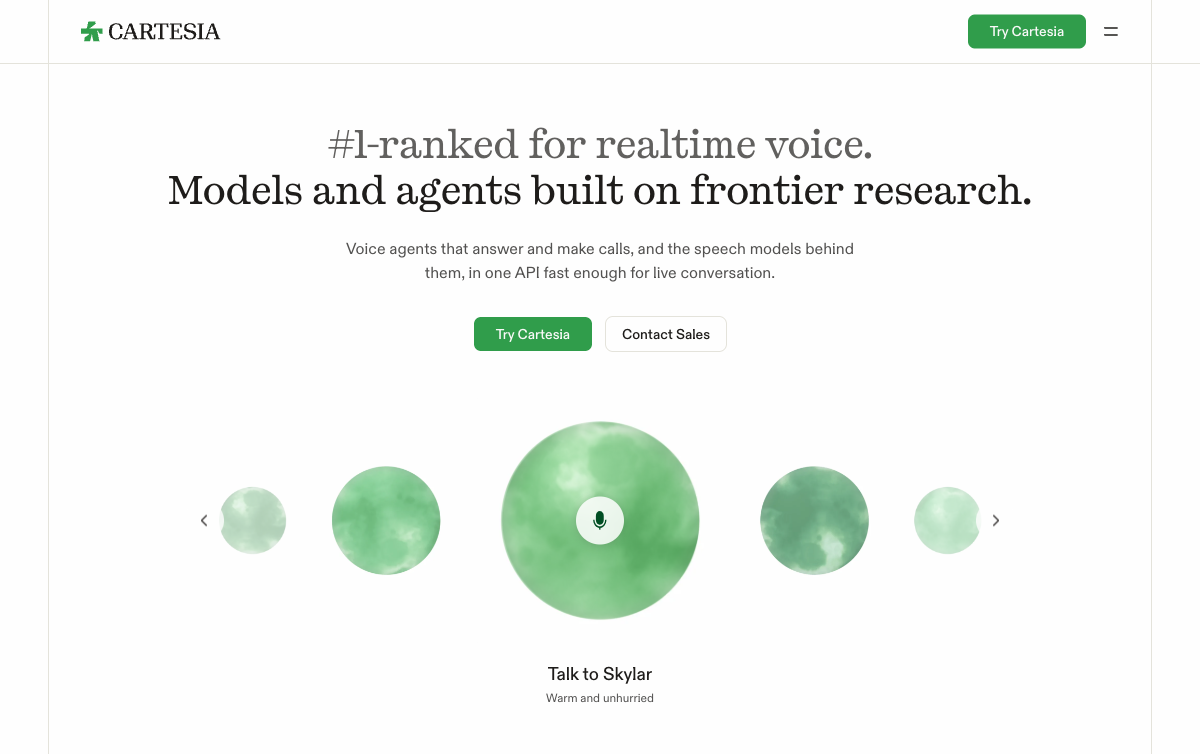 Cartesia — Sonic speech models and voice agents built for live conversation.
Cartesia is a speech-model company for developers, offering Sonic-3.6 with first audio in under 90 ms and a commercial license from $5/month. If your Fish Audio voice sits inside a live agent, Cartesia is built for that job.
Sonic speaks 44 languages from one model and clones a voice from 10 seconds of audio, per the Sonic page. Instant clones start on the $5 Pro plan, and professional clones on the $49 Startup plan.
Billing is one credit per character. Pro includes 100,000 credits and charges $65 per million on overage, while Scale drops overage to $38 per million.
Pros
- Under 90 ms to first audio, per Cartesia
- Instant cloning from 10 seconds on a $5 plan
- 44 languages from one model
- Overage lets a busy month run on instead of failing
Cons
- About 2.5–4x Fish Audio’s per-character price
- Free plan has no cloning
- Professional clones need the $49 Startup plan (2 slots)
- Agent-first product, so expect an API and playground, not a creator editor
Best for: Teams building phone and chat voice agents where every millisecond of latency shows. Pricing: Free (20,000 credits). Pro $5/mo (100,000 credits). Startup $49/mo (1.25M credits). Scale $299/mo (8M credits) (cartesia.ai/pricing, checked October 18, 2026).
4. Inworld TTS — best low-cost commercial API
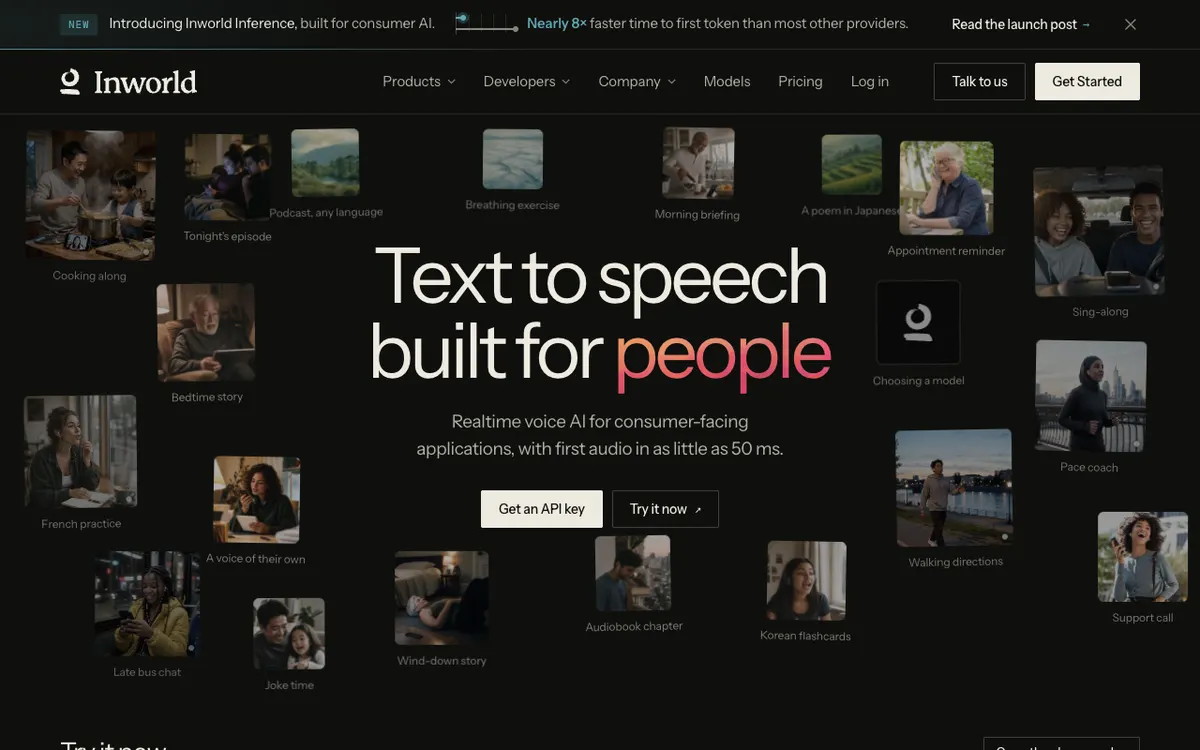 Inworld TTS — realtime TTS-2 and TTS-2 Flash for consumer apps.
Inworld TTS is a realtime speech API for consumer apps, offering instant voice cloning and a commercial license with no monthly fee. On price, it’s the only hosted option here that matches or beats Fish Audio.
TTS-2 Flash costs $15 per million characters on the free On-Demand plan, and $10 on the $25 Creator plan. The flagship TTS-2 costs $25 per million on On-Demand.
Instant cloning works from 3 to 30 seconds of audio, and both models render 50 non-verbal sounds such as [laugh] and [sigh]. Inworld says TTS-2 covers about 500 languages and dialects, while Flash covers fewer.
Pros
- Flash matches Fish Audio at $15 per million, and beats it from $25/mo
- Commercial license with no subscription on On-Demand
- Instant cloning from 3 seconds of audio
- First audio as low as 50 ms on Flash, per Inworld
Cons
- Language and latency figures are vendor-reported
- Flash takes non-verbal sounds only, not written direction
- Professional cloning is still in beta on TTS-2
- On-Demand needs a card on file before you create a professional clone
Best for: Developers who want Fish Audio’s price with a clearer commercial license. Pricing: On-Demand $0/mo (TTS-2 $25, Flash $15 per million characters). Creator $25/mo (TTS-2 $20, Flash $10). Builder $100/mo (TTS-2 $17.50, Flash $9) (inworld.ai/pricing, checked October 18, 2026).
5. Chatterbox — best open-source model for commercial use
 Chatterbox — Resemble AI’s open-source TTS family, now its only voice product.
Chatterbox is an open-source TTS and voice-cloning family from Resemble AI, released under the MIT license. It’s the cleanest way to self-host what Fish Audio sells, with no revenue cap and no attribution clause.
The lineup covers Chatterbox-Turbo (350M, English, built for voice agents), Chatterbox-Nano (110M, runs 3x faster than realtime on 8 CPU cores) and Chatterbox-Multilingual V3 (500M, 23+ languages). Turbo reads tags such as [laugh] and [cough] natively.
Every file carries Resemble’s Perth watermark, which survives MP3 compression. Resemble’s own product notice says it stopped selling voice generation and now focuses on detection, so the README’s link to a paid TTS service is out of date.
Pros
- MIT license on code and weights, with no revenue cap
- 23+ languages on Multilingual V3, plus six single-language finetunes
- Nano runs on CPU for on-device use
- Built-in watermark helps with disclosure rules
Cons
- No paid hosted API or support anymore
- You run the GPUs, scaling and uptime yourself
- Watermark is always on, which some pipelines won’t want
- English-only on Turbo and Nano
Best for: Startups that want to self-host voice cloning commercially without license math. Pricing: Free and open source (MIT). Your cost is compute (GitHub, checked October 18, 2026).
6. Qwen3-TTS — best open-source model with voice design
 Qwen3-TTS — Alibaba’s open-weight TTS series with cloning and voice design.
Qwen3-TTS is an open-source speech model series from Alibaba’s Qwen team, released under Apache 2.0 in January 2026. It clones a voice from 3 seconds of audio and can design a new voice from a written description.
The 0.6B and 1.7B models cover 10 languages: Chinese, English, Japanese, Korean, German, French, Russian, Portuguese, Spanish and Italian. The team reports end-to-end latency as low as 97 ms in streaming mode, and the models run on vLLM.
Instructions in plain language steer tone, pace and emotion. That’s a different control style from Fish Audio’s bracket tags, and handy for character work.
Pros
- Apache 2.0 weights, with no revenue cap
- 3-second cloning and text-prompted voice design
- Streaming with a reported 97 ms latency
- Strong on Chinese, Japanese and Korean, where Fish bills 3 bytes per character
Cons
- 10 languages, far fewer than Chatterbox or the hosted APIs
- No new models since the January 2026 launch, and the last commit was in March
- FlashAttention 2 and a recent GPU help a lot
- Hosted access runs through Alibaba Cloud, priced separately
Best for: Teams self-hosting multilingual voices for Asian and European markets. Pricing: Free and open source (Apache 2.0). Your cost is compute (Hugging Face, checked October 18, 2026).
7. F5-TTS — best for research and prototyping
 F5-TTS — a flow-matching TTS model for zero-shot voice cloning.
F5-TTS is an open-source zero-shot voice-cloning model from SJTU’s X-LANCE lab, with MIT-licensed code and non-commercial weights. It’s the research pick here, not the production one.
It’s still active in October 2026: release 1.1.22 landed about three months ago, and the last commit is from October 14. The v1 base model dates to March 2025 and was trained on Chinese and English, with community finetunes for other languages.
Keep the reference clip under 12 seconds, since longer clips are cut to about 12. The license section says the pretrained weights are CC-BY-NC because of the Emilia training data.
Pros
- Fast, simple zero-shot cloning from a short clip
- MIT code you can retrain on your own licensed data
- Gradio app, CLI and Docker image included
- Large community of finetunes and forks
Cons
- Pretrained weights are non-commercial (CC-BY-NC)
- Chinese and English only on the official base model
- No tags or emotion controls like Fish Audio’s
- Single generations top out at 30 seconds, with chunking for longer text
Best for: Researchers and hobbyists testing cloning ideas before they pick a commercial model. Pricing: Free. Code MIT, weights CC-BY-NC (GitHub, checked October 18, 2026).
Tools we left out: Resemble AI, PlayHT and Hume AI
Resemble AI still shows up on most Fish Audio alternatives lists. It stopped selling voice generation and cloning on August 13, 2026, so only its open Chatterbox models made ours. Our Resemble AI alternatives guide covers the paid options for its former customers.
PlayHT closed on December 31, 2025, and Hume AI’s TTS API ends on November 13, 2026, so don’t move a production voice to either. Our PlayHT alternatives guide covers where those users went.
Fish Audio alternatives comparison table
| Tool | Clone input | Languages | Latency (vendor) | API price per 1M chars | Commercial use |
|---|---|---|---|---|---|
| Fish Audio | About 10–15 s | 8 to 30+ (conflicting) | Not published | $15 per 1M bytes | Plus and up |
| ElevenLabs | 1–2 min (instant), 30+ min (pro) | 90+ on v4 | About 75 ms (Flash) | $40–$80 | Starter and up |
| MiniMax Speech 2.8 | 10 s–5 min | 40 | Not in docs | $60–$100 | Yes, pay as you go |
| Cartesia | 10 s | 44 | Under 90 ms | About $37–$65 | Pro and up |
| Inworld TTS | 3–30 s | About 500 (TTS-2) | As low as 50 ms (Flash) | $15–$25 On-Demand | On-Demand and up |
| Chatterbox | About 5 s (per Resemble) | 23+ (Multilingual V3) | Depends on your GPU | Compute only | Yes (MIT) |
| Qwen3-TTS | 3 s | 10 | 97 ms reported | Compute only | Yes (Apache 2.0) |
| F5-TTS | Under 12 s | Chinese, English | Depends on your GPU | Compute only | No (CC-BY-NC weights) |
Prices and claims checked October 18, 2026 on each vendor’s pricing page, docs or repository.
How to choose the right Fish Audio alternative
Clones have to pass for the real person? Choose ElevenLabs and train a Professional Voice Clone on 30+ minutes of audio.
Cloning lots of user voices? Choose MiniMax Speech 2.8. You pay $1.50 per voice with no seat or plan.
Building a live voice agent? Choose Cartesia, or Inworld TTS-2 Flash if price matters more than the last few milliseconds.
Want Fish Audio’s price with a clearer license? Choose Inworld TTS. Flash costs $10–$15 per million characters with commercial use on every plan.
Self-hosting a commercial product? Choose Chatterbox for language range or Qwen3-TTS for CJK and voice design. Use F5-TTS only for research.
Final verdict
Fish Audio is still one of the cheapest ways to clone a voice, and for English API work at $15 per million bytes it’s hard to undercut. Switch when you need what it doesn’t give you: professional-grade clones, published latency, or open weights without a revenue cap.
ElevenLabs wins on clone accuracy, Inworld on price and license, Cartesia on latency, and Chatterbox on self-hosting. If your voice ends up under a video rather than inside an app, see our AI video voiceover generator roundup or the Typecast alternatives guide for creator-first tools.