
Vidwip AI Voiceover is the Typecast alternative to pick when the voice goes under a video: ElevenLabs v3 performs cues like [whispers] instead of reading them aloud, in 190+ voices and 74 languages, on every plan. ElevenLabs is the deepest standalone voice studio, Fish Audio gives the most emotion tags per dollar, and HeyGen replaces Typecast's AI actors with full video avatars. Hume AI's TTS API shuts down on November 13, 2026, and LOVO's site was offline when we checked.
Typecast made emotional AI voices easy: pick Happy Paige or Whisper Chad, type a line, and the character acts it out. It’s still good at that, but plenty of creators now shop for Typecast alternatives before they renew.
The reasons are concrete. Smart Emotion and the emotion sliders only start on the $29 Pro plan, the free credits carry an attribution requirement, and newer models now take direction straight from the script.
This guide ranks seven Typecast alternatives on four things you can act on: emotion range, character variety, commercial license and price. Every competitor price was checked on the vendor’s own pricing page on October 18, 2026.
What Typecast offers today
Typecast is an AI voice generator from Neosapience with 600+ voices in 35+ languages, per its API section, and its FAQ counts 700+ AI voice actors. Its SSFM 3.0 model generates emotion from context, and the editor adds pitch, emotion, intensity and speed controls.
Here’s what each plan gets you on typecast.ai/pricing (checked October 18, 2026).
| Plan | Monthly | Download credits | Emotion control | Commercial use |
|---|---|---|---|---|
| Free | $0 | 3,000 lifetime (about 5 min) | Not listed | Attribution required |
| Basic | $5 | 30,000/mo (about 35 min) | Not listed | Yes |
| Plus | $19 | 40,000/mo (about 50 min) | Speed only | Yes |
| Pro | $29 | 75,000/mo (about 90 min) | Smart Emotion, emotion and intonation | Yes |
| Business | $69 | 200,000/mo (about 250 min) | Everything in Pro | Yes |
Two details matter most. The feature Typecast is known for sits on Pro, and every plan also meters AI avatar generations, from 6 on Basic to 40 on Business.
What to look for in a Typecast alternative
Emotion you can direct. Presets are quick, but tags are precise. Look for a model that takes cues like [whispers] in the script and performs them, rather than reading them out.
Character variety. Count voices, accents and ages, not just languages. A character piece needs a gravelly narrator and a bright kid, not 40 versions of the same announcer.
Commercial license by plan. Several free tiers here are non-commercial or need attribution. Know which plan clears a monetized YouTube video or a paid ad.
Voice or video. Some Typecast users only want audio, and some want the AI actor on screen. Decide which before you compare prices, because avatar tools cost more.
1. Vidwip AI Voiceover — best Typecast alternative when the voice goes under a video
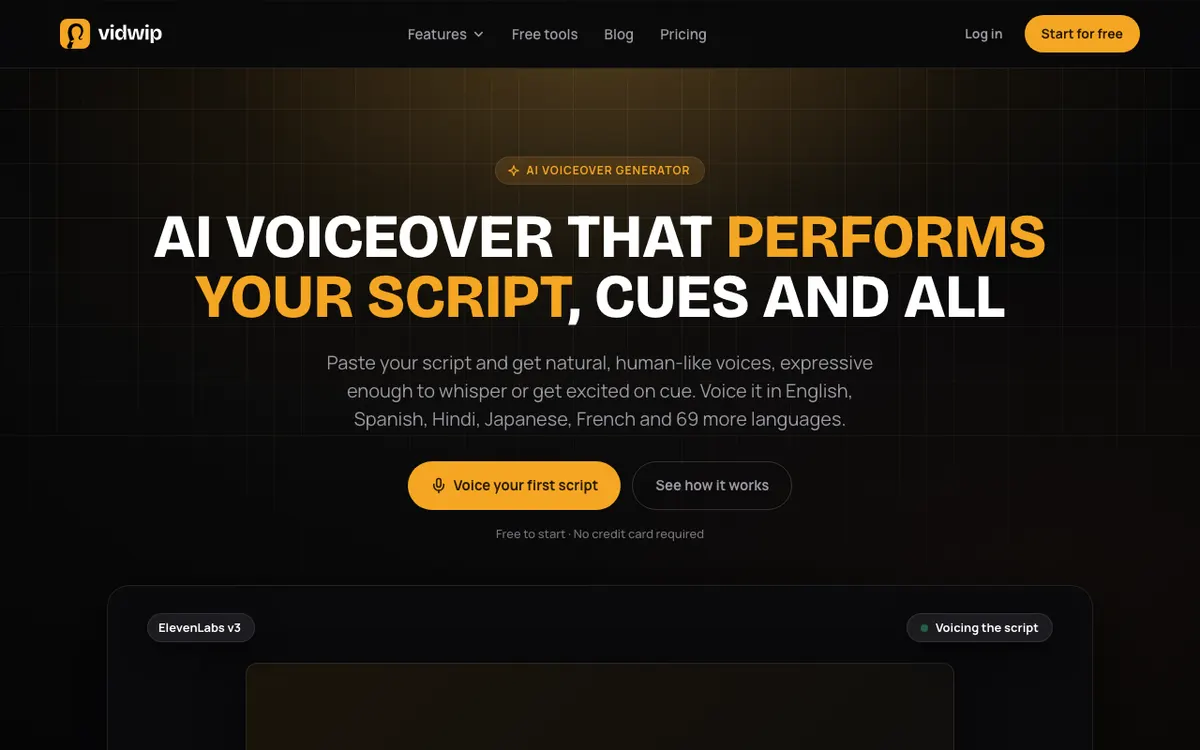 Vidwip AI Voiceover — script to speech, with cues in square brackets performed as direction.
Vidwip AI Voiceover is a script-to-speech tool inside the AI Studio editor, voicing up to 5,000 characters in 190+ voices and 74 languages. You type a cue like [whispers] or [warmly] where you want it, and ElevenLabs v3 acts it out instead of reading the word aloud.
That’s the Typecast workflow without the preset menu. You direct each line in the script itself, so one sentence can be calm and the next excited.
The voice picker holds 190+ ElevenLabs voices native to 23 languages, with accents from British and Indian English to Gulf Arabic and Brazilian Portuguese. Filter by accent, use case, gender and age, then play samples before you choose.
Every track comes back as one MP3 mastered to -14 LUFS and lands on your timeline. Pick a language other than the script’s and the AI agent translates it first, keeping your tags and brand spellings.
Pros
- Bracketed cues like [whispers] are performed, not read aloud
- 190+ voices native to 23 languages; every voice speaks all 74 languages
- Mastered MP3 placed on the timeline under your video, no import step
- Voice and language stay selected between tracks, so a series keeps one narrator
Cons
- No AI actors or avatars; it voices your video, it doesn’t put a presenter in it
- No voice cloning in the voiceover tool (cloning exists only inside dubbing)
- No line-level regeneration; changing a line means a new track
- One voice per track and MP3 output only; video export tops out at 1080p
Best for: YouTube, ad and course creators who want expressive narration and the video in one place, in more than one language. Pricing: Free to start, no credit card. Starter $25/mo (2,500 credits). Pro $99/mo (10,000 credits). Enterprise custom (vidwip.com/pricing, checked October 18, 2026).
If you’d rather not write the script at all, AI Video Voiceover watches your footage and writes the narration for you. To take a finished video into other languages, AI Video Dubbing keeps the original speaker’s voice.
2. ElevenLabs — best standalone voice studio
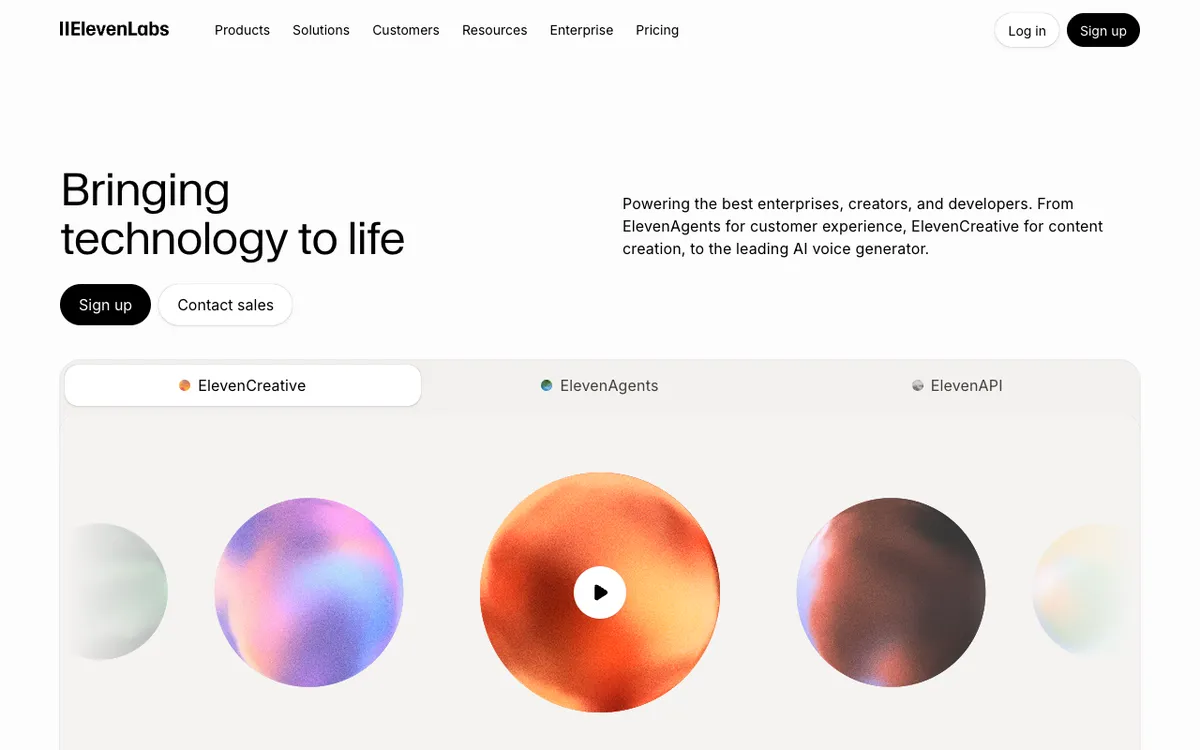 ElevenLabs — expressive text to speech with a large voice library and audio-tag direction.
ElevenLabs is an AI voice platform for creators and developers, offering the deepest voice library in this list and commercial rights from $6/month. If Typecast’s characters feel too narrow, this is the widest casting call.
Eleven v3 reads audio tags like [whispers] or [hesitant] as direction and supports 70+ languages. Its newest model, Eleven v4, is pitched as its “most emotive model yet” with 90+ languages, per its text-to-speech page.
Voice Design builds a new voice from a written description, which is how you get a specific character Typecast doesn’t stock. The library counts more than 10,000 voices on the same page.
Pros
- Audio tags for emotional direction on every plan, not just the top ones
- Voice Design creates a character voice from a text prompt
- Instant voice cloning from the $6 Starter plan
- Commercial license on every paid plan, with no extra royalties
Cons
- Free plan is non-commercial and requires attribution
- No AI actors; you get audio and import it into an editor
- Credit math takes work: about 121 minutes a month on Creator
- A lot of product surface (agents, API, music) if you only want voiceover
Best for: Creators who want the widest choice of character voices and fine-grained emotional direction. Pricing: Free (about 10 min/month, non-commercial). Starter $6/mo (about 30 min). Creator $22/mo (about 121 min). Pro $99/mo (about 600 min) (elevenlabs.io/pricing, checked October 18, 2026).
For more voice studios built around ElevenLabs-style quality, see our ElevenLabs alternatives guide.
3. Murf AI — best for polished business narration
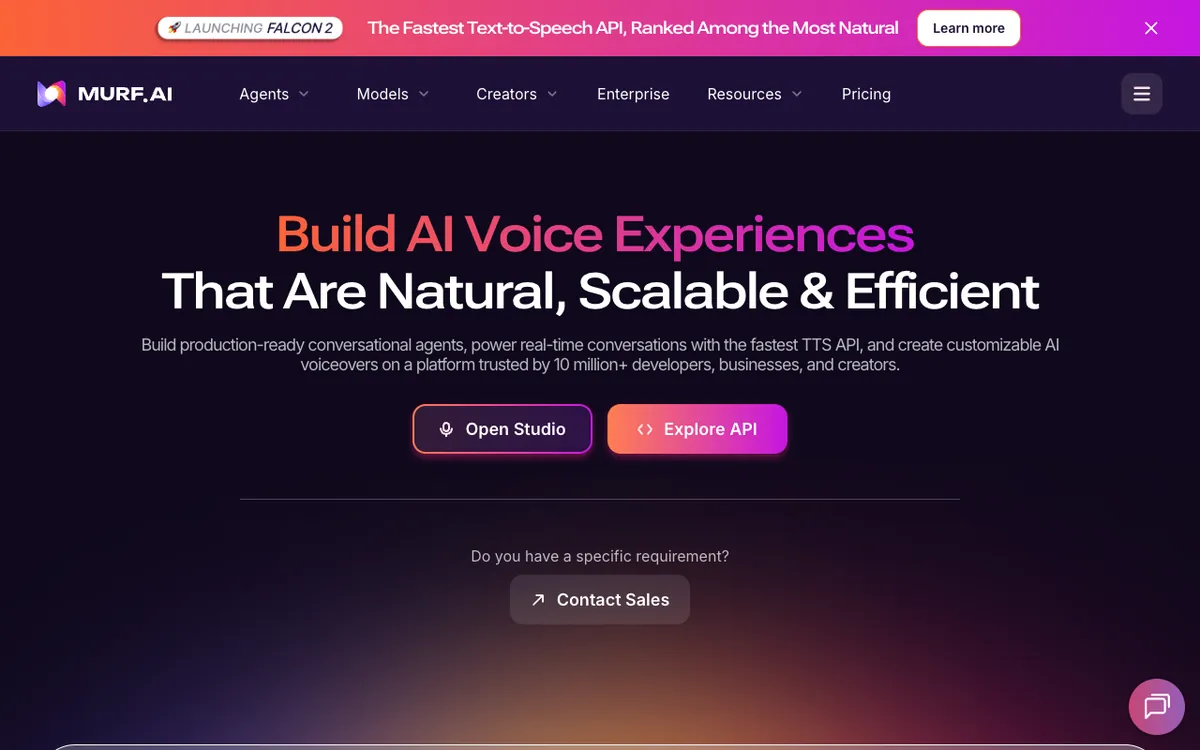 Murf AI — a voiceover studio with 200+ voices, styles and pronunciation control.
Murf AI is a text-to-speech studio for marketers and L&D teams, offering 200+ voices in 30+ languages from $19/month billed annually. It trades Typecast’s theatrical range for a steadier, presenter-style read.
Emotion comes from voice styles and tonalities rather than tags. The Business plan adds Emphasis, Variability and Say It My Way, where you record a line and the AI voice copies your delivery.
That makes Murf strong for explainers and training. It’s a weaker fit for a crying villain or a whispering ghost story.
Pros
- Voice styles per voice, with unlimited styles on Creator and Business
- Say It My Way copies your own read on Business
- Pronunciation control and a Canva integration from Creator
- Commercial rights from Creator; a business license on Business
Cons
- Free plan has no downloads and no commercial rights
- Emphasis, Variability and Say It My Way need the $66 Business plan
- One editor seat on Creator and Business; more means Enterprise
- No bracketed audio tags listed on its pricing page; delivery comes from styles
Best for: Marketing and training teams who want a consistent, professional narrator more than a character performance. Pricing: Free (10 min, no downloads). Creator $19/mo billed annually ($228/yr, 24 hours a year). Business $66/mo billed annually ($792/yr, 96 hours a year). Enterprise custom (murf.ai/pricing, checked October 18, 2026).
Our Murf AI alternatives guide goes deeper on e-learning and pronunciation tools.
4. Fish Audio — best value for emotion tags
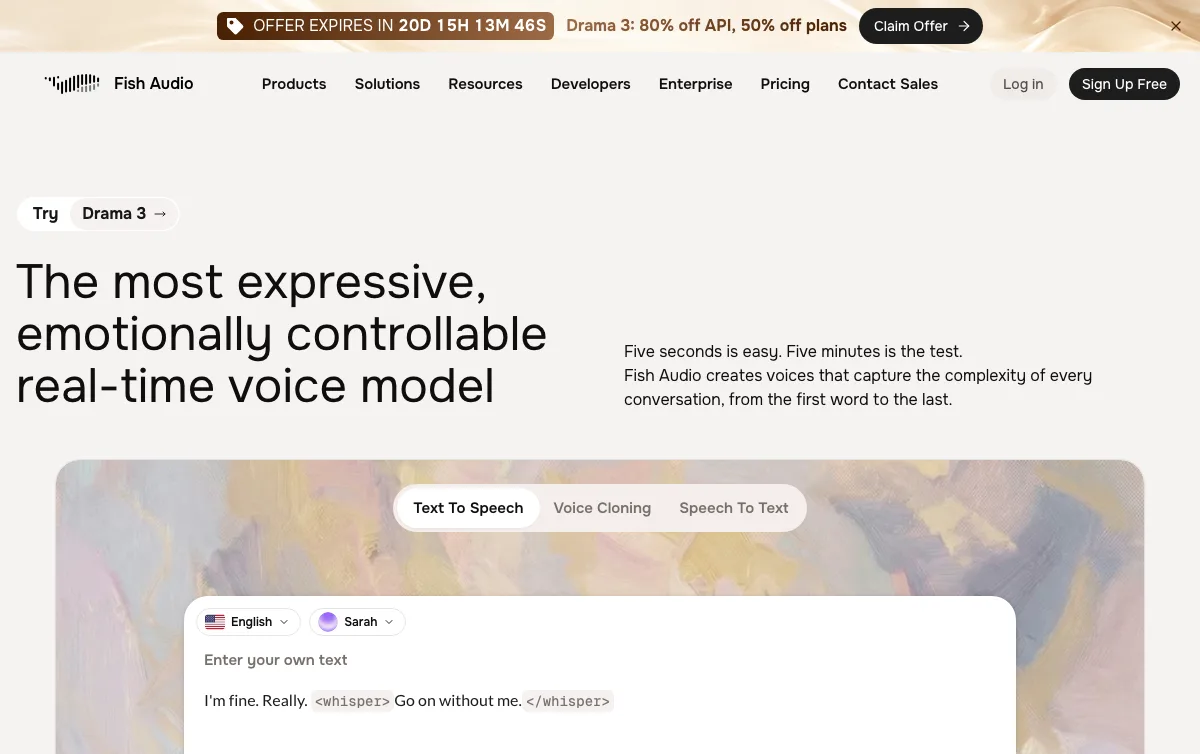 Fish Audio — text to speech and voice cloning with a huge community voice library.
Fish Audio is a text-to-speech and voice-cloning platform for creators, offering about 200 generated minutes a month from $11/month billed annually. On emotion tags per dollar, it’s the strongest pick here.
Its homepage lists bracketed emotion tags (angry, sad, embarrassed, whispering, excited) and sound tags like laughing, sobbing, sighing and panting. That’s closer to a drama toolkit than Typecast’s preset list.
Character variety comes from the crowd. The platform says it hosts over 2,000,000 voices, and you can clone your own from about 10 to 15 seconds of audio.
Pros
- Wide set of emotion and non-verbal tags, including crying and laughter
- About 200 minutes a month on Plus, far more than Typecast’s $19 plan
- Commercial use allowed from Plus
- Huge community voice library plus voice cloning
Cons
- Free plan is non-commercial, per its FAQ
- Language claims conflict: the FAQ lists 8 languages, another section says 30+
- Community voices vary a lot in quality and licensing clarity
- No AI actors or video tools
Best for: YouTubers and audio-drama makers voicing a lot of emotional dialogue on a tight budget. Pricing: Free (8,000 credits, up to 7 min). Plus $15/mo or $11/mo billed annually (about 200 min). Pro $100/mo or $75/mo billed annually (about 1,620 min) (fish.audio/plan, checked October 18, 2026).
5. HeyGen — best replacement for Typecast’s AI actors
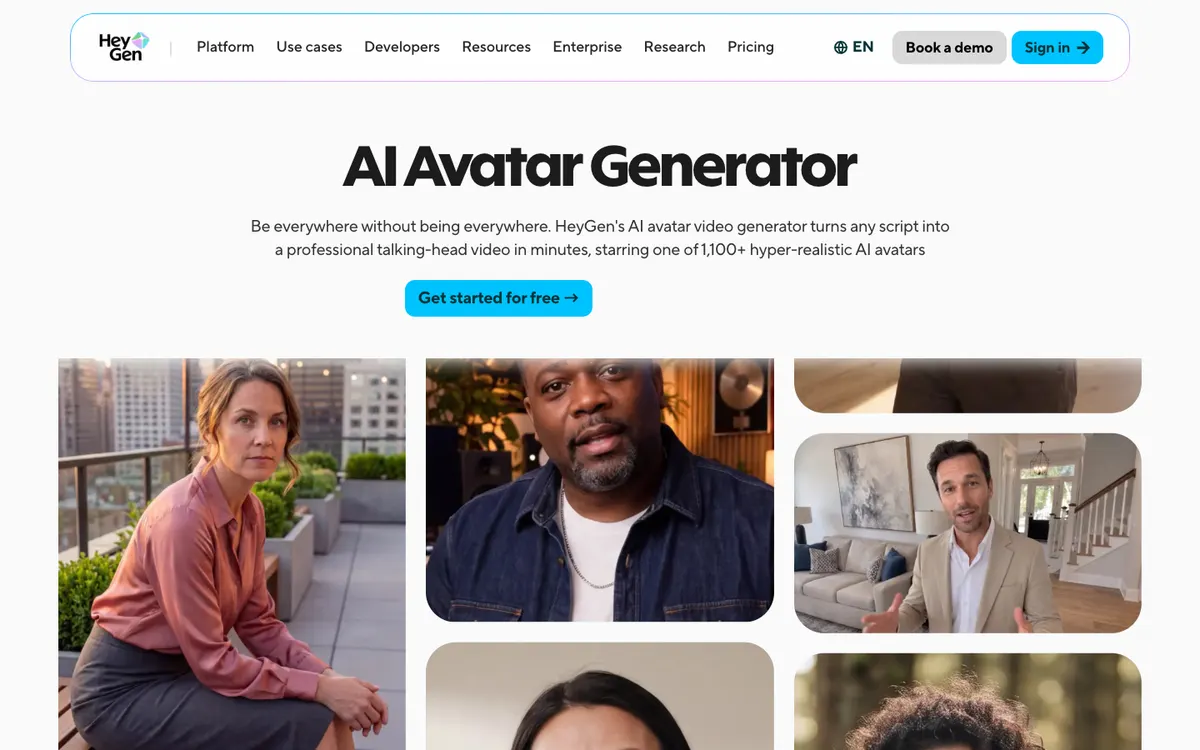 HeyGen — script-to-video with realistic AI avatars and digital twins.
HeyGen is an AI avatar video platform for marketers and educators, offering 1,100+ AI avatars and a digital twin of you from $29/month. If the reason you used Typecast was the on-screen AI actor, this is the bigger version of that idea.
You write a script, pick an avatar, and HeyGen renders a talking-head video. Its avatar page also covers translating a finished video into 175+ languages with lip movement matched to each one.
The trade-off is focus. HeyGen’s emotional range lives in the avatar’s performance, not in fine voice direction, and it costs more than a voice-only tool.
Pros
- 1,100+ avatars, per its avatar page, plus a custom digital twin with consent
- Avatar IV videos up to 30 minutes on paid plans
- 175+ languages and dialects for translation on paid plans
- Free plan to test: 3 videos a month, up to 1 minute each
Cons
- Far pricier per minute than a voice-only tool
- Less control over vocal emotion than tag-based voice models
- Commercial terms aren’t spelled out per plan on the pricing page
- Overkill if you only need an audio file
Best for: Marketers and course creators who want a presenter on screen, not just a voice. Pricing: Free (3 videos/month, 1 min each). Creator $29/mo or $24/mo billed annually. Pro from $49/mo. Business $149/mo plus $20 per seat (heygen.com/pricing, checked October 18, 2026).
See our HeyGen alternatives roundup if you want to compare avatar tools side by side.
6. Inworld TTS — best for directed character dialogue
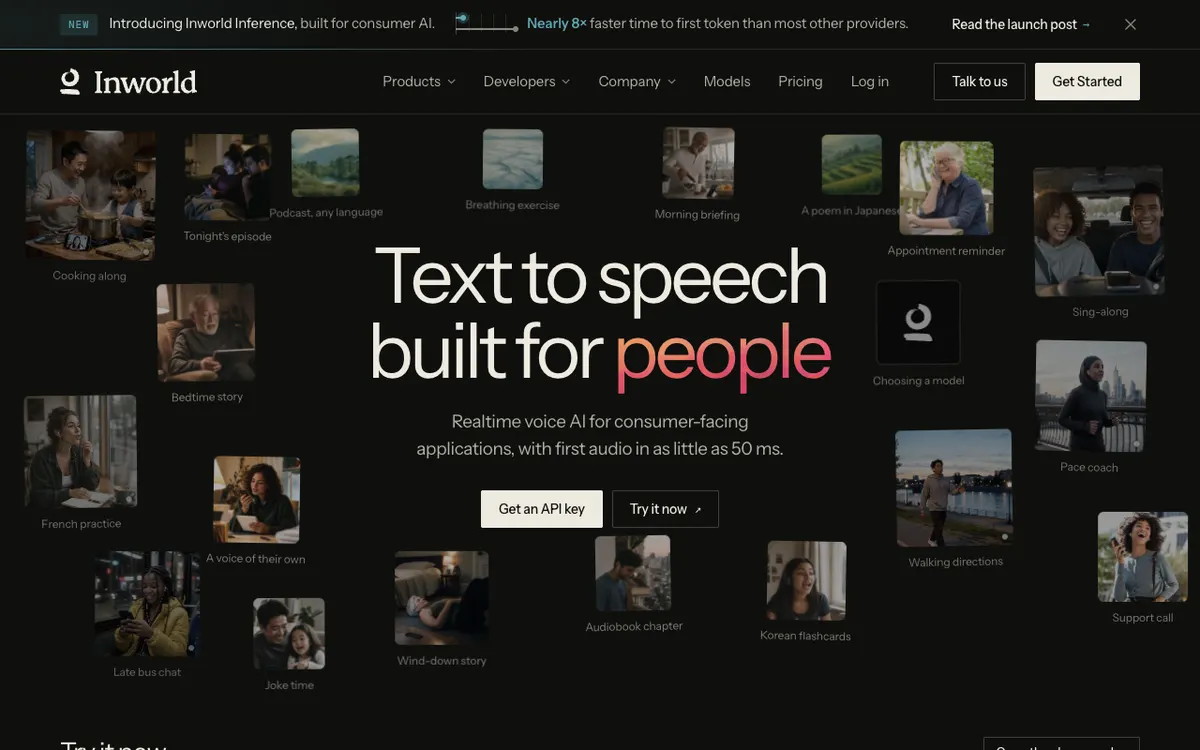 Inworld TTS — expressive text to speech with plain-language steering and a no-code playground.
Inworld TTS is a text-to-speech platform built for games and consumer apps, offering the Realtime TTS-2 model from $25 per million characters with no monthly fee. It grew out of AI game characters, so dialogue is its home turf.
You can describe the delivery in plain words, or write bracketed direction mid-line that holds until you change it. Both models render 50 non-verbal sounds such as [laugh] and [sigh].
Non-developers can test it in the TTS Playground with no code. Voice design from a text description is in preview, and instant cloning works from 3 seconds of audio.
Pros
- Plain-language steering plus bracketed direction that persists across lines
- 50 non-verbal sounds on both models
- Pay as you go with a commercial license on the On-Demand plan
- Instant voice cloning and voice design included
Cons
- Built API-first; the playground is for testing, not a full editor
- Vendor claims (about 500 languages, #1 on Artificial Analysis) are self-reported
- Voice design is still in preview
- No AI actors or timeline
Best for: Game, app and interactive-story builders voicing lots of character lines. Pricing: On-Demand $0/mo, $25 per million characters on TTS-2. Creator $25/mo ($20 per million). Builder $100/mo ($17.50 per million) (inworld.ai/pricing, checked October 18, 2026).
7. Cartesia — best low-cost expressive voices for developers
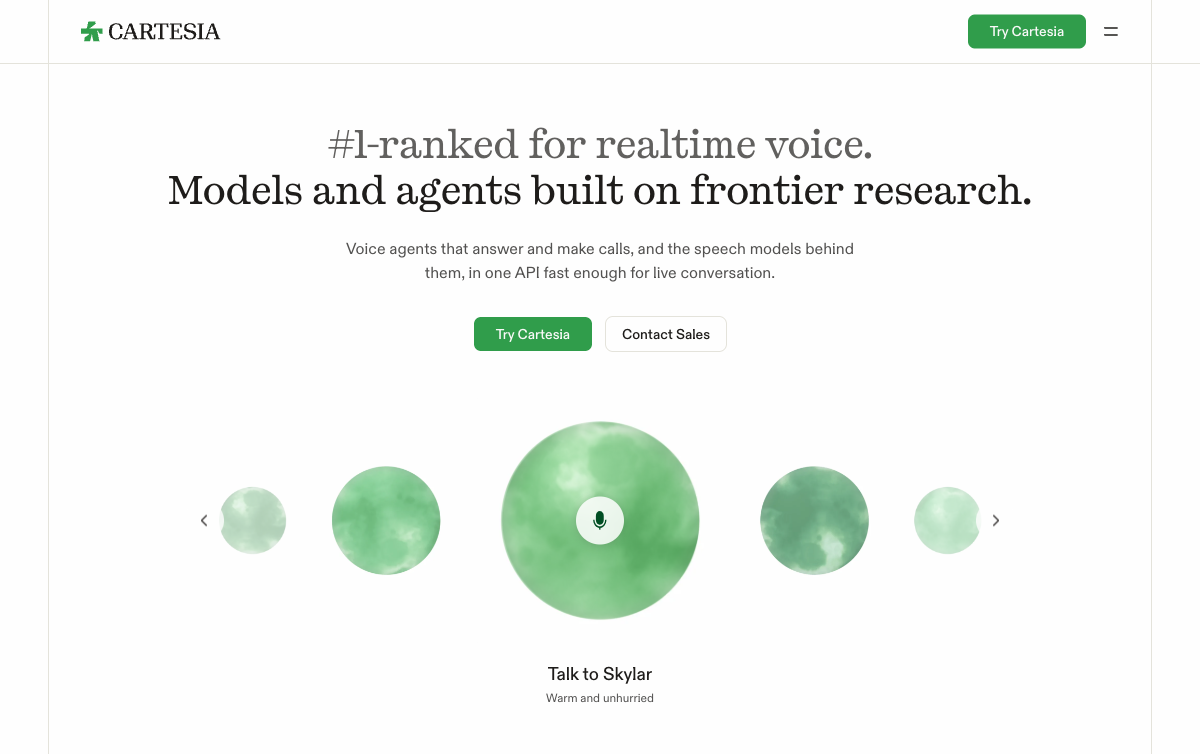 Cartesia — Sonic speech models built for realtime voice.
Cartesia is a speech-model company for developers, offering its Sonic-3.6 model with a commercial license from $5/month. It’s built for live voice agents, but the expressiveness carries over to scripted reads.
Sonic reads the emotional subtext of a line and sets the delivery itself, and you can drop non-verbal cues like [laughter] into the text. It speaks 44 languages from one model and clones a voice from 10 seconds of audio.
For a Typecast user, the catch is the workflow. Cartesia’s homepage leads with voice agents, so expect an API and a playground rather than a creator editor.
Pros
- Commercial license from the $5 Pro plan
- Automatic emotional delivery plus inline cues like [laughter]
- 44 languages from one model
- Instant voice cloning from 10 seconds of audio
Cons
- Built for voice agents and developers first
- No manual emotion presets like Typecast’s
- Professional cloning starts on the $49 Startup plan
- No AI actors or video tools
Best for: Developers and technical creators who want cheap, expressive voices through an API. Pricing: Free (20,000 credits). Pro $5/mo (100,000 credits, about 133 min). Startup $49/mo (1.25M credits). Scale $299/mo (cartesia.ai/pricing, checked October 18, 2026).
A note on Hume AI and LOVO
Both were on our shortlist, and neither made the ranking.
Hume AI’s developer docs say it is sunsetting its TTS and EVI APIs, with access ending November 13, 2026 and account data deleted after that. Its pricing page now redirects to a voice-AI evaluation homepage, so Octave isn’t a safe place to move a channel’s voice (Hume TTS docs, checked October 18, 2026).
LOVO’s site, pricing page and Genny app returned a “deployment disabled” error on October 17 and 18, 2026. We couldn’t verify a single current price or feature, so if you’re on LOVO today, export your projects and keep a backup tool ready.
PlayHT closed on December 31, 2025, and Resemble AI discontinued voice generation on August 13, 2026. Our PlayHT alternatives guide covers where those users moved.
Typecast alternatives comparison table
| Tool | Voices / languages | Emotion control | AI actors | Commercial use from | Paid from |
|---|---|---|---|---|---|
| Typecast | 600+ / 35+ | Smart Emotion and sliders (Pro) | Yes (metered) | Basic | $5/mo |
| Vidwip AI Voiceover | 190+ / 74 | Audio tags, every plan | No | See plans | Free / $25/mo |
| ElevenLabs | 10,000+ / 70+ (v3) | Audio tags, Voice Design | No | Starter | $6/mo |
| Murf AI | 200+ / 30+ | Voice styles; Say It My Way (Business) | No | Creator | $19/mo annual |
| Fish Audio | 2,000,000+ community / 8–30+ | Emotion and sound tags | No | Plus | $11/mo annual |
| HeyGen | 1,100+ avatars / 175+ | Avatar performance | Yes | Not stated | $24/mo annual |
| Inworld TTS | Stock + cloned / about 500 (vendor) | Steering, 50 non-verbal sounds | No | On-Demand | Pay as you go |
| Cartesia | Library + cloned / 44 | Automatic, inline cues | No | Pro | $5/mo |
How to choose the right Typecast alternative
Voice always ends up under a video? Choose Vidwip AI Voiceover. You direct the emotion with tags in the script, and the track lands on the timeline in any of 74 languages.
Want the widest character range? Choose ElevenLabs. Voice Design and a 10,000+ voice library cover characters Typecast doesn’t stock.
Voicing lots of emotional dialogue on a budget? Choose Fish Audio. About 200 minutes a month on Plus, with tags for crying, laughing and whispering.
Need the AI actor on screen? Choose HeyGen. It’s the closest match to Typecast’s avatars, with far more of them.
Building a game or app? Choose Inworld for directed dialogue, or Cartesia for the cheapest commercial entry.
Final verdict
Typecast is still a quick way to get a characterful read, but its emotion features sit on the $29 plan and its free credits need attribution. The best replacement depends on whether you need a voice, a presenter, or an API.
If the voice sits under a video, start with Vidwip AI Voiceover: write [whispers] where you want it and pick from 190+ voices. Compare plans on the pricing page when you’re ready to scale.
If you need a standalone audio file, ElevenLabs is the strongest all-rounder and Fish Audio the best value. For more options, see our AI video voiceover generator roundup or the AI video dubbing tools comparison.