
Gemini Omni 1.2 Flash is Google's default now: it edits clips by conversation, makes 3 to 15 second videos with native audio and costs $0.07 a second at 720p on the Gemini API. Veo 3.1 is the older generator, with 4, 6 or 8 second clips at up to 4K on Google Cloud, and its Gemini API preview models shut down on October 22, 2026. Use Omni to iterate, and Veo 3.1 when you need its look or 1080p natively. We did not run either model ourselves.
Gemini Omni vs Veo 3.1 is the choice Google now makes for you in most of its products. Omni Flash is the conversational editor, and Veo 3.1 is the older generator that keeps its 1080p look.
We haven’t run either model, so there is no hands-on test here. Every spec links to Google’s pages, and prices are US figures checked November 2026. For the full model profiles, see our Gemini Omni Flash review and Veo 3.1 review.
TL;DR: Gemini Omni vs Veo 3.1
Pick Gemini Omni 1.2 Flash to iterate on a clip, and Veo 3.1 when you need Google’s 1080p generator or a hosted Veo tier. Omni makes 3 to 15 second clips with audio and edits them by chat from about $0.07 a second. Veo 3.1 makes 4, 6 or 8 second clips and no longer has a live Gemini API endpoint.
| Dimension | Gemini Omni 1.2 Flash | Veo 3.1 | Edge |
|---|---|---|---|
| Job | Generate, then edit by conversation | Generate from prompt or references | Omni for editing |
| Clip length | 3 to 15 s, one-second steps | 4, 6 or 8 s, plus scene extension | Omni |
| Native audio | Yes, synced dialogue | Yes, sound and dialogue | Tie |
| Resolution | 360p and 720p native, 1080p and 4K upscaled | 1080p and 4K (Google) | Veo 3.1 |
| Gemini API | Current model | Preview shut down Oct 22, 2026 | Omni |
| Price | $0.07 a second at 720p | $0.40 a second with audio on Runway | Omni |
How Google’s two video lines split in November 2026
Google now runs two lines: Omni Flash for conversational editing, and Veo 3.1 for generation on enterprise and third-party hosts. Until October, both were on the Gemini API. Google’s deprecations page lists veo-3.1-generate-preview, veo-3.1-fast-generate-preview and veo-3.1-lite-generate-preview with an October 22, 2026 shutdown and names gemini-omni-1.2-flash as the replacement.
Google’s video docs go further and say the Veo 3.1 preview “has been shut down”. They recommend Omni Flash or the GA Veo models on the Gemini Enterprise Agent Platform. The deprecations page calls its dates the earliest possible, so we read the preview as retired.
That leaves three places Veo 3.1 still runs:
- Google’s consumer tools: the Veo page lists Gemini, Google Flow, Google Vids and Google AI Studio as access points.
- Google’s enterprise platform: GA Veo models, for companies building on Google Cloud.
- Third-party hosts: Runway’s API and Vidwip both run Veo 3.1.
 Google DeepMind’s Veo page, checked November 6, 2026
Gemini Omni Flash at a glance
Omni Flash is Google’s first Omni model, announced at I/O on May 20, 2026, and the current version is Omni 1.2 Flash from November 5. Google’s 1.2 announcement lists 3 to 15 second clips, native audio and multi-turn editing. It takes text, image and video inputs, with up to 6 reference images for character consistency.
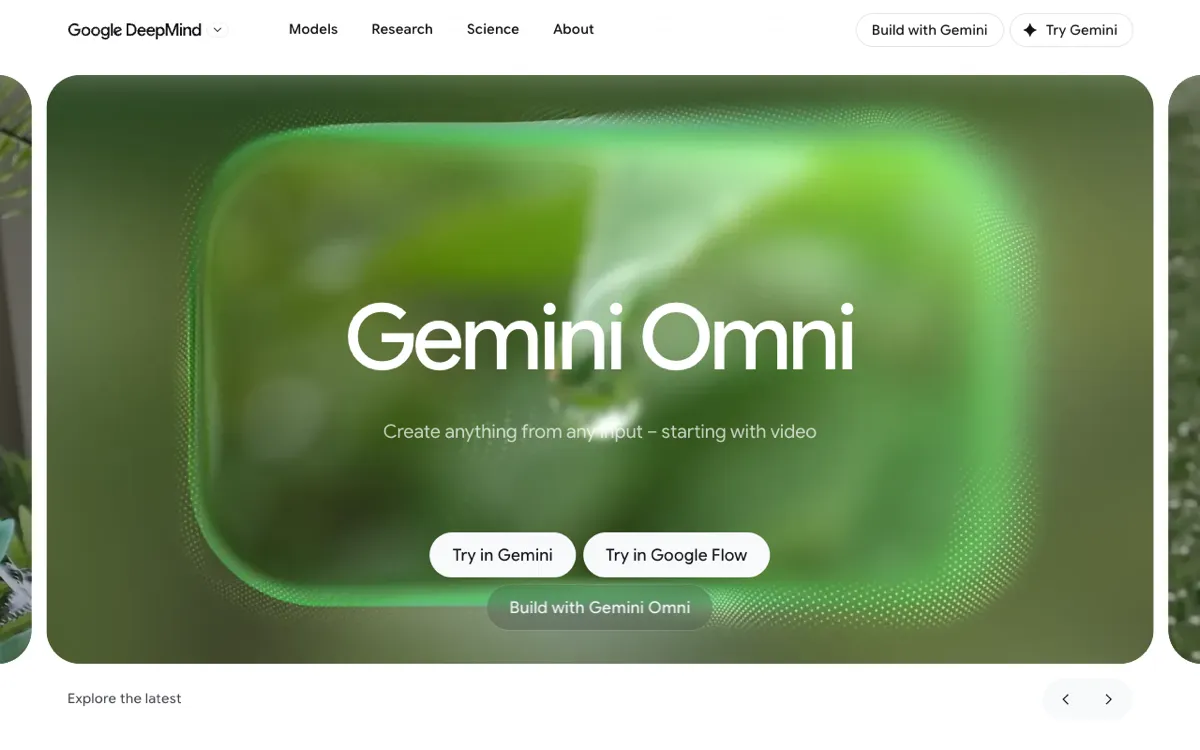 Google DeepMind’s Gemini Omni page lists the Gemini app, Flow and the API.
The editing is the point. You swap a product or background, change the lighting or weather, or switch the aspect ratio, turn by turn, without regenerating the whole clip. Our Omni Flash review covers the version history and limits.
Veo 3.1 at a glance
Veo 3.1 is Google DeepMind’s flagship text-to-video model, with 1080p and 4K output, reference images, first and last frame control and scene extension. Google lists it as available in the Gemini app, Flow, Vids, AI Studio and its enterprise platform. Its model page says natural speech in short segments is “still being improved”.
Veo comes in three tiers: Veo 3.1, Fast and Lite. Lite launched on March 31, 2026, per Google’s deprecations page, and Vidwip lists it at 720p.
Quality and control
Omni wins on control, and the quality evidence is thin for both. Omni 1.2 Flash edits an existing clip, and Google says its own side-by-side tests prefer 1.2 over 1.1 by 62% to 38% on visual consistency. Those are Google’s numbers.
For independent scores, the first Omni Flash ranked first in text to video on Artificial Analysis in a July 31 report by AlphaSignal, at 1,244 Elo. When we checked for our Seedance 2.5 vs Veo 3.1 comparison on November 6, Veo 3.1 sat at 961 Elo, around 22nd to 24th. Those boards were read months apart and we found no number for Omni 1.2, so do not read it as a clean head-to-head.
Veo’s strength is the 1080p picture and a locked, conventional shot. Omni’s trade-off is that its 1080p and 4K are upscaled from a 720p generation, per Google’s docs. Early testers also saw some prompts with people refused by content filters.
Audio
Both models make sound in the same pass as the picture. Veo 3.1 generates effects, ambient noise and dialogue. Omni 1.2 Flash adds clearer lip-sync and distinct multi-speaker conditioning.
If sound is the deciding factor, our Veo alternatives list covers other models with native audio.
Clip length
Omni makes longer clips: 3 to 15 seconds in one-second steps, 10 by default. Veo 3.1 makes exactly 4, 6 or 8 seconds, and Google’s scene extension continues a clip into a longer sequence.
Omni can also extend, in 3 to 10 second turns up to 30 seconds in total, per Google’s current docs. That is a per-model detail that changed between 1.1 and 1.2, so check the docs for the version you call.
Price per second
Omni undercuts full Veo 3.1 and Veo 3.1 Fast, but not Veo 3.1 Lite. Google’s Gemini API lists Omni 1.2 Flash at $0.023 a second at 360p, $0.07 at 720p, $0.104 at 1080p and $0.209 at 4K. Both 1080p and 4K are upscaled.
For Veo 3.1, Google Cloud’s pricing page lists GA rates by audio and resolution. Its unit reads “1 count”, which matches a second at Runway’s rates, as our Veo 3.1 review explains. These are the figures we checked in November 2026:
| Where | Veo 3.1 | Veo 3.1 Fast | Veo 3.1 Lite | Omni 1.2 Flash, 720p |
|---|---|---|---|---|
| Google Cloud (Vertex AI), audio on | $0.40 a second (720p, 1080p) | $0.10 a second at 720p, $0.12 at 1080p | $0.05 a second at 720p, $0.08 at 1080p | n/a |
| Runway API, audio on | $0.40 a second | $0.15 a second | not listed | n/a |
| Runway API, audio off | $0.20 a second | $0.10 a second | not listed | n/a |
| Vidwip, Starter | $0.60 a second | $0.19 a second | $0.08 a second | not run |
| Vidwip, Pro annual | $0.474 a second | $0.150 a second | $0.063 a second | not run |
| Gemini API | preview shut down | preview shut down | preview shut down | about $0.07 a second |
An 8-second 720p clip is about $0.56 on Omni, against $3.20 for Veo 3.1 with audio on Runway. Remember that Omni’s low price buys a 720p generation, and its higher resolutions cost more.
Which Google video model should you use?
Match the model to the job.
- Refining one clip over many turns: Omni 1.2 Flash, the only one of the two built for it.
- Cheap drafts: Omni at 360p ($0.023 a second), or Veo 3.1 Lite on a host that runs it.
- Clips of 9 to 15 seconds in one pass: Omni. Veo stops at 8.
- Native 1080p delivery: Veo 3.1, without upscaling.
- A Gemini API integration built today: Omni, since the Veo preview endpoints are gone.
- An existing Veo pipeline: Veo 3.1 through Google’s enterprise platform or a third-party host.
If you work in the Gemini app or Flow, you can often try both. Flow offers Veo and Omni, according to Google’s model pages.
Run Veo 3.1 in Vidwip
Vidwip’s AI Video Generator runs Veo 3.1, Veo 3.1 Fast and Veo 3.1 Lite in one picker, all with sound, at 4, 6 or 8 seconds. Veo 3.1 is 60 credits a second at 1080p, Fast is 19 at 1080p and Lite is 8 at 720p. Vidwip does not run Gemini Omni.
| Model | Credits/s | 8-second shot | Starter | Pro annual |
|---|---|---|---|---|
| Veo 3.1 (1080p) | 60 | 480 credits | $4.80 | $3.79 |
| Veo 3.1 Fast (1080p) | 19 | 152 credits | $1.52 | $1.20 |
| Veo 3.1 Lite (720p) | 8 | 64 credits | $0.64 | $0.51 |
A credit costs $0.01 on Starter monthly ($25 for 2,500) and $0.0079 on Pro annual ($79 a month for 10,000). AI video needs a paid plan, from $25 a month. See pricing, the models page, and cheapest Veo 3.1 provider for other hosts.
Conclusion
Omni 1.2 Flash is where Google is putting its effort, and it is the better pick for editing, longer clips and API work in 2026. Veo 3.1 is still the one to choose for native 1080p and for pipelines already built on it, now through Google’s enterprise platform or a host such as Vidwip.
Start with a 360p Omni draft to settle the shot, then render the final on whichever model matches your delivery size. We will update this post when Google publishes a head-to-head benchmark or new Veo rates. If you’re weighing the wider field, read Seedance 2.5 vs Veo 3.1 and our note on why Sora is gone.