
MoneyPrinterTurbo is the only faceless video generator on GitHub at real scale that is still shipping — 120,191 stars, MIT, a release on 2 September 2026, and a free Edge TTS path that needs no voice API key. short-video-maker is the cleanest codebase but has not been touched since June 2025 and renders through Remotion, which is not free for teams of four or more. RedditVideoMakerBot owns the Reddit-story format under GPL-3.0. MoneyPrinter V2 is AGPL-3.0 and bills you per generated image. ShortGPT has been dormant since February 2025 — read it, do not run a channel on it. All figures checked 4 September 2026.
A faceless video generator on GitHub is a pipeline, not a product. Clone one and you get a script writer, a text-to-speech engine, a caption timer, a stock-footage fetcher, and an ffmpeg render step wired together — plus a config file full of empty API key fields that are your problem now.
That trade is the whole point. You give up the polished web UI and get uncapped renders, no watermark, and the ability to run a hundred videos in a loop overnight.
Five repos are worth your clone. One of them is genuinely thriving, one is dormant, and the rest sit somewhere in between — and knowing which is which before you spend an evening on Docker is most of the value here.
Every star count, licence, and last-commit date below was pulled from the GitHub API on 4 September 2026. All vendor prices were checked the same day.
What a faceless video generator on GitHub actually gives you
Strip the marketing off and every one of these repos does the same five jobs in the same order.
- Script — an LLM turns a topic into narration, or you paste the text yourself.
- Voice — TTS reads the narration to a WAV or MP3.
- Captions — either the TTS engine’s own word timings, or a Whisper pass over the generated audio.
- Footage — stock clips from Pexels, generated images, gameplay recordings, or your own files.
- Render — MoviePy, Remotion, or raw ffmpeg composites it all and writes an MP4.
The differences that matter are which of those five each project outsources to a paid API, and how many of them still work today without patching. A repo that hasn’t merged a commit in eighteen months is not “stable” when four of its five stages depend on third-party endpoints that keep moving.
Hosted tools solve the maintenance problem and create a billing one. If you’d rather not touch a terminal, the sibling roundup of 4 free faceless video generators ranked for 2026 covers that side — CapCut, Clipchamp, Fliki and friends, with their watermark and clip-length ceilings.
This post is the opposite trade: self-hosted repos, no caps, and setup measured in hours.
1. MoneyPrinterTurbo — the only one still shipping
MoneyPrinterTurbo is the default answer for a self-hosted faceless video pipeline in 2026, and it isn’t close.
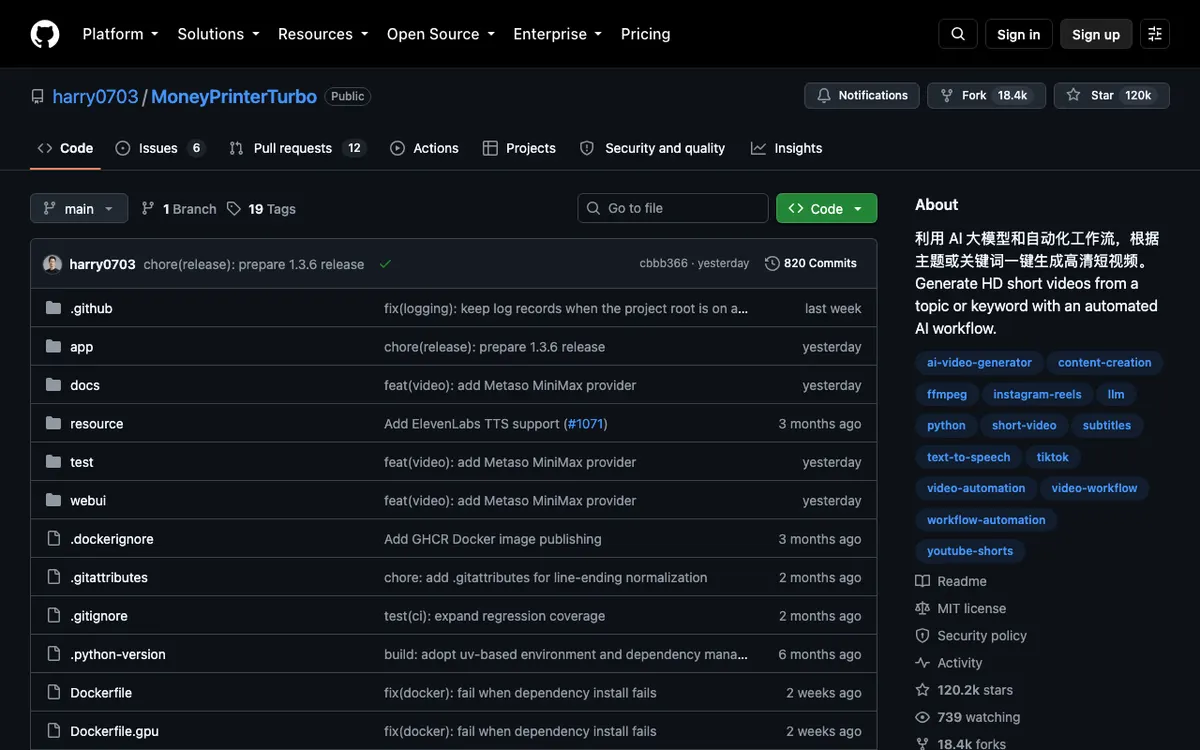 MoneyPrinterTurbo — 120,191 stars, MIT, release 1.3.6 shipped 2 September 2026.
Stars: 120,191 · 18,413 forks (checked 4 September 2026) Licence: MIT Stack: Python 3.11+, Streamlit WebUI, FastAPI, MoviePy 2.2.1
You give it a topic. An LLM writes the script and extracts the search keywords, Pexels returns matching clips, a TTS engine narrates, subtitles burn in, and it exports 1080×1920, 1920×1080, or 1080×1080.
The provider list is the reason it wins. Scripts run through Moonshot (the shipped default), OpenAI, Claude, Gemini, DeepSeek, Qwen, Azure OpenAI, Grok, MiniMax, or anything OpenAI-compatible — including a local Ollama model.
Voice is the same story. Edge TTS is the default and needs no API key at all, with Azure Speech, ElevenLabs, Gemini TTS, Fish Audio, MiniMax, and self-hosted Chatterbox available if you want better.
Captions have two modes. The default edge provider reuses the TTS engine’s own timestamps, which is fast and needs no GPU; switching subtitle_provider to whisper runs local faster-whisper against the audio instead, downloading a roughly 3 GB large-v3 model on first use (or 1.6 GB if you set large-v3-turbo).
Pros
- Actively maintained — 820 commits, release 1.3.6 on 2 September 2026, only 6 open issues
- Edge TTS and Pexels are both free, so the first video costs nothing in API spend
- Four ways in: Streamlit WebUI, REST API, CLI, and an agent skill file
- Windows one-click package, Docker image, and a Google Colab notebook all maintained
- MIT licence with no viral clauses
Cons
- The primary README is Chinese; the English translation lags on newer options
- The README is dense with sponsor and affiliate links, which makes the “recommended” provider list less neutral than it looks
- Bundled background music is described in the repo itself as pulled from YouTube videos, with a note to delete it if there are copyright issues — replace
resource/songsbefore you publish commercially - Whisper captions want a GPU to be pleasant; on CPU they add minutes per video
Best for: anyone who wants a working faceless channel pipeline this weekend rather than a codebase to rewrite. Real setup cost: 20–40 minutes with Docker. One free Pexels key, one LLM key or a local Ollama install. Minimum 4 cores and 4 GB RAM; 6–8 cores and 8 GB recommended.
2. short-video-maker — the cleanest code, frozen since 2025
short-video-maker is the one to read if you want to understand how these pipelines are built, and the one to fork if you want to build your own.
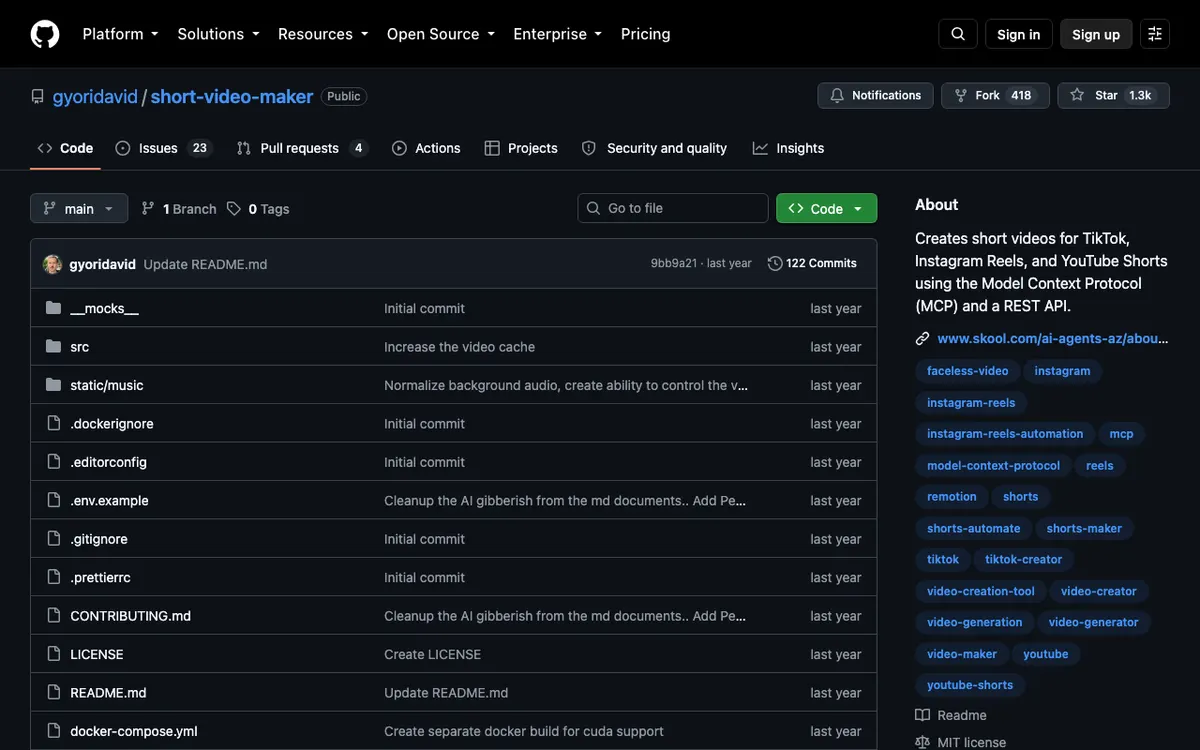 short-video-maker — 1,329 stars, MIT, and no commit since 21 June 2025.
Stars: 1,329 · 418 forks (checked 4 September 2026) Licence: MIT (but see the Remotion note below) Stack: TypeScript, Kokoro TTS, whisper.cpp v1.5.5, Pexels, Remotion, ffmpeg
The pipeline is unusually honest about its own scope. It does not write scripts — you POST narration text and search terms per scene, and it returns a rendered short.
Kokoro runs the text-to-speech locally through kokoro-js, whisper.cpp times the captions locally, Pexels supplies the background clips, and Remotion composes and renders. The free Pexels key is the only credential in the entire project.
It exposes both an MCP server and a REST API on port 3123, which is why it turned up in so many n8n automation tutorials. Three Docker images ship: tiny (a tiny.en Whisper model and a q4-quantised Kokoro), latest (base.en and fp32), and a CUDA build.
The maintenance picture is blunt. The last commit landed 21 June 2025 — over fourteen months ago — with 23 open issues and no tagged releases at all.
Pros
- Zero paid API keys: local TTS, local caption timing, free stock footage
- Runs in 3 GB of RAM on 2 vCPUs, which fits a cheap VPS
- MCP server plus REST API makes it the easiest of the five to drive from an agent or n8n
- Genuinely readable TypeScript, with a documented dependency table naming every licence
Cons
- Unmaintained since June 2025 — treat it as a fork base, not a dependency
- English only, because kokoro-js supported no other language at the time of writing
- Windows is explicitly unsupported (whisper.cpp builds fail)
- It renders through Remotion, which is not free for companies of four or more: $25 per seat per month with a three-seat minimum, or $0.01 per render with a $100/month floor on the automation licence (checked September 2026)
Best for: developers who want a local, key-free base to fork, and who are under Remotion’s free-team threshold.
Real setup cost: 15 minutes with the tiny Docker image. Longer if you fork it, because you will be patching a fourteen-month-old dependency tree.
3. RedditVideoMakerBot — one format, done properly
RedditVideoMakerBot ignores the general-purpose framing entirely and builds exactly one thing: the Reddit-story-over-gameplay video.
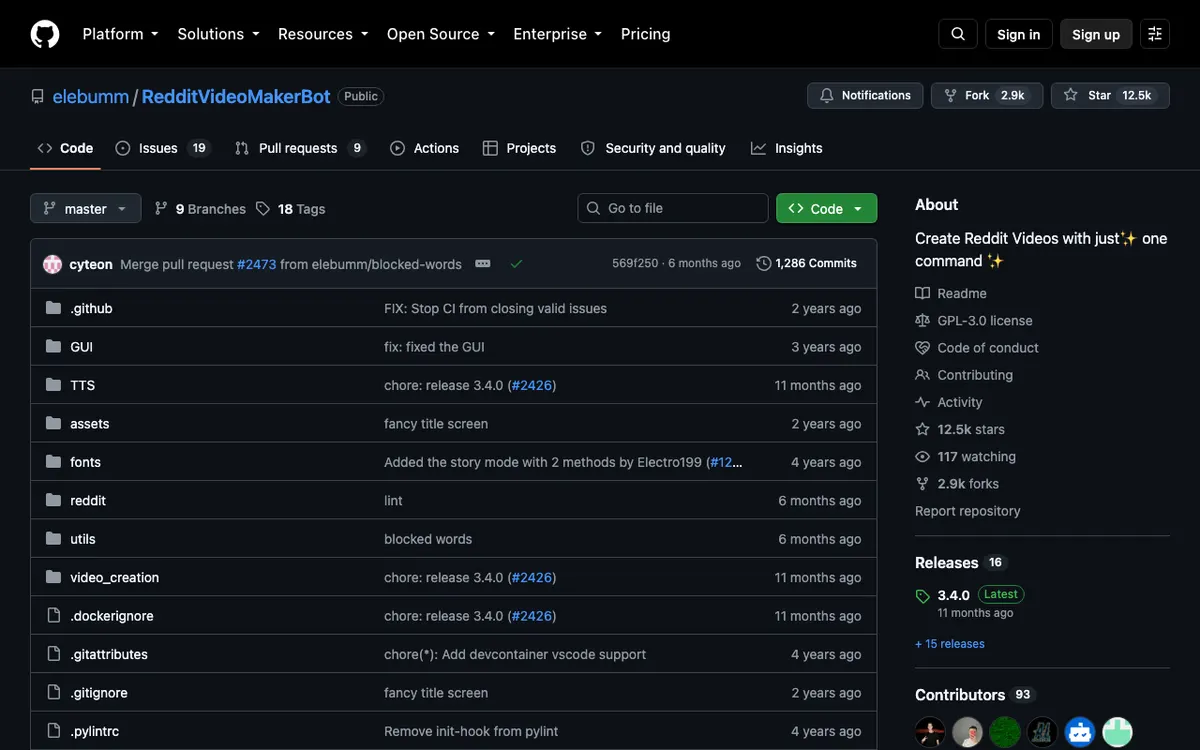 RedditVideoMakerBot — 12,528 stars, GPL-3.0, 1,286 commits from 93 contributors.
Stars: 12,528 · 2,890 forks (checked 4 September 2026) Licence: GPL-3.0 Stack: Python 3.10, PRAW, Playwright, MoviePy 2.2.1, yt-dlp, ffmpeg
The architecture is the interesting part. PRAW pulls a thread through the official Reddit API, then Playwright screenshots each comment as a styled card — light, dark, or transparent — instead of generating text captions.
TTS reads the same comments aloud, and everything composites over gameplay footage that yt-dlp fetches on demand.
Background options ship as named presets: minecraft, gta, rocket-league, csgo-surf, cluster-truck, fall-guys, steep, motor-gta, and more, with lofi audio underneath at a configurable 0.15 volume.
Seven TTS engines are wired in: TikTok (the default), StreamlabsPolly, AWS Polly, Google Translate, local pyttsx3, ElevenLabs, and OpenAI. The TikTok path is free but needs your sessionid cookie pasted into config.toml, which is an unofficial endpoint and the first thing to break.
Deliberately, it does not upload. The README says that is to avoid community-guideline trouble, so you get an MP4 and post it yourself.
Pros
- The most polished single-format pipeline here, with 93 contributors behind it
- Seven TTS backends, including two that cost nothing
- Post translation into 100+ languages via the
translatorspackage - Interactive first-run setup writes
config.tomlfor you
Cons
- Last release 3.4.0 shipped eleven months ago; the last merge to
masterwas 17 March 2026 - Heavy install —
torch,transformers, andspacyall sit inrequirements.txtfor a video tool - GPL-3.0, so anything you build on it inherits the copyleft
- The default TikTok voice depends on a session cookie and an unofficial endpoint
- Your background footage is someone else’s gameplay recording — check the source before monetising
Best for: Reddit-story channels, and nothing else.
Real setup cost: 30–45 minutes. A free Reddit script app for client_id and client_secret, plus Playwright browsers and a several-gigabyte pip install.
4. MoneyPrinter V2 — AI images instead of stock footage
MoneyPrinter V2 is the most-starred repo here after Turbo, and the one whose scope wanders furthest from video.
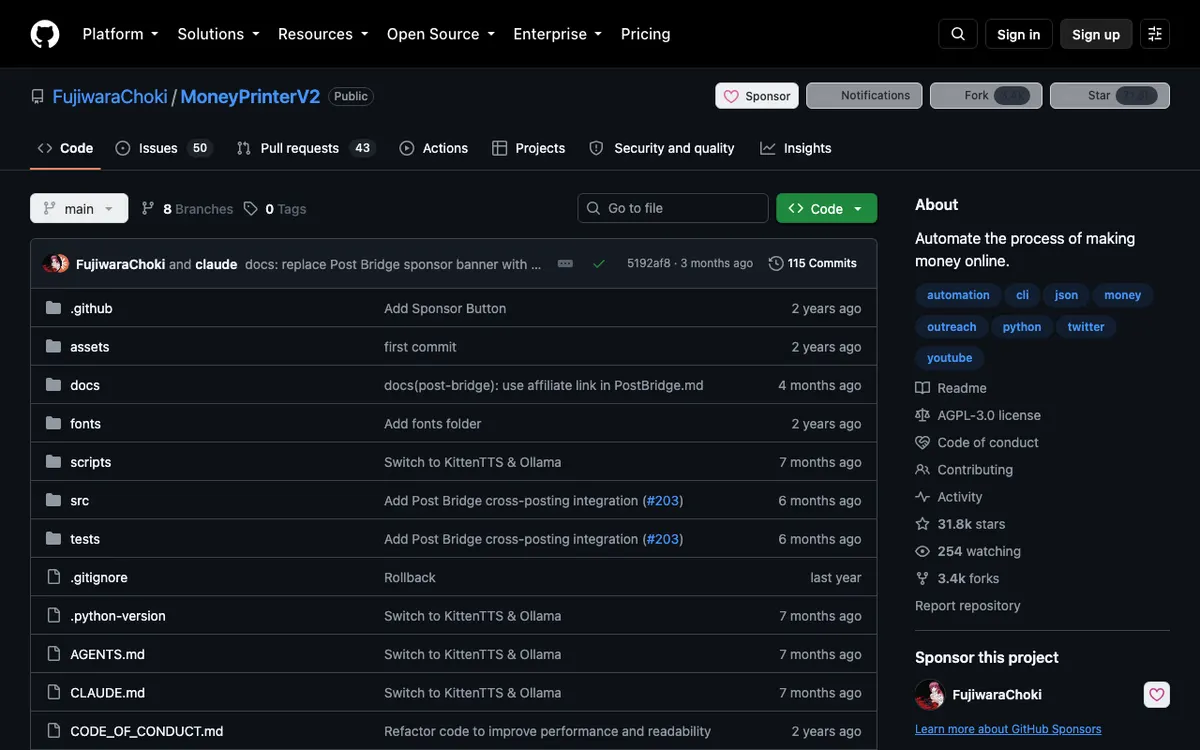 MoneyPrinter V2 — 31,799 stars, AGPL-3.0, and 43 open pull requests as of 4 September 2026.
Stars: 31,799 · 3,431 forks (checked 4 September 2026) Licence: AGPL-3.0 Stack: Python 3.12, Ollama, KittenTTS, faster-whisper, MoviePy, ImageMagick, Selenium
The YouTube Shorts automator is one of four modules, alongside a Twitter bot, an Amazon affiliate poster, and a Google Maps business scraper for cold outreach. That breadth is why the issue tracker looks the way it does.
Its video path is genuinely different from the rest. A local Ollama model picks the topic, writes the script, and then writes image prompts — there is no stock footage step at all.
Nano Banana 2 (gemini-3.1-flash-image-preview) generates 9:16 images, KittenTTS narrates locally, faster-whisper times the subtitles, and MoviePy plus ImageMagick assemble a timed slideshow. Selenium drives a Firefox profile to upload the result.
That design has a real cost. Google’s pricing puts Nano Banana 2 at $0.067 per 1024px image with no free tier, so a twelve-image short is about $0.80 in images before you count anything else (checked September 2026).
Pros
- AI-generated visuals mean no stock-library sameness and no Pexels attribution requirement
- Ollama and KittenTTS keep the script and the voice local and free
- Uploads to YouTube itself, which none of the others do
- Optional AssemblyAI path if local Whisper subtitles are not accurate enough
Cons
- AGPL-3.0 — network use triggers source disclosure, which rules it out for a closed SaaS wrapper
- 50 open issues and 43 open pull requests; the last code change was roughly six months before this was checked, and the most recent commit was a sponsor-banner edit
requirements.txtleavesmoviepyunpinned whilesrc/classes/YouTube.pystill callsfrom moviepy.editor import *, an import MoviePy 2 removed — pinmoviepy<2yourself or the first run dies on import- Needs ImageMagick installed and discoverable on
PATH, plus Go if you touch the outreach module - Per-image billing scales badly the moment you batch
Best for: image-driven story shorts where stock footage would look wrong, on a project that can live with AGPL. Real setup cost: 45–90 minutes, most of it on Python 3.12, ImageMagick, the MoviePy pin, and a Firefox profile for uploads.
5. ShortGPT — the framework everyone forked, now dormant
ShortGPT defined the shape of this category in 2023. It is also the clearest cautionary tale in it.
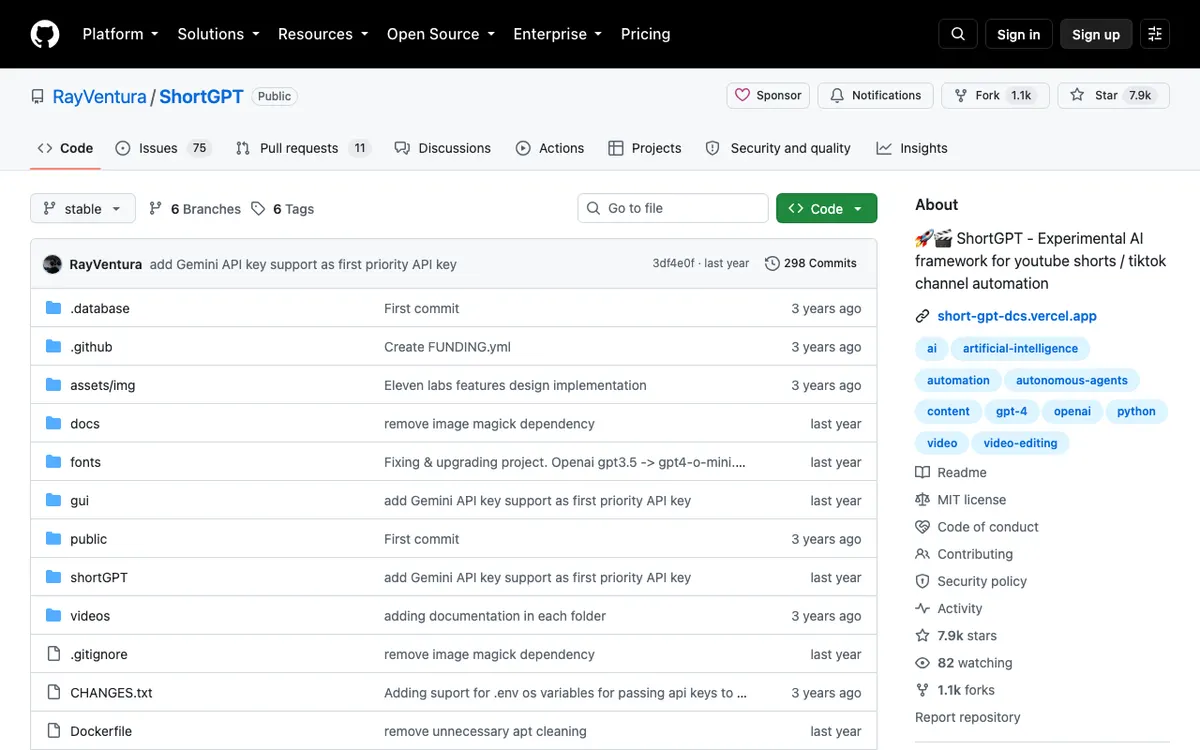 ShortGPT — 7,916 stars, MIT, and no commit since 10 February 2025.
Stars: 7,916 · 1,148 forks (checked 4 September 2026) Licence: MIT Stack: Python 3.10, Gradio, OpenAI, EdgeTTS, whisper-timestamped, Pexels, MoviePy, TinyDB
The framework idea still reads well. Four engines split the work: ContentShortEngine for shorts, ContentVideoEngine for long-form, ContentTranslationEngine for dubbing an existing video into another language, and an EditingEngine driven by a JSON “editing markup language” designed for an LLM to write.
Voice runs through EdgeTTS free across 30+ languages or ElevenLabs for quality, captions come from whisper-timestamped, footage from Pexels and Bing Images, and state persists in TinyDB. You run it as a Gradio app on port 31415, via Docker or Colab.
Then the dates. The last commit and the v0.3.0 release both landed on 10 February 2025 — roughly nineteen months before this check — with 75 open issues and 11 open pull requests behind them.
Its pins have aged accordingly: openai==1.37.0, gradio==5.12.0, protobuf==3.20.3, pillow==10.4.0, moviepy==2.1.2. Outside the supplied Docker image, expect a resolver fight.
Pros
- The cleanest conceptual separation of any project here, and worth reading for that alone
- MIT licence with a Colab notebook that still demonstrates the flow
- EdgeTTS keeps voice free across 30+ languages
- The only one shipping a dedicated translation and dubbing engine
Cons
- Unmaintained for roughly nineteen months, with 75 open issues
- Four API keys in
.env— Gemini, OpenAI, ElevenLabs, and Pexels — before the first render - Docker is now effectively required; the pinned dependency set fights modern Python
- Bing Images as an asset source is a licensing hazard for anything commercial
Best for: reading the architecture, or forking with your eyes open. Not for running a channel. Real setup cost: 20 minutes via Docker if the image still builds; hours if it does not.
Comparison table
| Repo | Stars | Licence | Language | Last commit | Script | Voice | Captions | Footage | Render |
|---|---|---|---|---|---|---|---|---|---|
| MoneyPrinterTurbo | 120,191 | MIT | Python | 2 Sep 2026 | 12+ LLM providers or Ollama | Edge TTS free, 8 paid options | TTS timestamps or faster-whisper | Pexels, Pixabay, Coverr, AI clips | MoviePy 2.2.1 |
| MoneyPrinter V2 | 31,799 | AGPL-3.0 | Python | 14 Jun 2026 (docs) | Ollama, local | KittenTTS, local | faster-whisper or AssemblyAI | Nano Banana 2 AI images | MoviePy + ImageMagick |
| RedditVideoMakerBot | 12,528 | GPL-3.0 | Python | 17 Mar 2026 | Reddit thread via PRAW | 7 engines, TikTok default | Playwright comment screenshots | Gameplay clips via yt-dlp | MoviePy 2.2.1 |
| ShortGPT | 7,916 | MIT | Python | 10 Feb 2025 | OpenAI or Gemini | EdgeTTS or ElevenLabs | whisper-timestamped | Pexels, Bing Images | MoviePy 2.1.2 |
| short-video-maker | 1,329 | MIT | TypeScript | 21 Jun 2025 | none — you supply it | Kokoro, local | whisper.cpp, local | Pexels | Remotion |
All values checked 4 September 2026.
What each repo actually costs to run
The script is the cheapest part of a faceless pipeline, and almost everyone budgets for it first.
A 60-second narration is around 150 words, or roughly 250 output tokens. At OpenAI’s rates, gpt-4o-mini bills $0.15 per million input tokens and $0.60 per million output — fractions of a cent per video (checked September 2026).
Voice is where a channel’s economics live:
- Edge TTS, Kokoro, KittenTTS, pyttsx3 — $0. Local or unofficial-but-free endpoints. Quality is fine for narration, short of a premium voice on emotion.
- OpenAI tts-1 — $15 per million characters, tts-1-hd $30. That 150-word script is about 900 characters, so roughly $0.014 per short on tts-1.
- ElevenLabs — free tier gives 10,000 credits a month with no commercial licence. Starter is $6/month for 30,000 credits, Creator $11/month for 121,000, Pro $99/month for 600,000 (checked September 2026).
Footage is free until it isn’t. The Pexels API costs nothing and allows 200 requests per hour and 20,000 per month, with attribution required and higher limits available on request.
Swap to generated video or images and you are suddenly paying per clip — Nano Banana 2 at $0.067 per 1024px image is the clearest example.
Then there is compute, which is real and easy to forget. Whisper caption passes want a GPU to feel quick, MoneyPrinterTurbo’s large-v3 model is a 3 GB download, and Remotion renders by opening headless Chrome tabs — which is why short-video-maker’s Docker images cap concurrency at 1 to dodge out-of-memory errors on small machines.
Rough all-in for a hundred 60-second videos a month, using free voice and free stock: $0 in API spend and a $6–12/month VPS. Swap in ElevenLabs and generated visuals and the same hundred videos land closer to $80–100.
How to choose
- You want videos this week, not a project. MoneyPrinterTurbo. It is the only one with a release inside the last six months, and Edge TTS plus Pexels means no card on file.
- You are building your own product on top. Fork short-video-maker for the architecture, then check Remotion’s licence against your headcount before you commit to that renderer.
- You are running a Reddit-story channel. RedditVideoMakerBot, and accept GPL-3.0.
- Your topic has no good stock footage. MoneyPrinter V2’s image-generation path, budgeted at roughly $0.80 per short in images, and only if AGPL-3.0 works for you.
- You want to understand the category. Read ShortGPT’s engine split, then go build on something maintained.
- You do not want to run infrastructure at all. Use a hosted tool and accept the caps — the free faceless video generator roundup lists which ones watermark and which don’t.
Two more repos are worth a bookmark without earning a full section. Revideo (4,022 stars, MIT, TypeScript) is a code-first rendering engine rather than a faceless pipeline — no script writer, no TTS, but a clean API if you want to own the composition layer.
ClipForge (697 stars, AGPL-3.0, TypeScript) is newer, actively committed as of 29 August 2026, and aimed squarely at e-commerce product videos, with Chinese-first documentation.
Where self-hosting stops paying off
Two costs stay hidden until you are three weeks in.
The first is voice quality. Edge TTS and Kokoro are good enough for a script read straight through, and noticeably not good enough when a video needs emphasis in the right places.
Most creators who stick with faceless publishing end up paying for voice eventually — the free-tier limits and language coverage are compared across tools in the free AI video voiceover roundup, and the paid tiers in the AI video voiceover generator comparison.
The second is caption accuracy. Every project here either trusts the TTS engine’s own word timings or runs a Whisper pass, and the second option is the accurate one — at the price of a model download and a GPU you would rather not rent.
The same accuracy question, benchmarked across dedicated tools, is covered in the AI video transcription tool comparison and the free transcription roundup.
If your videos are meant for more than one language market, the dubbing step is a third cost that none of these repos handles well — ShortGPT’s translation engine is the only attempt, and it has been dormant since February 2025. The free AI video dubbing tools comparison covers what the dedicated tools do instead.
Which faceless video generator on GitHub should you clone?
Clone MoneyPrinterTurbo. It is MIT, it shipped release 1.3.6 on 2 September 2026, it renders a complete video from a topic with one free API key, and 120,191 stars mean the failure modes are already answered in the issue tracker.
Fork short-video-maker only if you want to own the code — the architecture is the best of the five, but you are adopting a fourteen-month-old dependency tree and a renderer that starts billing at four people.
Treat the other three as specialists. RedditVideoMakerBot for Reddit stories, MoneyPrinter V2 for AI-image shorts you can afford, and ShortGPT for reading rather than running.
And if the setup cost is the part that stops you, the hosted equivalents are one install away — faceless video generator apps ranks the phone and desktop builds that do the same job without a dependency tree.
And check the dates yourself before you commit. Every figure here was accurate on 4 September 2026, and the single most useful signal in this category — whether anyone is still merging pull requests — is also the one that changes fastest.